
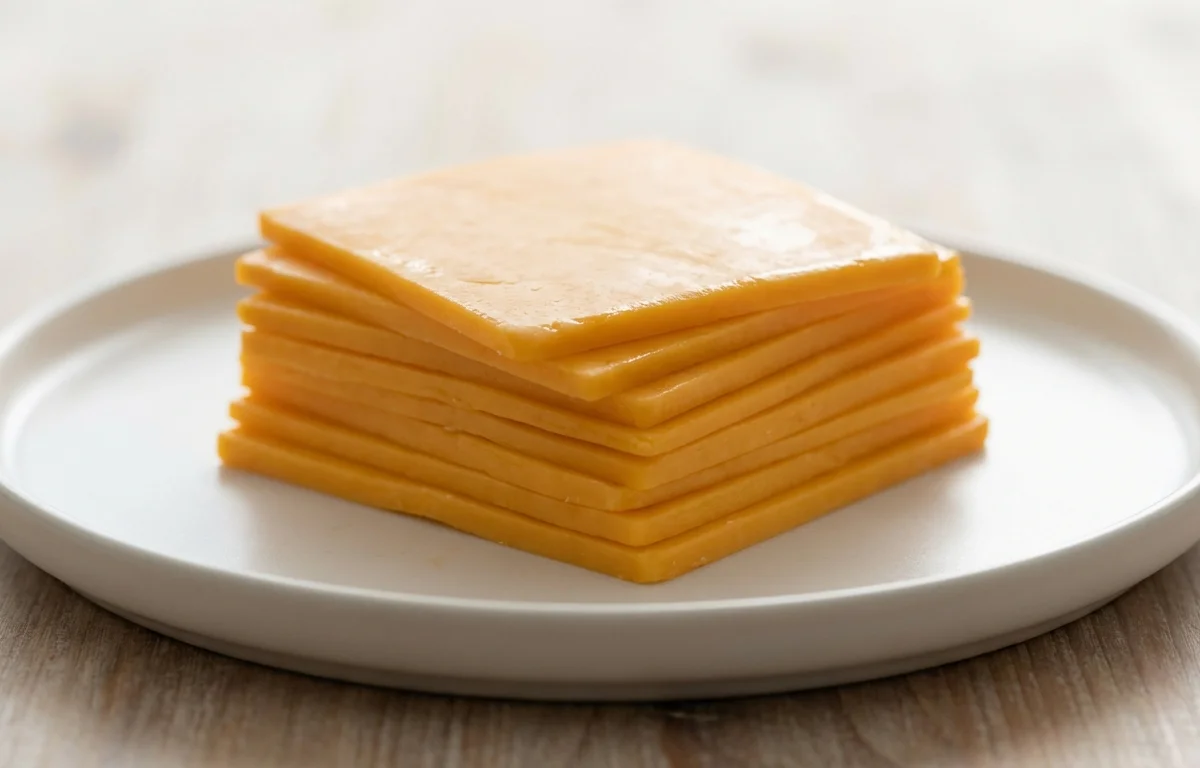
Cheese Slices
Soft, creamy, perfectly meltable cheese slices made right at home. Forget plastic-wrapped singles — these are silky, flavorful, and customize with any cheese you love. Great for burgers, sandwiches, or a quick snack, ready to chill and slice in about 2 hours.
For 8 servings
- prep
Line the loaf pan and grease it.
1.Cut parchment paper to fit the loaf pan, leaving overhang on two sides for easy lifting.2.Grease parchment lightly with butter. - prep · ~5 min
Bloom the gelatin.
1.Pour cold water into a small bowl.2.Sprinkle gelatin evenly over water and let it sit for 5 minutes until spongy.TIPEven sprinkling prevents lumps — don't dump it all in one spot. - boil · ~5 min
Melt the cheese mixture.
1.Place saucepan over low heat and add milk, cream, salt, and shredded cheddar.2.Stir constantly with whisk until cheese is fully melted and mixture is smooth, about 5 minutes.3.Do not let it boil — keep heat very low.TIPLow, gentle heat keeps the cheese from splitting or turning grainy. - mix · ~1 min
Add gelatin and finish the mixture.
1.Remove saucepan from heat.2.Add bloomed gelatin to warm cheese mixture.3.Whisk vigorously for 1 minute until gelatin completely dissolves and mixture is homogeneous. - assemble · ~120 min
Pour into pan and chill.
1.Pour cheese mixture through a fine-mesh strainer into prepared loaf pan for extra smoothness.2.Smooth the top with a spatula.3.Cover surface directly with plastic wrap to prevent a skin from forming.4.Refrigerate at least 2 hours until fully set.TIPDirect-contact plastic wrap stops a rubbery skin from forming on the surface. - prep
Slice and serve.
1.Lift cheese block out using parchment overhang.2.Place on cutting board and slice into 8 even slices using a sharp knife or cheese slicer.3.Serve immediately on burgers, sandwiches, or crackers.TIPWarm the blade under hot water and wipe dry for cleaner, professional-looking slices.
What to keep in mind.
7 tips from the recipe — small details that make a real difference to the final dish.
- 1Use a fine-mesh strainer when pouring the mixture into the pan to catch any undissolved gelatin or cheese clumps.
- 2Press plastic wrap directly onto the surface of the warm cheese mixture before chilling to prevent a tough skin.
- 3Warm your knife under hot water and wipe it dry before each cut for perfectly clean, deli-style slices.
- 4For extra creaminess, let the cheese mixture cool to room temperature before refrigerating — shocking it while hot can cause graininess.
- 5Store slices between sheets of parchment in an airtight container in the fridge for up to 2 weeks.
- 6Bloom the gelatin in cold water — hot water will weaken its setting power and make the slices too soft.
- 7If the mixture splits or looks greasy, whisk in 1–2 tablespoons of cold milk off the heat to bring it back together.
Adapt it for your goals.
Spicy jalapeño
Stir in 2 tablespoons finely minced pickled jalapeños and 1 tablespoon of the pickling brine before pouring — adds a bright, tangy heat that cuts through rich cheese.
herb & garlicHerb & garlic
Whisk in 1 teaspoon garlic powder and 1 tablespoon finely chopped fresh chives or parsley after removing from heat for a savory, aromatic slice perfect on sandwiches.
smoky baconSmoky bacon
Add 1/2 teaspoon smoked paprika and 2 tablespoons cooked, crumbled bacon bits — gives a backyard-burger vibe even without the grill.
low moisture mozzarella swapLow-moisture mozzarella swap
Replace cheddar with an equal weight of low-moisture mozzarella and add 1/4 teaspoon onion powder for a milder, stretchier slice ideal on pizzas or Italian subs.
dairy free / veganDairy-free / vegan
Use 300g shredded vegan cheddar-style cheese (coconut-oil based works best), and replace the milk/cream with 180ml unsweetened oat milk plus 1 tablespoon refined coconut oil — the gelatin still sets, but the slices will be slightly softer.
Why this is on our healthy list.
Rich in Calcium
Cheddar cheese is a top dietary source of calcium, essential for strong bones and teeth — a single slice provides about 15-20% of the daily need.
High-Quality Protein
Each slice delivers roughly 6–7 grams of complete protein from dairy, supporting muscle repair and satiety.
Contains Vitamin B12
Dairy in this recipe provides vitamin B12, which is vital for nerve function and red blood cell formation.
No Artificial Additives
Unlike store-bought processed slices, this homemade version contains no stabilizers, emulsifiers, or artificial colorings.
Frequently asked questions
The heat was likely too high, causing the cheese to break. Keep the saucepan on low heat and stir constantly — never let the mixture simmer or boil.


