
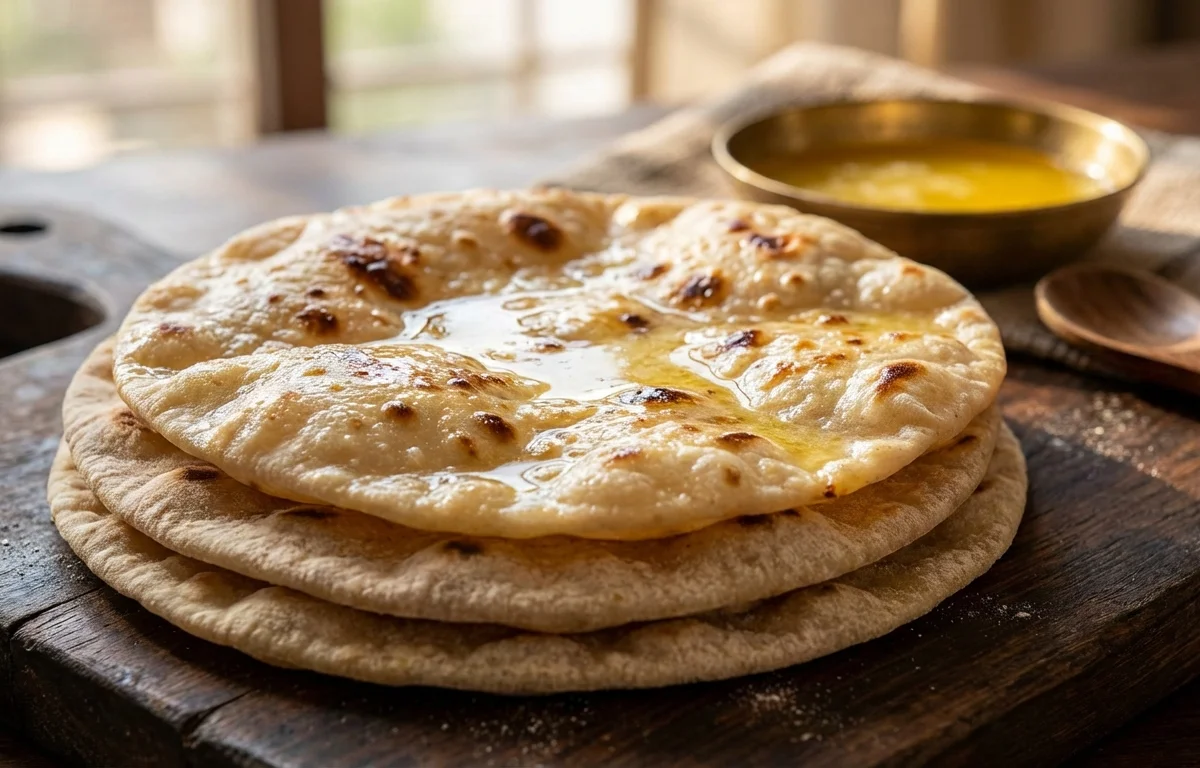
Chapati
Soft everyday Indian flatbreads made with whole wheat flour, water, and a little salt. Cooked on a hot tawa until lightly spotted and puffed, chapati is a simple staple that pairs with almost any sabzi, dal, or curry.
For 8 servings
- knead · ~8 min
Knead the dough.
1.Add whole wheat flour and salt to a wide bowl.2.Pour in water little by little and bring everything together.3.Knead for 5 to 6 minutes until the dough is soft, smooth, and not sticky.TIPA soft dough gives softer chapatis, so avoid making it stiff. - rest · ~15 min
Cover and rest the dough.
Cover the dough with a plate or damp cloth and let it rest for 15 minutes. This relaxes the gluten and makes rolling easier.
- prep · ~3 min
Divide and shape the dough balls.
1.Knead the rested dough briefly until smooth again.2.Divide it into 8 equal portions.3.Roll each portion between your palms into a smooth ball. - prep · ~7 min
Roll the chapatis.
1.Dust one dough ball lightly with whole wheat flour.2.Roll it into a thin round about 6 inches wide.3.Repeat with the remaining dough balls, keeping them covered so they do not dry out.TIPUse only a light dusting of flour while rolling, or the chapatis can turn dry. - fry · ~8 min
Cook the chapatis on a hot tawa.
1.Heat a tawa or flat pan over medium-high heat.2.Place one rolled chapati on the hot tawa and cook until small bubbles appear, about 20 to 30 seconds.3.Flip and cook the second side until light brown spots appear, about 30 seconds.4.Flip again and press gently with a clean cloth or spatula until the chapati puffs and cooks through.TIPThe pan should be hot before the chapati goes on; a cool pan makes it hard and dry. - garnish
Brush with ghee if using.
- serve
Serve the chapatis hot.
Stack the cooked chapatis in a cloth-lined container to keep them soft and warm until serving.
What to keep in mind.
7 tips from the recipe — small details that make a real difference to the final dish.
- 1If the dough feels tight after kneading, wet your hands and knead again rather than adding a lot more flour.
- 2Resting the dough covered is key; exposed dough forms a dry skin that causes cracks while rolling.
- 3Roll from the center outward and rotate often so the chapati stays even and puffs more easily on the tawa.
- 4Use only a light dusting flour on the board; excess dry flour burns on the pan and makes chapatis dull and dry.
- 5Cook on a properly hot tawa: bubbles should appear quickly, but the surface should not char before the second flip.
- 6After cooking, keep chapatis stacked in a cloth-lined container so trapped steam keeps them soft.
- 7For make-ahead use, half-cook each chapati until pale spots form, cool, then finish on the tawa just before serving.
Adapt it for your goals.
Ghee-brushed
Brush the hot chapatis generously with ghee for a richer finish and softer texture, especially good with dry sabzis.
veganVegan
Skip the ghee or brush with a neutral oil to keep the chapatis fully plant-based.
ajwainAjwain
Add a small pinch of ajwain to the dough for a subtle aromatic flavor that pairs well with potato or lentil dishes.
multigrainMultigrain
Replace part of the whole wheat flour with millet or barley flour for a more rustic taste and slightly heartier texture.
Why this is on our healthy list.
Whole Grain Goodness
Made with whole wheat flour, chapati keeps the bran and germ, offering more fiber and nutrients than refined flatbreads.
Light Everyday Staple
This recipe uses only flour, water, and salt, with optional ghee, making it a simple side without heavy frying.
Pairs Well With Balanced Meals
Chapati works naturally with dals, beans, and vegetable curries, helping build a satisfying meal with grains and plant foods.
Frequently asked questions
The usual causes are a stiff dough, too much dusting flour, or cooking on a pan that is not hot enough. Keep the dough soft and store cooked chapatis covered.


