Lachha Paratha
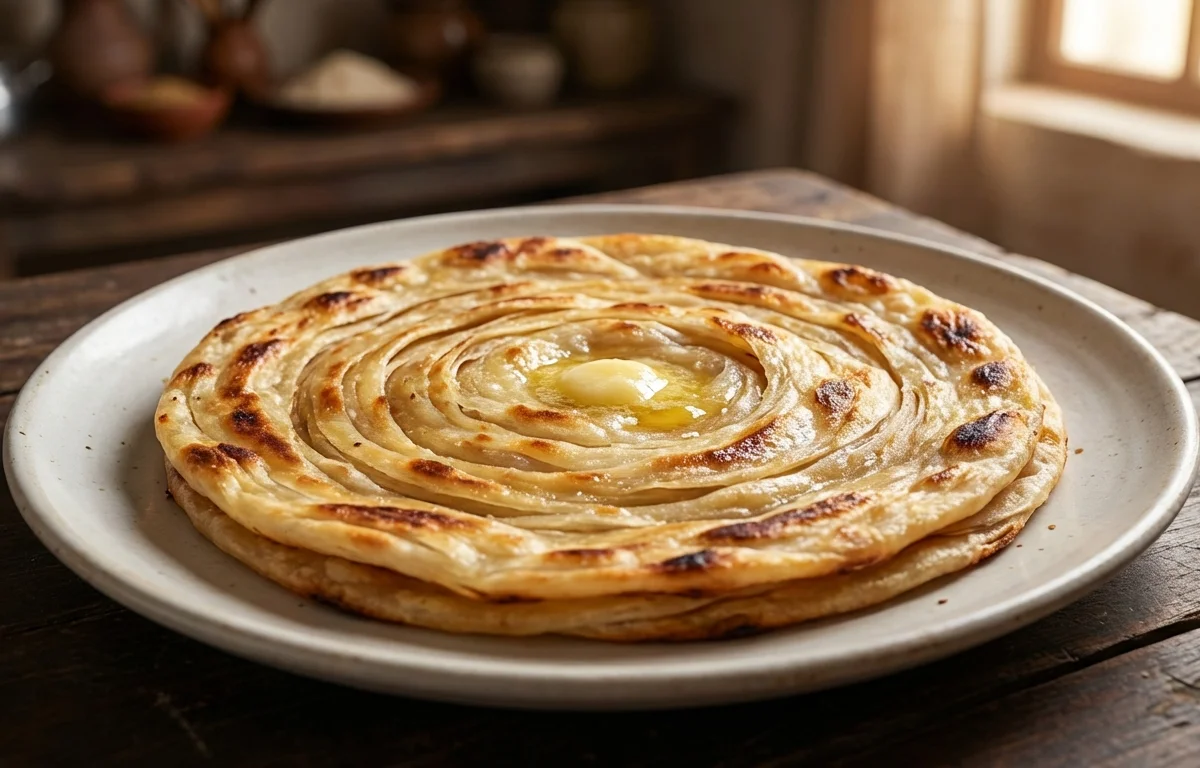
Layered whole wheat flatbread with crisp golden edges and soft flaky folds inside. This North Indian favorite is made by rolling, pleating, and pan-cooking the dough until the layers separate beautifully.
For 4 servings
- knead · ~8 min
Knead the dough.
1.Add 2 cups whole wheat flour and salt to a wide bowl.2.Pour in lukewarm water little by little and mix to form a soft dough.3.Knead for 5 to 6 minutes until smooth and pliable.4.Rub 1 tsp ghee over the dough to keep it from drying.TIPKeep the dough slightly softer than regular roti dough so the layers roll easily. - rest · ~20 min
Cover and rest the dough.
Cover the dough with a plate or damp cloth and let it rest for 20 minutes. This helps the gluten relax and makes shaping easier.
- prep · ~3 min
Divide the dough and make balls.
Knead the dough briefly again, then divide it into 4 equal portions. Roll each portion into a smooth ball.
- assemble · ~5 min
Shape the first paratha with layers.
1.Dust one dough ball with flour and roll it into a thin circle.2.Spread a little ghee all over the surface.3.Sprinkle a light dusting of flour on top.4.Cut from the center to the edge and roll into a tight cone.5.Stand the cone upright, press it down gently, and rest it seam-side down.TIPA thin sheet and light flour-ghee coating are what create clear flaky layers. - rest · ~5 min
Rest the shaped dough cones.
Shape the remaining dough balls the same way and let all 4 cones rest for 5 minutes before rolling.
- prep · ~5 min
Roll the layered cones into parathas.
Dust each cone lightly with flour and roll gently into a 5 to 6 inch round paratha. Do not press too hard or the layers will stick together.
- fry · ~6 min
Cook the parathas on a hot tawa.
1.Heat a tawa over medium heat until hot.2.Place one rolled paratha on the tawa and cook until small bubbles appear.3.Flip it and spread a little ghee around the edges and over the top.4.Flip again and cook both sides until golden brown spots appear and the layers look crisp.TIPCook on medium heat so the inside cooks through before the outside gets too dark. - fry · ~12 min
Cook the remaining parathas.
Cook the other 3 parathas the same way, using the remaining ghee as needed.
- serve · ~1 min
Crush gently and serve hot.
Once each paratha is off the tawa, clap it lightly between your palms or crush the edges gently to open the layers. Serve hot.
What to keep in mind.
7 tips from the recipe — small details that make a real difference to the final dish.
- 1Keep the dough softer than roti dough so the cone rolls without cracking.
- 2After spreading ghee, use only a light dusting of flour; too much dries the layers.
- 3Roll the final paratha gently from the center outward so the pleated layers stay distinct.
- 4If the dough springs back while rolling, let it rest 5 more minutes before trying again.
- 5Cook on a fully hot but medium-heat tawa so the inside steams and the outside browns evenly.
- 6Clap or gently crush the paratha right after cooking to separate the flaky layers.
- 7For make-ahead prep, shape the cones in advance, cover well, and roll just before cooking.
Adapt it for your goals.
Low-ghee
Use a thinner smear of ghee between layers and cook with minimal fat for a lighter paratha that still stays layered.
ajwainAjwain
Sprinkle ajwain with the flour layer for a more aromatic, slightly earthy paratha that pairs well with yogurt and pickles.
veganVegan
Replace ghee with neutral oil for layering and roasting to keep the same flaky technique without dairy.
triangle lachhaTriangle-lachha
Instead of shaping a cone, fold the greased dough into layered triangles for a different look with similar flaky texture.
Why this is on our healthy list.
Whole Grain Goodness
Made primarily with whole wheat flour, this paratha offers more fiber and grain nutrients than flatbreads made with refined flour.
Satisfying Energy
The combination of whole wheat and ghee makes it filling and substantial, which helps it work well as a hearty meal base.
Simple Ingredient List
With just whole wheat flour, water, salt, and ghee, this dish avoids additives and keeps the preparation straightforward.
Frequently asked questions
Usually the dough was rolled too thick initially, pressed too hard in the final roll, or did not get enough ghee-and-flour between the layers.



.webp)