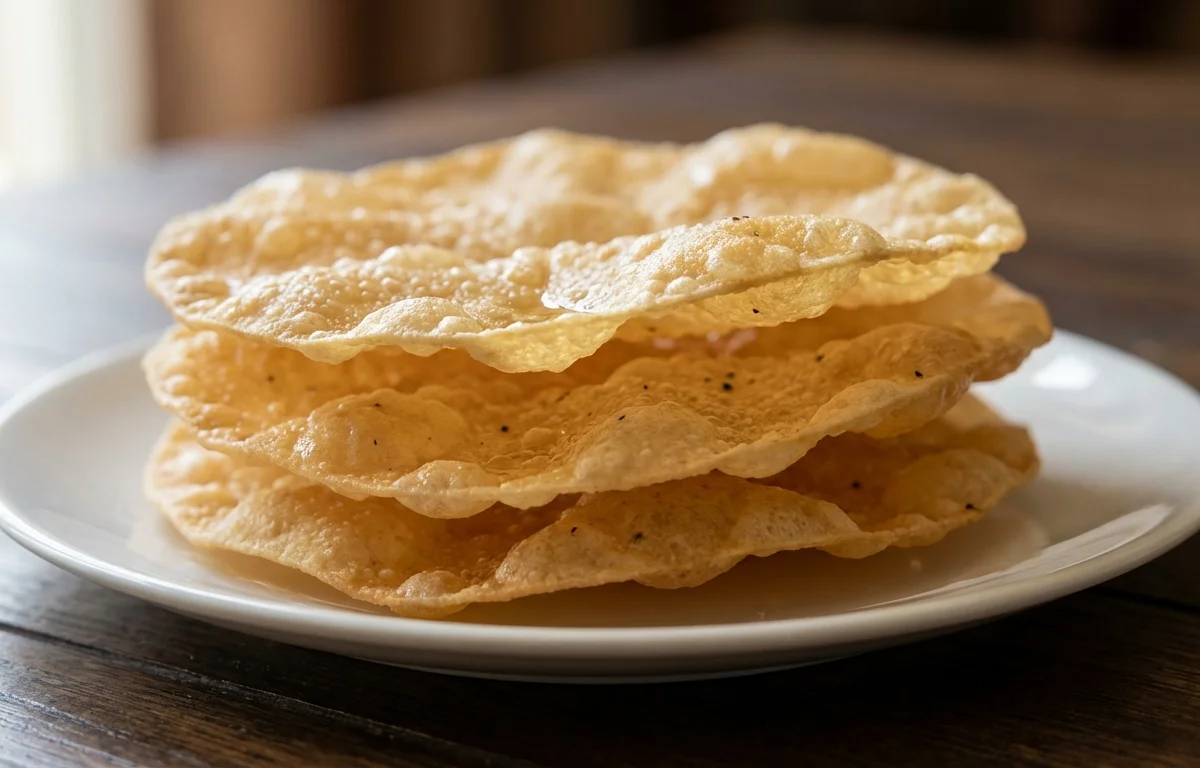
Pappadam
Crispy, wafer-thin lentil crackers with a satisfying crunch and subtle spiced flavor. These South Indian staples are sun-dried and flash-fried in seconds, puffing up beautifully. Serve alongside rice, dal, and curries for that essential textural contrast.
For 4 servings
- prep · ~120 min
Grind the urad dal into a fine flour.
1.Wash the urad dal thoroughly and drain.2.Spread on a clean cloth and let dry completely in shade for about 2 hours.3.Grind the dried dal to a very fine powder using a spice grinder or dry mill.4.Sieve through a fine mesh strainer to ensure a smooth flour.TIPThe dal must be bone-dry before grinding — any moisture will clog the grinder and make a coarse flour. - mix · ~7 min
Make the spiced dough.
1.Coarsely crush the black peppercorns and cumin seeds in a mortar and pestle.2.In a bowl, mix the urad dal flour, crushed spices, salt, and asafoetida.3.Add water 1 tablespoon at a time and knead into a stiff, smooth dough.4.Knead for 5-7 minutes until the dough is pliable and not sticky.TIPAdd water very sparingly — the dough should be much stiffer than roti dough. Too much water and the papads won't crisp up. - prep · ~10 min
Portion and flatten the dough.
1.Divide the dough into 8 equal portions and roll each into a smooth ball.2.Grease a plastic sheet or clean kitchen towel lightly with oil.3.Place one ball on the sheet, cover with another layer of plastic, and flatten slightly with your palm.4.Roll out as thin as possible into a 6-inch round, using a rolling pin. The thinner, the crispier.TIPRoll from the center outward with gentle, even pressure. Don't worry about perfect circles — rustic shapes fry just as well. - other · ~300 min
Dry the papads in the sun.
1.Carefully transfer the rolled papads onto a clean, dry cotton cloth or a wire rack.2.Place under direct sunlight until completely dry and brittle, about 4-6 hours.3.Turn them once halfway through for even drying.4.Store the dried, unfried papads in an airtight container until ready to fry.TIPIf sunlight isn't available, dry them in an oven at the lowest setting (150°F/65°C) with the door slightly ajar for 2-3 hours. - fry · ~8 min
Deep-fry the papads until puffed and golden.
1.Heat the oil in a large heavy-bottomed pan over medium-high heat until it reaches 350°F (175°C).2.Test with a tiny piece of dough: it should sizzle and rise immediately.3.Carefully slide one dried papad into the hot oil.4.Press it gently with a slotted spoon to help it puff up evenly — it takes just 3-5 seconds.5.Flip and fry the other side for 2-3 seconds until light golden and blistered.TIPThe oil must be hot enough. If it's too cool, the papad won't puff; if too hot, it'll burn before expanding. Work one at a time — they cook fast. - prep · ~2 min
Drain the fried papads.
1.Lift the fried papad with a slotted spoon and shake off excess oil.2.Place on a plate lined with paper towels to absorb any remaining oil.3.Repeat with the remaining dried papads. - serve
Serve the crispy pappadams immediately.
Serve the pappadams hot and crisp, alongside steamed rice, dal, sambar, or any curry. They soften as they cool, so they're best eaten right away.
What to keep in mind.
7 tips from the recipe — small details that make a real difference to the final dish.
- 1Ensure the urad dal is bone-dry before grinding to avoid a pasty flour.
- 2Knead the dough until very stiff—it should be drier than chapati dough.
- 3Roll the papads paper-thin; thick ones won't puff or crisp properly.
- 4Dry the rolled papads completely; any moisture left will make them chewy.
- 5Test oil temperature with a dough scrap; it must sizzle instantly for proper puffing.
- 6Store uncooked dried papads in an airtight container for up to a month.
- 7Fry one papad at a time to keep oil temperature steady and prevent sticking.
Adapt it for your goals.
Spicy Garlic Papad
Add 1/2 tsp garlic powder and 1/4 tsp cayenne to the dough for a pungent, fiery version.
Black Pepper & AjwainBlack Pepper & Ajwain
Replace cumin with 1/2 tsp ajwain (carom) seeds for a more digestive, thymol-forward flavor.
Masala PapadMasala Papad
Top the fried papad with diced onion, tomato, cilantro, and a squeeze of lemon for a popular chaat-style snack.
Gluten Free SnackGluten-Free Snack
This recipe is naturally gluten-free—skip the asafoetida if sensitive to gluten-based carriers.
Why this is on our healthy list.
High in Plant Protein
Urad dal provides a good source of plant-based protein, supporting muscle repair and satiety.
Rich in Dietary Fiber
Black gram lentils offer fiber that aids digestion and promotes gut health.
Low in Fat When Properly Drained
Flash-frying at the right temperature ensures minimal oil absorption, keeping the snack light.
Contains Digestive Spices
Asafoetida and cumin are traditionally used to aid digestion and reduce bloating.
Frequently asked questions
Yes, brush with oil and bake at 375°F for 5-7 minutes or microwave for 30 seconds, though they won't puff as airily.