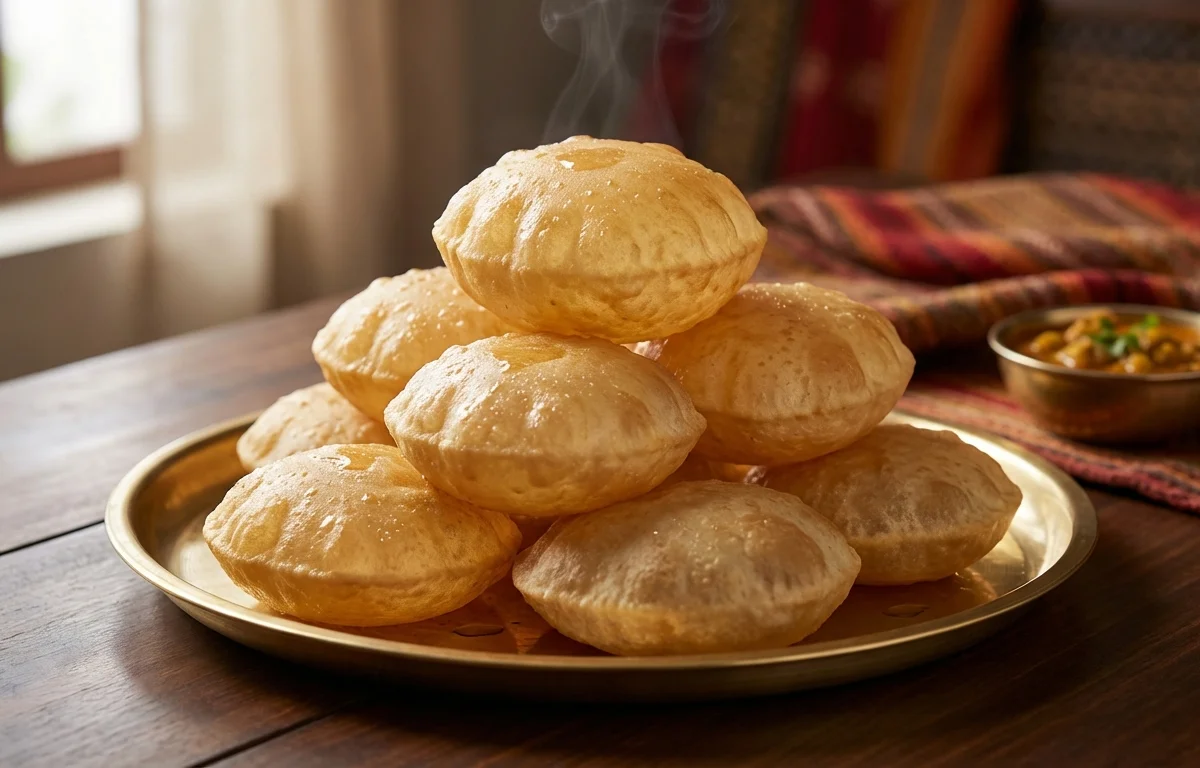
Poori
Crisp, puffed Indian fried bread made with whole wheat flour, a little semolina, and hot oil. Poori comes together with a firm dough that fries into golden rounds perfect with sabzi, chana, or a simple pickle.
For 16 servings
- mix
Mix the dry ingredients.
Add whole wheat flour, semolina, and salt to a wide bowl. Mix well so the semolina is evenly distributed through the flour.
- knead · ~5 min
Knead a firm dough.
1.Add 1 tsp oil to the flour mixture and rub it in with your fingers.2.Pour in water little by little and bring the dough together.3.Knead for 4 to 5 minutes until smooth and firm, not soft or sticky.TIPA firm dough helps the pooris puff and keeps them from soaking up too much oil. - rest · ~15 min
Cover and rest the dough.
Cover the dough with a plate or damp cloth and let it rest for 15 minutes.
- prep · ~10 min
Divide and roll the pooris.
1.Divide the dough into 16 equal small balls.2.Lightly grease the rolling surface with a few drops of oil if needed.3.Roll each ball into a small disc about 4 inches wide, keeping the thickness even.TIPDo not use extra dry flour for rolling, as loose flour can burn in the oil. - fry · ~5 min
Heat the oil for frying.
Heat oil for frying in a deep kadai over medium-high heat until hot. A small piece of dough should rise quickly without browning too fast.
- fry · ~8 min
Fry the pooris until puffed and golden.
1.Slide one rolled poori into the hot oil carefully.2.Press it gently with a slotted spoon so it puffs up.3.Flip and fry the other side for a few seconds until lightly golden.4.Lift it out and let excess oil drip back into the kadai.TIPKeep the oil hot enough for quick puffing; if the oil is too cool, the pooris turn greasy and dense. - serve
Serve the pooris hot.
Fry the remaining pooris the same way and serve hot while fully puffed and crisp.
What to keep in mind.
7 tips from the recipe — small details that make a real difference to the final dish.
- 1Keep the dough firmer than chapati dough; a soft dough makes pooris drink oil and stay flat.
- 2After resting, knead once briefly before dividing so the dough rolls smoother and puffs more evenly.
- 3Roll each disc to an even thickness with no thin edges, or the rim will crisp before the center puffs.
- 4Avoid dusting with dry flour while rolling; any loose flour in the oil burns and darkens later pooris.
- 5Fry one poori at a time if you are new to it, so the oil temperature stays steady and puffing is easier to control.
- 6Press gently on the top with a slotted spoon as soon as the poori rises; that trapped steam helps it balloon fully.
- 7Pooris are best eaten right away, but you can roll the discs ahead and keep them covered with a lightly oiled cloth for a short time.
Adapt it for your goals.
Masala-poori
Add ajwain, crushed black pepper, or a little cumin to the dough for a more aromatic poori that pairs well with potato sabzi.
atta onlyAtta-only
Skip the semolina for a softer, more traditional whole wheat poori if you prefer less crispness.
mini pooriMini-poori
Roll smaller discs for bite-size pooris that are great for festive meals, kids, or serving with chana.
palak pooriPalak-poori
Use thick spinach puree in place of some water for green pooris with extra flavor and a colorful breakfast plate.
Why this is on our healthy list.
Whole Grain Base
Made primarily with whole wheat flour, this poori offers more natural grain character and fiber than breads made with refined flour.
Simple Ingredient List
This recipe uses pantry basics like whole wheat flour, semolina, water, salt, and oil, without added sugars or processed fillers.
Satisfying Energy
The combination of wheat and frying makes poori filling and useful as a hearty accompaniment to vegetable curries or legumes.
Frequently asked questions
Usually the dough is too soft, the discs are rolled unevenly, or the oil is not hot enough. Keep the dough firm, roll evenly, and fry in hot oil.