
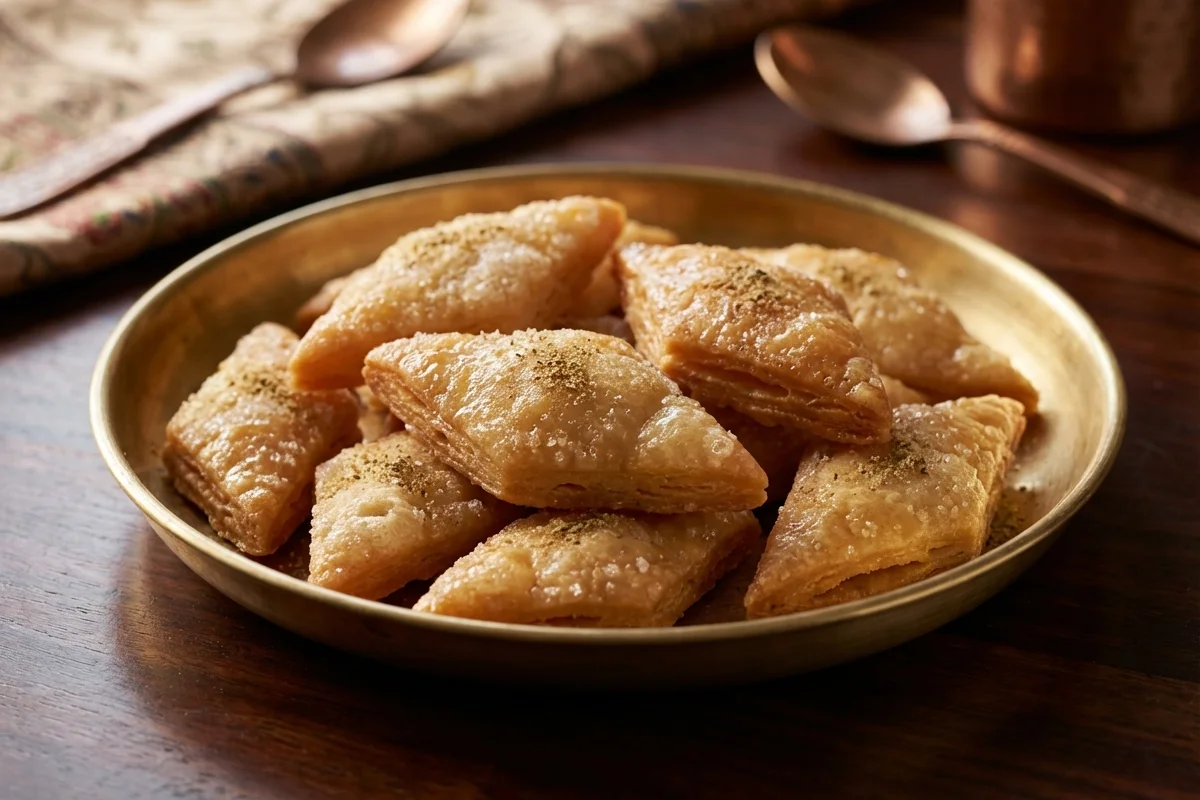
Shakarpara
Crispy, bite-sized fried flour cookies coated in a sweet sugar glaze. This classic Indian festive snack is wonderfully addictive and perfect for celebrations like Diwali.
For 6 servings
Prepare the Dough
- In a large mixing bowl, combine the maida (all-purpose flour) and rava (semolina).
- Pour the melted ghee over the flour mixture. Using your fingertips, rub the ghee into the flour until it resembles coarse breadcrumbs. When you press a small amount in your fist, it should hold its shape.
- Gradually add water, a little at a time, and knead to form a stiff and firm dough. Be careful not to add too much water. The dough should not be soft.
- Cover the dough with a damp cloth and let it rest for at least 20-30 minutes. This allows the rava to absorb moisture and the gluten to relax.
Roll and Cut the Shakarpara
- After the dough has rested, knead it again for a minute until smooth.
- Divide the dough into two equal portions.
- Take one portion and place it on a rolling surface. Roll it out into a thick circle or rectangle, about 1/4-inch in thickness. It should not be too thin, as this will make them hard, or too thick, as they may not cook through.
- Using a sharp knife or a pizza cutter, trim the uneven edges. First, cut the rolled dough into 1-inch wide vertical strips. Then, cut the strips diagonally to create classic diamond shapes.
Fry the Shakarpara
- Heat the oil in a kadai or deep pan over medium-low heat. The oil must not be too hot.
- To test the oil temperature, drop a tiny piece of dough into it. It should sizzle and rise to the surface slowly. If it rises instantly, the oil is too hot.
- Carefully slide the cut diamond pieces into the hot oil, frying in batches to avoid overcrowding the pan.
- Fry on a consistent low to medium-low flame, stirring occasionally, until they are light golden brown and crispy on all sides. This slow frying process takes about 8-10 minutes per batch and is key to a crispy texture.
- Once fried, use a slotted spoon to remove the shakarpara and drain them on a plate lined with paper towels to absorb excess oil.
Prepare the Sugar Syrup
- In a separate wide, heavy-bottomed pan, combine the sugar and 1/2 cup of water.
- Place the pan on medium heat and bring the mixture to a boil, stirring continuously until the sugar dissolves completely.
- Cook the syrup until it reaches a 'one-string consistency'. To check, dip a spoon in the syrup, let it cool for a few seconds, then touch the syrup with your forefinger. Touch your thumb and forefinger together and gently pull them apart. A single, continuous thread should form.
- Once the consistency is reached, turn off the heat and immediately stir in the cardamom powder.
Coat and Finish
- Quickly add all the fried shakarpara pieces into the hot sugar syrup.
- Using a spatula, gently but continuously toss the pieces to ensure they are all evenly coated with the syrup.
- As the syrup cools, it will begin to crystallize and form a matte, white coating on the shakarpara. Keep stirring gently to prevent them from clumping together.
- Once coated and separated, spread them on a large plate or tray in a single layer to cool down completely. They will become perfectly dry and crispy upon cooling.
- Store in an airtight container at room temperature.
What to keep in mind.
5 tips from the recipe — small details that make a real difference to the final dish.
- 1The dough must be stiff. A soft dough will absorb excess oil during frying and result in soft, oily shakarpara.
- 2Fry on low to medium-low heat for a crispy texture that is cooked through. High heat will brown the outside quickly while leaving the inside raw.
- 3The one-string consistency of the sugar syrup is crucial. If undercooked, the coating will be sticky. If overcooked, the sugar will crystallize too fast and become hard.
- 4Work quickly when coating the shakarpara in the syrup, as it cools and thickens rapidly.
- 5Ensure the shakarpara are completely cool before storing them in an airtight container to maintain their crispness.
Adapt it for your goals.
Healthier Version
Replace half of the maida with whole wheat flour (atta) for a nuttier flavor and more fiber. You can also bake them at 180°C (350°F) for 15-20 minutes, flipping halfway, instead of deep-frying.
Jaggery Version (Gur Para)Jaggery Version (Gur Para)
Substitute the sugar with an equal amount of grated jaggery (gur) to make the syrup. This gives the snack a more traditional, earthy sweetness and a golden-brown color.
Savory Version (Namak Para)Savory Version (Namak Para)
Omit the sugar syrup. Instead, add 1 tsp of ajwain (carom seeds), 1 tsp of crushed black pepper, and salt to taste to the dough. Fry as directed for a savory, crispy snack.
Why this is on our healthy list.
Instant Energy Boost
The combination of refined flour and sugar provides a quick source of carbohydrates, offering an instant boost of energy, which can be beneficial in moderation.
Source of Healthy Fats
Ghee is a source of healthy saturated fats and fat-soluble vitamins like A, E, and D. It is considered beneficial for gut health in traditional Indian medicine.
Aromatic Digestive Aid
Cardamom, used for flavoring, is known for its digestive properties. It can help soothe indigestion and has a calming, aromatic effect.
Frequently asked questions
One serving of Shakarpara (about 95g) contains approximately 400-450 calories, primarily from carbohydrates and fats due to the flour, sugar, and deep-frying process.


