
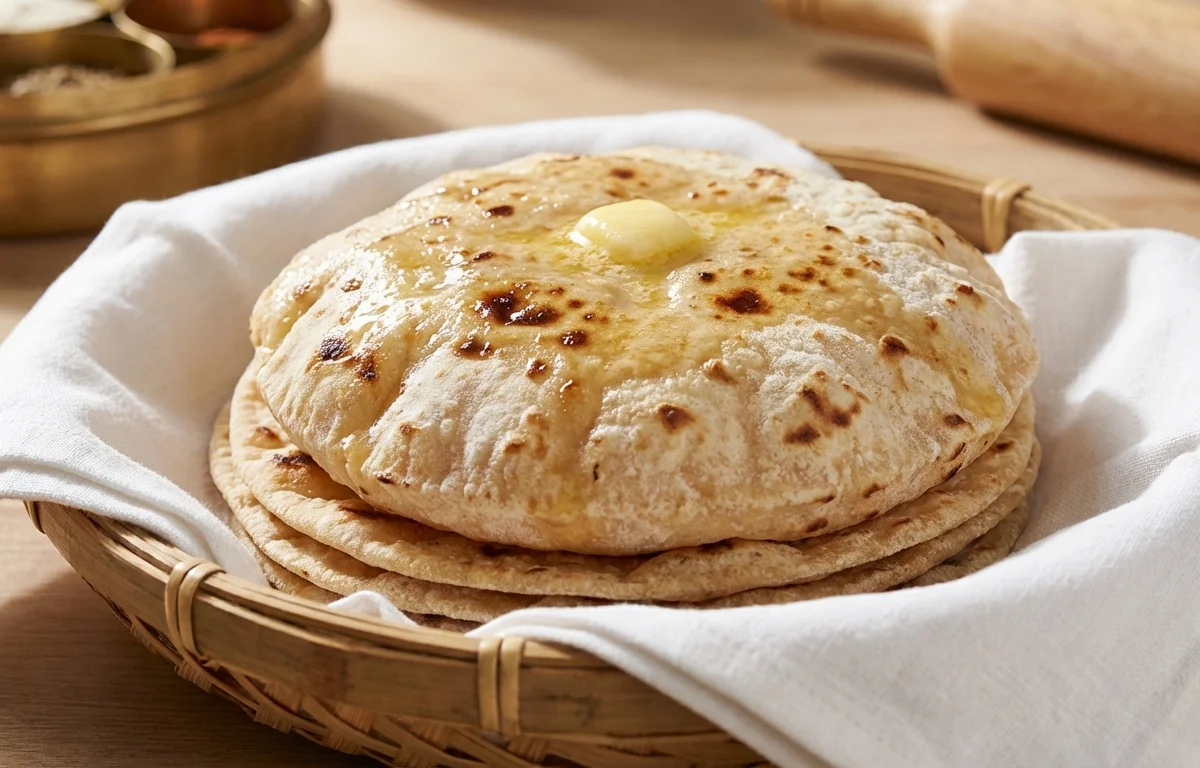
Tawa Roti
Soft everyday Indian flatbreads made with whole wheat flour, water, and a little salt. Rolled thin and cooked on a hot tawa, these rotis are simple, wholesome, and perfect with dal, sabzi, or curry.
For 8 servings
- knead · ~6 min
Knead the dough.
1.Add atta and salt to a wide bowl and mix well.2.Pour in water little by little and bring everything together.3.Knead for 5 to 6 minutes until the dough is soft, smooth, and pliable.TIPA slightly soft dough makes softer rotis after cooking. - rest · ~15 min
Cover and rest the dough.
Cover the dough with a plate or damp cloth and let it rest for 15 minutes. This helps the flour hydrate and makes rolling easier.
- prep · ~3 min
Divide and shape the dough balls.
1.Knead the rested dough once more for a few seconds.2.Divide it into 8 equal portions.3.Roll each portion into a smooth ball. - prep · ~5 min
Roll the rotis.
1.Dust one dough ball lightly with atta.2.Roll it into a thin, even circle about 5 to 6 inches wide.3.Use just enough dusting flour to prevent sticking.TIPIf the edges crack while rolling, the dough needs a few drops of water kneaded in. - saute · ~2 min
Cook the roti on the tawa.
1.Heat a tawa over medium-high heat until evenly hot.2.Place one rolled roti on the tawa and cook until small bubbles appear on top, about 20 to 30 seconds.3.Flip and cook the second side for 30 to 40 seconds until light brown spots appear.4.Flip once more and press gently with a cloth or spatula so the roti cooks evenly.TIPThe tawa should be hot before the roti goes on; a lukewarm tawa makes it dry and hard. - garnish · ~8 min
Brush with ghee and repeat.
Transfer the cooked roti to a plate or casserole and brush lightly with ghee. Roll and cook the remaining dough balls the same way.
- serve
Serve the rotis warm.
What to keep in mind.
7 tips from the recipe — small details that make a real difference to the final dish.
- 1Keep the dough slightly soft and tacky, not stiff; it relaxes into much softer rotis after cooking.
- 2Resting the dough for the full 15 minutes helps the atta hydrate, so the rotis roll thinner without springing back.
- 3Use only a light dusting of atta while rolling; too much dry flour on the surface can make the roti tough on the tawa.
- 4Roll from the center outward and rotate often to keep the roti evenly thin, which helps it cook and puff uniformly.
- 5Wait for small bubbles before the first flip and light brown spots before the second; flipping too early can leave dense patches.
- 6Stack cooked rotis in a covered casserole or wrapped in a clean cloth to trap steam and keep them soft.
- 7If a roti turns crisp instead of soft, the tawa is often too cool or the dough was kneaded too firm.
Adapt it for your goals.
Vegan
Skip the ghee or brush with a neutral oil after cooking for a fully plant-based everyday roti.
no gheeNo-ghee
Leave the rotis unbrushed for a lighter finish; keep them covered after cooking so they stay soft.
ajwain rotiAjwain-roti
Add a pinch of ajwain to the dough for a subtle, earthy flavor that pairs especially well with dals and dry sabzis.
multigrainMultigrain
Replace part of the atta with millet or barley flour for a nuttier taste and a more rustic texture.
Why this is on our healthy list.
Whole Grain Goodness
Made primarily with whole wheat atta, these rotis retain the bran and germ for more natural fiber and a steadier, hearty bite.
Simple Everyday Ingredients
With just whole wheat flour, water, salt, and a little ghee, this is a minimally processed staple that fits many home-style meals.
Supports Balanced Meals
Tawa roti pairs easily with dal, beans, vegetables, and curries, making it a practical base for a more balanced Indian plate.
Frequently asked questions
The dough is usually too stiff, the tawa is not hot enough, or the rotis are overcooked. Keep the dough soft, cook quickly on a hot tawa, and store covered.


