Classic Sourdough Bread
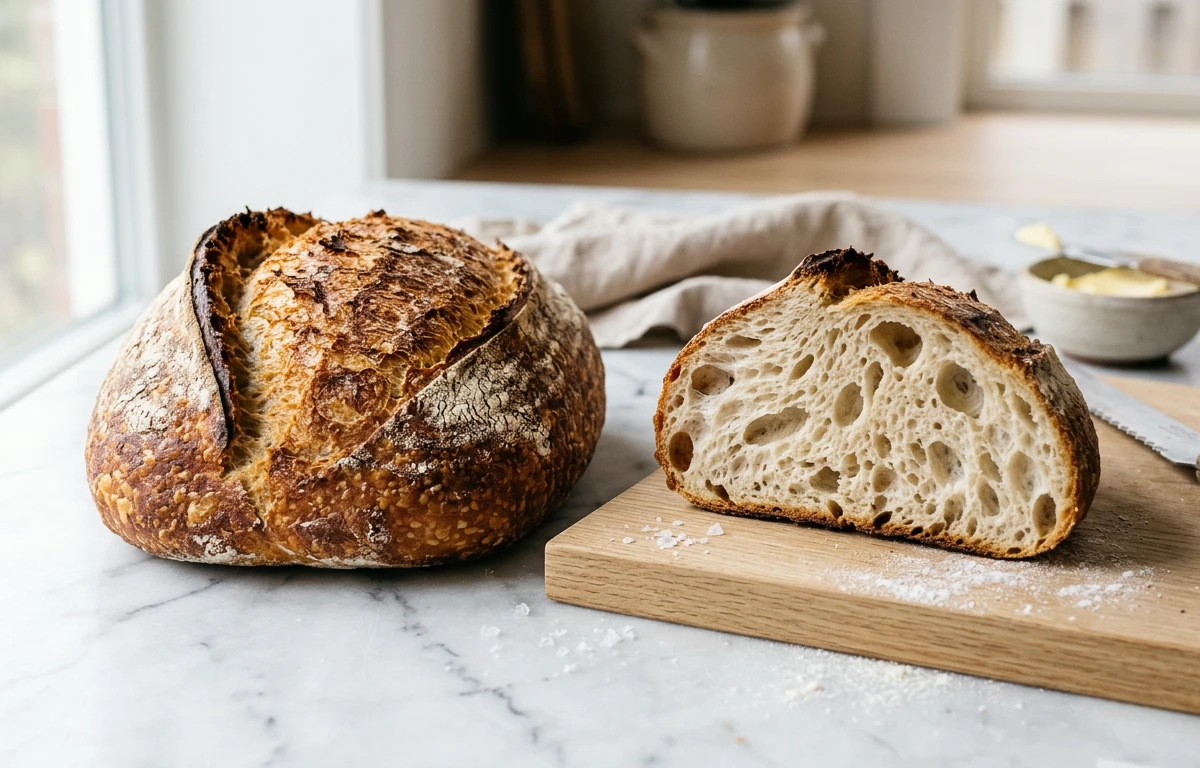
A rustic, golden-crusted loaf with a chewy, open crumb and that signature tang. Built from just flour, water, salt, and a lively starter, this bread rewards patience with deep, complex flavor. Perfect sliced warm with butter or as the base for an epic sandwich.
For 12 servings
- mix · ~60 min
Mix the autolyse dough.
1.In a large bowl, combine bread flour, whole wheat flour, and 350 ml of the warm water.2.Mix by hand until no dry bits remain. The dough will look shaggy.3.Cover the bowl and let it rest for 1 hour at room temperature.TIPDon't skip the autolyse. It kickstarts gluten development and makes a more extensible dough. - mix · ~5 min
Incorporate starter and salt.
1.Add the active sourdough starter and salt to the rested dough.2.Use your hand to pinch and fold the dough over itself, squishing all the ingredients together until the starter is fully incorporated and the dough feels even.3.With wet hands, dimple the surface and pour the remaining 30 ml of water over the top.4.Fold the dough over itself until all the water is absorbed.TIPWet your hands before handling the dough to prevent it from sticking excessively. - rest
Perform stretch and folds for bulk fermentation.
1.Cover the bowl and let the dough rest for 30 minutes.2.Wet your hand, reach under the dough, gently stretch a section up, and fold it over the center.3.Rotate the bowl 90 degrees and repeat until you've stretched and folded all four sides (about 4 folds total).4.Cover and repeat this stretch-and-fold process 3 more times, every 30 minutes, for a total of 4 sets over the first 2 hours of bulk fermentation.TIPIf the dough still feels very loose and sticky after the second fold, add one or two more sets. - rest
Finish bulk fermentation.
After the final set, let the dough rest undisturbed in a warm spot (75-78°F) until it has grown by 30-50%, shows a slightly domed top, and has visible bubbles throughout. This can take 2-4 more hours depending on the kitchen temperature.
TIPWatch the dough, not the clock. The dough is ready when it jiggles when you shake the bowl gently. - mix · ~20 min
Preshape the dough.
1.Turn the dough out onto a lightly floured surface.2.Gently pull the edges into the center to form a loose round ball.3.Cover with a towel and let it bench rest for 20 minutes. - mix · ~3 min
Perform the final shape.
1.Flip the rested round so the smooth side is down. Stretch the dough gently into a rectangle.2.Fold the top third down, then the bottom third up over the top, like a letter.3.Starting from one short side, roll the dough tightly into a log, sealing the seam with your fingers as you go.4.Use a bench scraper to create taut surface tension, pulling the loaf towards you on an un-floured workspace. - rest
Cold proof the loaf overnight.
Place the shaped loaf seam-side up in a floured banneton basket. Cover with a damp towel or plastic wrap and place in the refrigerator to proof for 12-16 hours. A long cold proof develops the best flavor and scoring ease.
TIPThe dough should pass the poke test: when poked, the indent should slowly spring back halfway. If it springs back fast, it needs more time. - bake · ~45 min
Preheat the oven and Dutch oven.
Place a Dutch oven with its lid on the middle rack of the oven. Preheat the oven to 500°F (260°C) for 45 minutes to ensure the pot is aggressively hot.
- bake · ~50 min
Score and bake the sourdough.
1.Turn the cold dough out of the banneton onto a piece of parchment paper. The seam should now be facing down.2.Dust the top with a little flour and use a bread lame or sharp knife to score a deep slash down the center at a 45-degree angle.3.Carefully lift the dough by the parchment paper and lower it into the blistering-hot Dutch oven. Cover with the lid immediately.4.Bake covered for 20 minutes, then remove the lid, reduce the temperature to 450°F (230°C), and bake for 25-30 minutes more, until the crust is deeply caramelized and crackling.TIPA deep, confident cut allows the bread to open up (the 'ear') instead of bursting at the seams. - serve · ~120 min
Cool completely before slicing.
Transfer the loaf to a wire rack. This is the hardest step—let it cool for at least 2 hours to allow the crumb to set fully. Cutting into hot bread results in a gummy interior.
TIPIf you knock on the bottom of the loaf, it should sound hollow; that's the sign of a perfectly baked bread.
What to keep in mind.
8 tips from the recipe — small details that make a real difference to the final dish.
- 1Feed your starter 4-6 hours before mixing; it should double in size and be bubbly.
- 2Use warm water (90°F) to keep the dough temperature ideal for fermentation.
- 3Wet your hands before stretch and folds to prevent sticking and tearing.
- 4Let bulk fermentation run until the dough jiggles and shows bubbles, not just by time.
- 5A cold proof of 12-16 hours develops a deeper tang and makes scoring easier.
- 6Preheat your Dutch oven for a full 45 minutes to ensure a blistering-hot start.
- 7Score with a confident, angled slash at least 1/2 inch deep for a dramatic ear.
- 8Cool the loaf for a full 2 hours; slicing early ruins the crumb texture.
Adapt it for your goals.
Seeded loaf
Add 50g of toasted sesame, sunflower, and flax seeds during the final shape for nutty crunch and texture.
cheese & herbCheese & herb
Fold in 100g of cubed cheddar or gruyère and 2 tbsp chopped rosemary during the last stretch and fold for a savory twist.
whole grain boostWhole grain boost
Replace 100g of bread flour with rye or spelt flour for a darker color, earthier flavor, and slightly denser crumb.
fruit & nutFruit & nut
Add 80g of dried cranberries, 60g of chopped walnuts, and a pinch of cinnamon during the final shape for a sweet-and-savory loaf.
Why this is on our healthy list.
Good Source of Fiber
Whole wheat flour contributes dietary fiber, which supports digestive health and helps maintain steady blood sugar levels.
Natural Fermentation
The long fermentation breaks down phytic acid, making minerals like iron and zinc more bioavailable to your body.
Lower Glycemic Impact
Sourdough's organic acids slow the rate of starch digestion, leading to a gentler rise in blood sugar compared to conventional bread.
Minimal Ingredients
Made with just four ingredients — no preservatives, dough conditioners, or added sugars — offering a clean, whole-food option.
Frequently asked questions
Yes, especially early in bulk fermentation. Wet your hands and use gentle stretch-and-fold techniques; the dough will tighten and become less sticky after a few sets.