
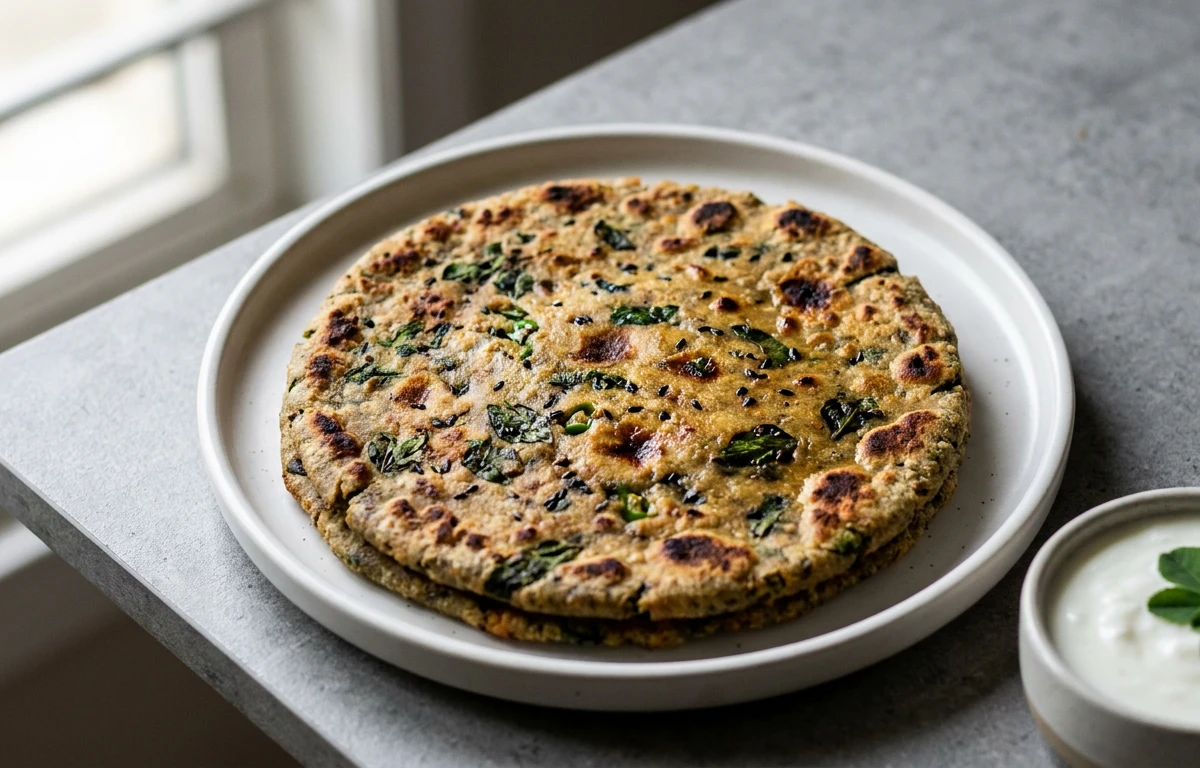
Methi Bajra Paratha
Nutty, earthy pearl millet flatbreads studded with fresh fenugreek leaves and mild spices. This rustic winter staple from Rajasthan and Gujarat is crisp on the outside, soft within, and pairs perfectly with pickle, yogurt, or a dollop of ghee.
For 8 servings
- prep
Prepare the methi leaves.
Wash the fresh methi leaves thoroughly under running water. Pat dry with a clean kitchen towel and finely chop them.
TIPRemove thick stems — they add bitterness and make the dough tear. - mix · ~1 min
Mix the dry ingredients.
In a large mixing bowl, combine bajra flour, salt, turmeric, red chili powder, cumin seeds, and ajwain. Mix well with your fingers to distribute everything evenly.
- mix · ~1 min
Add methi, chili, and ginger.
Add the chopped methi leaves, green chili, and grated ginger to the flour mixture. Mix again until the methi is evenly distributed through the flour.
TIPRub the flour and leaves together between your palms to release moisture from the methi. - knead · ~10 min
Knead the dough.
1.Pour warm water little by little into the flour mixture while mixing.2.Bring everything together into a shaggy mass, then knead for 4-5 minutes.3.Press the dough with your fingers — it should be soft but not sticky.4.Shape into a smooth ball, cover with a damp cloth, and rest for 5 minutes.TIPBajra dough is fragile — don't worry if tiny cracks appear; patching them while rolling is normal. - prep · ~2 min
Divide and portion the dough.
1.Pinch off 8 equal portions of the dough.2.Roll each portion between your palms into a smooth, crack-free ball.3.Cover the balls with a dry cloth so they don't dry out. - prep · ~2 min
Roll out a paratha.
1.Place one dough ball between two sheets of parchment or greased plastic.2.Flatten gently with your palm, then use a rolling pin to roll outward evenly.3.Roll to a 5-6 inch disc, about 3-4 mm thick.4.Carefully peel off the top sheet — patch any cracks with your fingers.TIPDon't roll too thin. Bajra dough has no gluten and will tear; 3-4 mm thickness is the sweet spot. - fry · ~3 min
Cook the paratha on tawa.
1.Heat a tawa or flat griddle over medium-high heat.2.Gently transfer the rolled paratha onto the hot tawa.3.Cook for 40-50 seconds until the surface changes color and small blisters appear.4.Flip and cook the other side for 30-40 seconds.5.Drizzle 1/4 tsp of ghee around the edges and spread with a spatula.6.Flip again and press gently with the spatula — both sides should be golden with brown spots.TIPKeep heat at medium-high. Too low and the paratha dries out; too high and it burns without cooking through. - prep
Repeat for remaining dough balls.
Roll and cook all 8 parathas the same way. Stack them on a plate and cover with a clean kitchen towel to keep warm and soft.
- serve
Serve warm with ghee, pickle, and yogurt.
Brush each paratha with a little extra ghee before serving. Serve immediately with fresh yogurt, mango pickle, or garlic chutney.
What to keep in mind.
7 tips from the recipe — small details that make a real difference to the final dish.
- 1Wash and dry methi leaves thoroughly before chopping to prevent excess moisture from making the dough sticky.
- 2Knead the dough while it's still warm from the water — it helps the bajra flour hydrate evenly for a pliable texture.
- 3Roll parathas between parchment sheets to prevent tearing; bajra dough lacks gluten and is naturally fragile.
- 4Cook on medium-high heat — too low dries out the paratha, too high burns it before the center cooks through.
- 5Press gently with a spatula during cooking to encourage even browning and ensure the interior is fully cooked.
- 6Stack cooked parathas under a clean kitchen towel to trap steam and keep them soft and pliable until serving.
- 7Make ahead: refrigerate rolled discs between parchment for up to 2 days; cook directly from the fridge.
Adapt it for your goals.
Low-oil
Cook the parathas on a non-stick tawa without ghee, then brush with just a few drops of ghee after cooking — reduces fat while keeping the signature nutty flavor.
spinach swapSpinach-swap
Replace methi with equal quantity of blanched, squeezed, and finely chopped spinach for a milder, non-bitter green paratha with similar texture.
nutty crunchNutty-crunch
Add 2 tablespoons of roasted and crushed peanuts or sesame seeds to the dough for extra crunch and a deeper nutty note that complements bajra.
veganVegan
Use any neutral plant-based oil (like sunflower or avocado oil) instead of ghee for cooking and brushing — the parathas remain deliciously crisp without dairy.
Why this is on our healthy list.
Rich in Millet Fiber
Bajra (pearl millet) is high in insoluble fiber, which aids digestion and helps maintain steady blood sugar levels — making this paratha a hearty, slow-energy release flatbread.
Good Source of Iron
Fenugreek leaves and bajra both contribute iron, supporting oxygen transport in the blood and helping combat fatigue naturally.
Gluten-Free by Nature
Bajra flour is inherently gluten-free, making these parathas a safe and satisfying option for those with celiac disease or gluten sensitivity.
Digestive Spice Blend
Ajwain (carom seeds), cumin, and ginger are traditionally used in Indian cooking to reduce bloating and aid digestion, balancing the hearty millet.
Frequently asked questions
Bajra flour contains no gluten, so the dough is naturally fragile. Knead with warm water, rest the dough for 5 minutes, and roll between parchment sheets to minimize cracking.


