Pan-Fried Bacon Strips
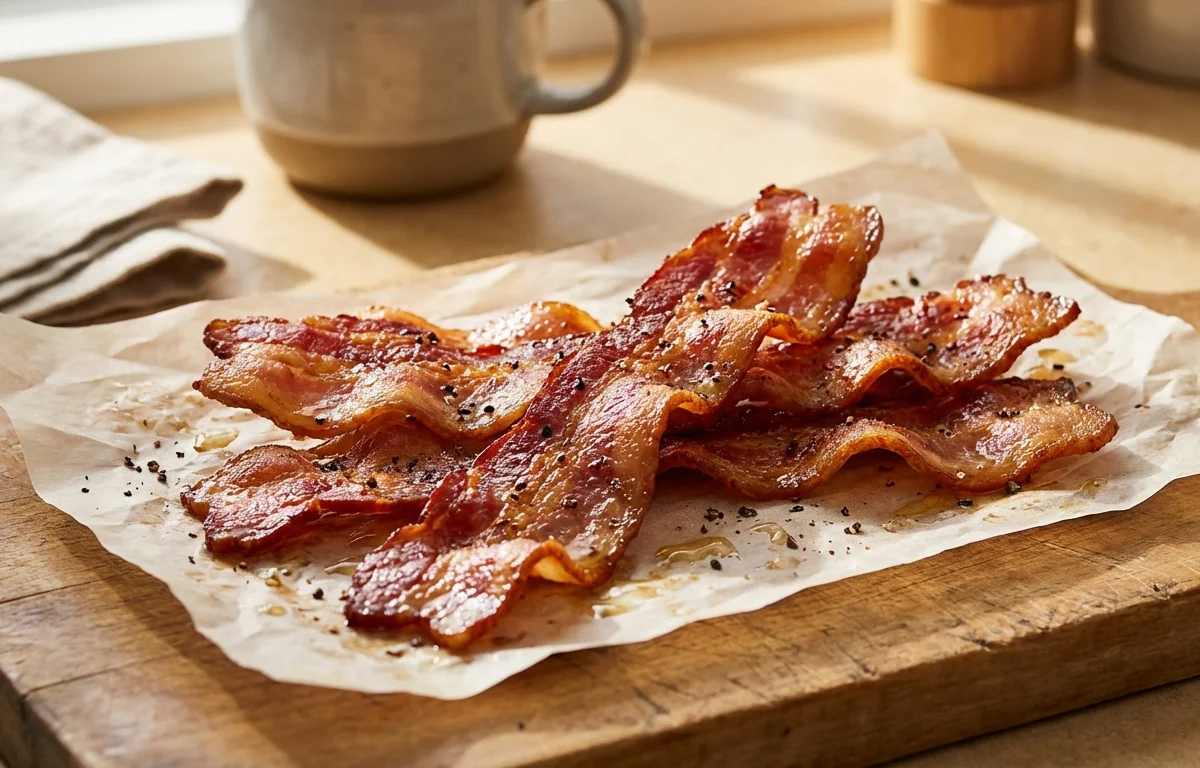
Crispy, golden, and perfectly rendered, these pan-fried bacon strips are a breakfast staple that comes together in one skillet. Starting with a cold pan ensures the fat renders slowly, leaving you with evenly cooked, shatteringly crisp bacon and no burnt edges. Ready in about 15 minutes with minimal cleanup.
For 4 servings
- prep
Arrange bacon in a cold skillet.
Lay the bacon strips in a single layer in a cold cast iron skillet or heavy-bottomed frying pan. Do not overlap the strips. Starting in a cold pan allows the fat to render slowly and evenly.
TIPTake the bacon out of the fridge 5 minutes before cooking so it isn't ice-cold — this helps it cook more evenly. - fry · ~5 min
Cook the bacon over medium-low heat.
Place the skillet over medium-low heat. Cook the bacon undisturbed for 4 to 5 minutes until the bottom edges start to curl and brown. Adjust the heat as needed — if the bacon is sizzling too aggressively or smoking, lower the heat.
- fry · ~5 min
Flip and continue cooking until crisp.
Use tongs to flip each strip. Continue cooking for another 3 to 5 minutes, flipping occasionally for even browning, until the bacon reaches your desired level of crispiness. For chewier bacon, stop earlier; for shatteringly crisp bacon, cook until deep golden-brown.
TIPWatch closely in the last minute — bacon goes from perfectly crisp to burnt very quickly. - fry · ~1 min
Drain the bacon on paper towels.
Transfer the cooked bacon strips to a plate lined with paper towels to absorb excess grease. Let them rest for 1 minute — they will continue to crisp up as they cool.
- serve
Serve immediately while hot and crisp.
Plate the bacon strips and serve right away. Bacon is best enjoyed fresh and hot, straight from the pan.
What to keep in mind.
6 tips from the recipe — small details that make a real difference to the final dish.
- 1Place bacon in a cold skillet to render fat slowly and prevent burnt edges.
- 2Use thin-cut or regular bacon; thick-cut may not crisp evenly with this method.
- 3Flip bacon occasionally during the last few minutes for uniform browning.
- 4Watch closely in the final minute—bacon can go from crisp to burnt quickly.
- 5Let drained bacon rest on paper towels for 1 minute; it will crisp up as it cools.
- 6Pour rendered bacon fat through a fine-mesh strainer into a jar for future cooking.
Adapt it for your goals.
Maple-glazed bacon
In the last minute of cooking, brush each strip with a thin layer of pure maple syrup. Flip and cook 30 seconds more for a sweet, caramelized finish — perfect for brunch or dessert topping.
spicy black pepper baconSpicy black pepper bacon
Sprinkle freshly cracked black pepper and a pinch of cayenne over the bacon after flipping. The heat complements the salty, fatty richness for a bold, savory kick.
brown sugar candied baconBrown sugar candied bacon
After draining on paper towels, immediately press each strip into a plate of light brown sugar. Let cool completely for a crunchy, sweet-and-salty treat ideal for salads or appetizers.
Why this is on our healthy list.
High-quality protein source
Each serving of bacon provides a significant amount of complete protein, which supports muscle repair and satiety.
Contains essential B vitamins
Bacon is rich in B vitamins like B1, B3, and B12, which help convert food into energy and support nervous system function.
Provides choline for brain health
Bacon contains choline, a nutrient important for cognitive function and cell membrane integrity.
Mineral content for bone and blood health
Bacon offers phosphorus for strong bones and iron for healthy red blood cell production, both in bioavailable forms.
Frequently asked questions
Thick-cut bacon works but will take longer to cook and may not crisp as evenly. Use thin-cut or regular for best results with this cold-start method.