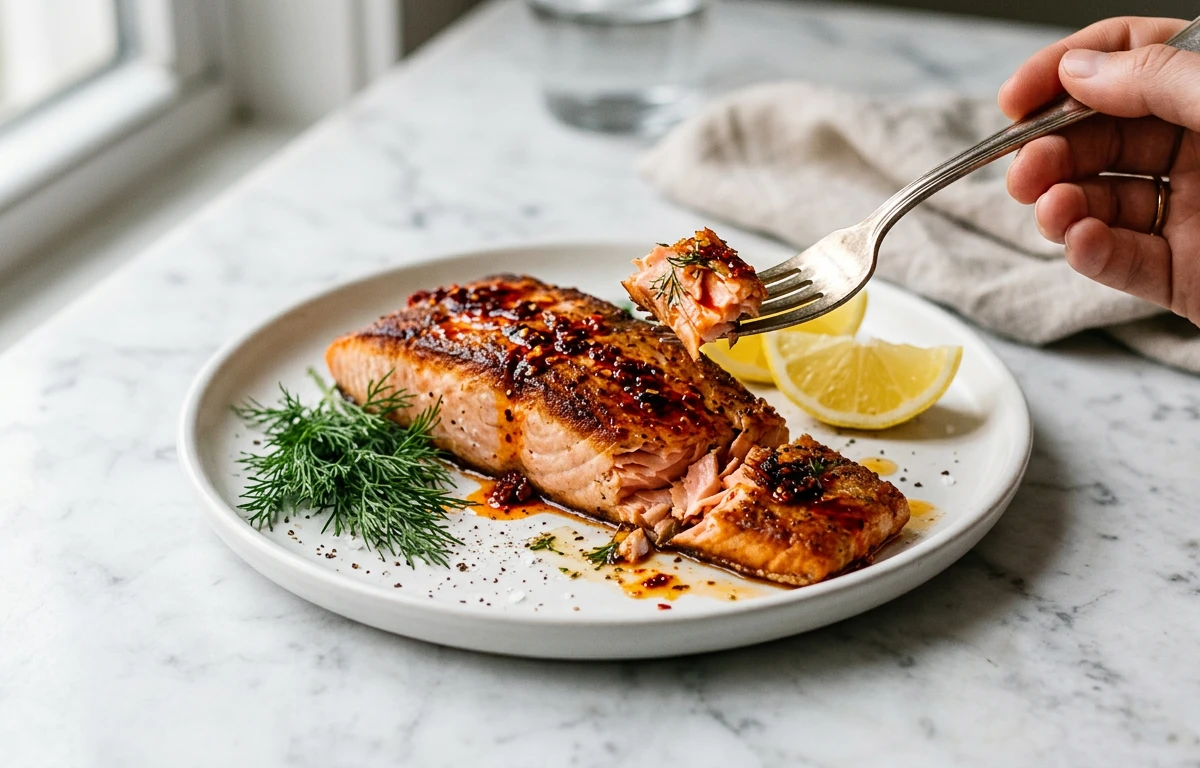
Perfect Pan-Seared Salmon
Crispy golden skin and tender, flaky flesh in every bite. This foolproof pan-seared salmon delivers restaurant-quality results with just a handful of pantry staples and one hot skillet. The high-heat sear locks in moisture while creating that irresistible crust, and the whole dish comes together in under 15 minutes.
For 4 servings
- prep · ~2 min
Pat the salmon completely dry.
Remove salmon fillets from the refrigerator 10 minutes before cooking. Use paper towels to firmly press and dry both the skin side and flesh side until no moisture remains. Thorough drying is the key to crispy skin.
TIPMoisture is the enemy of a good sear. Even slightly damp fish will steam rather than crisp. - prep · ~2 min
Season the salmon generously.
Season the flesh side of each fillet evenly with salt. Let the fillets sit for 2 minutes so the salt begins to penetrate the fish.
- prep · ~3 min
Preheat the skillet.
Place a heavy-bottomed skillet over medium-high heat. Add olive oil and swirl to coat the bottom. Heat until the oil shimmers and just begins to smoke lightly.
TIPDo not add the fish until the oil is shimmering. A properly heated pan prevents sticking. - fry · ~6 min
Sear the salmon skin-side down.
Carefully lay the fillets skin-side down in the hot skillet. Press each fillet gently with a spatula for 10 seconds to ensure full skin contact. Cook undisturbed for 5 to 6 minutes until the skin is golden and crisp.
TIPResist the urge to move or lift the fillets. The skin releases naturally when fully crisped. - fry · ~3 min
Flip and finish cooking.
Use a fish spatula to flip each fillet away from you. Add butter and crushed garlic cloves to the pan. Cook flesh-side down for 2 to 3 minutes until the salmon reaches 125°F for medium or 130°F for medium-well. Spoon the melted butter over the fish as it cooks.
TIPSalmon continues cooking off heat. Pull it when it's 5°F below your target internal temperature. - rest · ~2 min
Rest the salmon.
Transfer fillets skin-side up to a plate and let them rest for 2 minutes. The residual heat gently finishes cooking the interior.
TIPSkin-side up keeps the crust crisp by letting steam escape. - garnish
Garnish with black pepper and serve with lemon wedges.
What to keep in mind.
6 tips from the recipe — small details that make a real difference to the final dish.
- 1For the crispiest skin, pat the salmon dry with paper towels and let it air-dry uncovered in the fridge for 1 hour before cooking.
- 2Use a fish spatula to flip the fillets — its thin, angled blade slides under the skin without tearing it.
- 3Don't crowd the pan: leave at least 1 inch between fillets so they sear, not steam.
- 4Let the salmon rest skin-side up after cooking to keep the crust crunchy, not soggy.
- 5If your skillet isn't non-stick, preheat it until a drop of water dances before adding oil.
- 6For evenly cooked salmon, choose fillets that are similar in thickness — aim for 1 to 1.5 inches.
Adapt it for your goals.
Herb Butter
Add a sprig of thyme or rosemary to the butter along with the garlic for an aromatic, earthy twist that complements the salmon's richness.
Spicy Maple GlazeSpicy Maple Glaze
Brush the flesh side with a mix of 1 tbsp maple syrup, ½ tsp smoked paprika, and a pinch of cayenne before flipping for a sweet-heat caramelized crust.
Lemon Caper Pan SauceLemon-Caper Pan Sauce
After removing the salmon, deglaze the pan with 2 tbsp lemon juice and 1 tbsp capers, swirl in an extra pat of butter, and drizzle over the fillets.
Dairy FreeDairy-Free
Substitute the butter with 1 tbsp of ghee or avocado oil; the garlic can be omitted or replaced with a shallot for a dairy-free version.
Why this is on our healthy list.
Rich in Omega-3s
Salmon is one of the best natural sources of long-chain omega-3 fatty acids (EPA and DHA), which support heart and brain health.
High-Quality Protein
A single serving provides over 30 grams of complete protein, essential for muscle repair and satiety.
Good Source of Selenium
Wild and farmed salmon are rich in selenium, an antioxidant mineral that supports thyroid function and immune health.
Vitamin D Boost
Salmon is one of the few natural food sources of vitamin D, important for bone health and immunity.
Frequently asked questions
The pan likely wasn't hot enough, or the fish was too moist. Heat the oil until it shimmers, pat the skin bone-dry, and press the fillet down gently for 10 seconds to ensure full contact.