Perfect Pan-Seared Steak
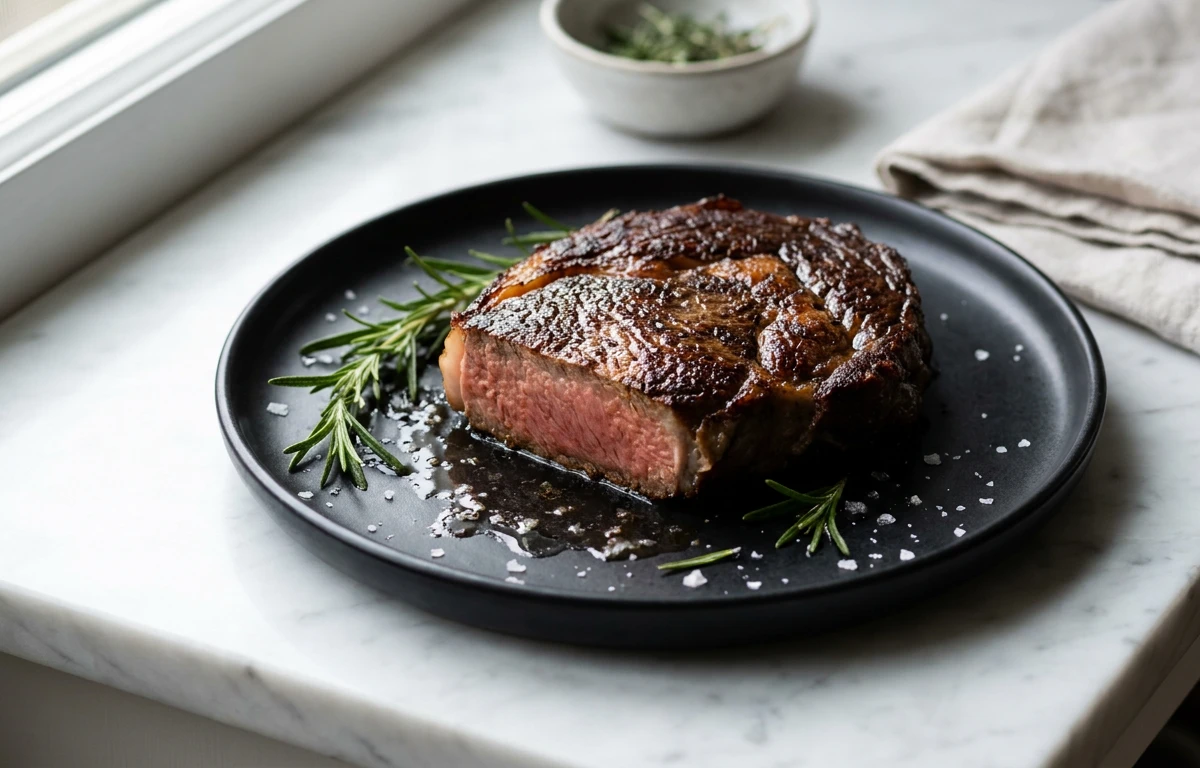
A beautifully crusted, juicy steak with a perfectly pink center, cooked entirely in a skillet. This method delivers steakhouse results at home—no grill required. Ready in under 15 minutes with minimal ingredients.
For 4 servings
- prep
Temper the steak and season generously.
1.Remove steaks from refrigerator 30-45 minutes before cooking to come to room temperature.2.Pat steaks completely dry with paper towels on both sides.3.Season all sides evenly with a small pinch of salt and a generous grind of black pepper.TIPDrying the surface is the single most important step—any moisture left will steam the steak instead of searing it. - prep · ~5 min
Preheat the skillet.
Place a cast iron skillet over high heat and let it get very hot until it just begins to smoke, about 4-5 minutes. A properly heated skillet is key to a good crust.
- fry · ~4 min
Sear the first side.
1.Add the oil to the hot skillet and swirl to coat the bottom.2.Lay the steaks in the skillet away from you to avoid splatter.3.Sear without moving for 3-4 minutes until a deep brown crust forms.TIPResist the urge to move the steak. It will naturally release from the pan when the crust is properly formed. - fry · ~3 min
Flip, add butter and aromatics.
1.Flip the steaks using tongs.2.Immediately add butter, smashed garlic cloves, and thyme sprigs to the skillet.3.Tilt the skillet slightly so butter pools at one edge and, using a spoon, baste the steaks continuously with the foaming butter for 2-3 minutes.TIPBasting with butter continuously adds flavor and helps cook the second side evenly. - prep
Check for doneness.
Use an instant-read thermometer to check the internal temperature. For medium-rare, pull steaks off heat at 125°F-130°F (52°C-54°C). For medium, pull at 135°F-140°F (57°C-60°C).
TIPThe steak will continue cooking after it leaves the pan — pulling it 5°F before your target temperature prevents overcooking. - rest · ~5 min
Rest the steak.
Transfer steaks to a cutting board and rest for at least 5 minutes. Spoon any remaining butter from the skillet over the top. Resting allows the juices to redistribute throughout the meat.
TIPSlicing a steak right off the heat will cause the juices to run out onto the board, leaving the meat dry. - assemble
Slice against the grain and serve.
1.Identify the direction of the grain running through the steak.2.Slice perpendicular to the grain into half-inch thick strips.3.Transfer to a platter and drizzle with any resting juices.TIPSlicing against the grain shortens the muscle fibers, making each bite tender rather than chewy.
What to keep in mind.
6 tips from the recipe — small details that make a real difference to the final dish.
- 1Bring the steak to room temperature before cooking for even doneness.
- 2Pat the steak bone-dry with paper towels to ensure a perfect crust.
- 3Use a high-smoke-point oil like avocado or canola to prevent burning.
- 4Let the steak rest for at least 5 minutes after cooking to retain juices.
- 5Slice against the grain to maximize tenderness in every bite.
- 6Use an instant-read thermometer for precise doneness every time.
Adapt it for your goals.
Herb-crusted
Add a dry rub of rosemary, garlic powder, and cracked black pepper before searing for an extra aromatic crust.
peppercorn saucePeppercorn sauce
After removing the steak, deglaze the pan with brandy and cream, then stir in crushed green peppercorns for a classic steakhouse sauce.
low oilLow-oil
Use a non-stick pan and skip the butter basting, relying solely on a quick sear with a minimal oil spray—ideal for a lighter preparation.
reverse searReverse sear
Oven-roast the steak at a low temperature (250°F/120°C) until the center reaches 115°F, then sear in a hot skillet for a more evenly cooked interior.
Why this is on our healthy list.
High in Protein
A 6-ounce serving of strip steak provides about 46 grams of complete protein, which supports muscle repair and satiety.
Rich in B Vitamins
Beef is naturally abundant in vitamin B12, niacin, and B6, which help maintain energy metabolism and nervous system function.
Contains Iron and Zinc
Red meat is a key source of heme iron and zinc, both of which are easily absorbed and essential for immune health and oxygen transport.
Frequently asked questions
The pan may not be hot enough, or you tried to move the steak before the crust formed. Let it sear undisturbed for 3-4 minutes—it will release naturally when ready.