
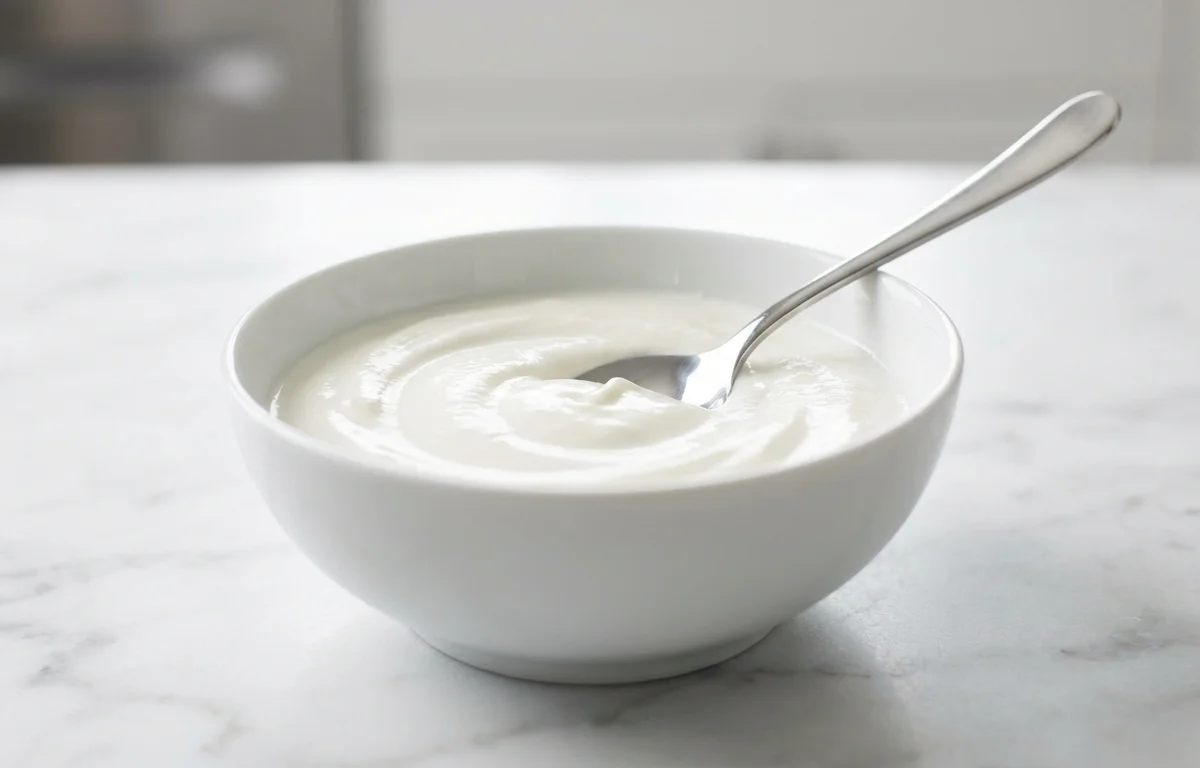
Plain Greek Yogurt
Thick, creamy, and delightfully tangy homemade yogurt, strained to achieve that signature Greek-style richness. With just two simple ingredients and a little patience, you can skip the store-bought tubs and create a velvety, protein-packed staple right in your own kitchen.
For 4 servings
- boil · ~20 min
Heat the milk.
1.Pour the whole milk into a large, heavy-bottomed pot.2.Warm over medium-high heat, stirring occasionally, until it reaches 185°F (85°C) — just before a full boil.TIPUse a cooking thermometer — target 185°F exactly to change the protein structure for a thicker yogurt. - rest · ~30 min
Cool the milk.
1.Remove the pot from heat and let the milk cool to 110°F (43°C).2.To speed cooling, set the pot in a sink filled with a few inches of cold water and stir gently.TIPIf the milk is too hot it will kill the yogurt cultures. Lukewarm to the touch is perfect. - mix
Inoculate the milk.
1.In a small bowl, whisk the 2 tablespoons of plain yogurt with a ladleful of the warm milk until smooth.2.Pour the yogurt mixture back into the pot of milk and whisk gently to distribute evenly. - other · ~480 min
Incubate the yogurt.
1.Pour the inoculated milk into a clean ceramic or glass bowl and cover tightly with a lid or plastic wrap.2.Place in a warm, draft-free spot (like an oven with the light on, or wrapped in a thick towel) for 8 to 12 hours.3.Do not move or jostle the bowl during incubation.TIPThe longer it sits, the tangier it gets. For extra-thick Greek yogurt, aim for a full 12 hours. - other · ~120 min
Strain the yogurt.
1.Line a fine-mesh strainer with a double layer of cheesecloth and set it over a large bowl.2.Once the yogurt is set and chilled for 2 hours, gently spoon it into the lined strainer.3.Let it drain in the refrigerator for 2 to 4 hours, until it reaches your desired thickness.TIPThe longer you strain, the thicker the yogurt. The strained liquid (whey) can be saved for smoothies or baking. - mix
Whisk and store.
1.Scrape the strained yogurt into a clean bowl and whisk until smooth and creamy.2.Transfer to an airtight container and refrigerate. Stays fresh for up to 1 week.
What to keep in mind.
6 tips from the recipe — small details that make a real difference to the final dish.
- 1Use a kitchen thermometer to heat milk to exactly 185°F — this denatures the whey proteins for a thicker set.
- 2Cool the milk to 110°F before adding the starter; anything hotter will kill the live cultures.
- 3For a tangier flavor, incubate for the full 12 hours; for a milder taste, check at 8 hours.
- 4Strain the yogurt in the refrigerator, not at room temperature, to prevent spoilage and control thickness.
- 5Save the whey that drains off — it adds protein to smoothies, soups, or bread dough.
- 6Use a heavy-bottomed pot and stir occasionally while heating to prevent scorching the milk.
Adapt it for your goals.
Low-fat
Replace whole milk with 2% or skim milk. The yogurt will be thinner and less rich but still tangy and protein-rich, with fewer calories and less saturated fat.
non dairyNon-dairy
Substitute whole milk with full-fat oat or soy milk (avoid almond, which is too thin). Use a dairy-free yogurt starter with live cultures for a plant-based, lactose-free alternative.
extra thickExtra-thick
After straining, fold in 1 tablespoon of milk powder per litre before incubation. This increases the protein content, resulting in an ultra-dense, almost cream-cheese-like yogurt.
high proteinHigh-protein
Add 2 tablespoons of non-fat dry milk powder to the milk before heating. This boosts protein without adding fat, creating an extra-thick, macros-friendly yogurt.
Why this is on our healthy list.
High in Protein
Straining removes excess liquid, concentrating the protein content. Greek yogurt is an excellent source of casein, which supports muscle repair and satiety.
Rich in Probiotics
Live active cultures from the starter yogurt support gut health by replenishing beneficial bacteria, aiding digestion and immune function.
Natural Calcium Source
Whole milk provides a significant amount of calcium, essential for strong bones and teeth, and the straining process preserves most of this mineral.
Lower in Lactose
The fermentation process consumes much of the lactose, and straining removes some of the remaining whey, making Greek yogurt easier to digest for many with mild lactose sensitivity.
Frequently asked questions
Yes, but UHT milk may produce a slightly thinner yogurt because its proteins are already altered. Add 2 tablespoons of milk powder per litre to help it set.


