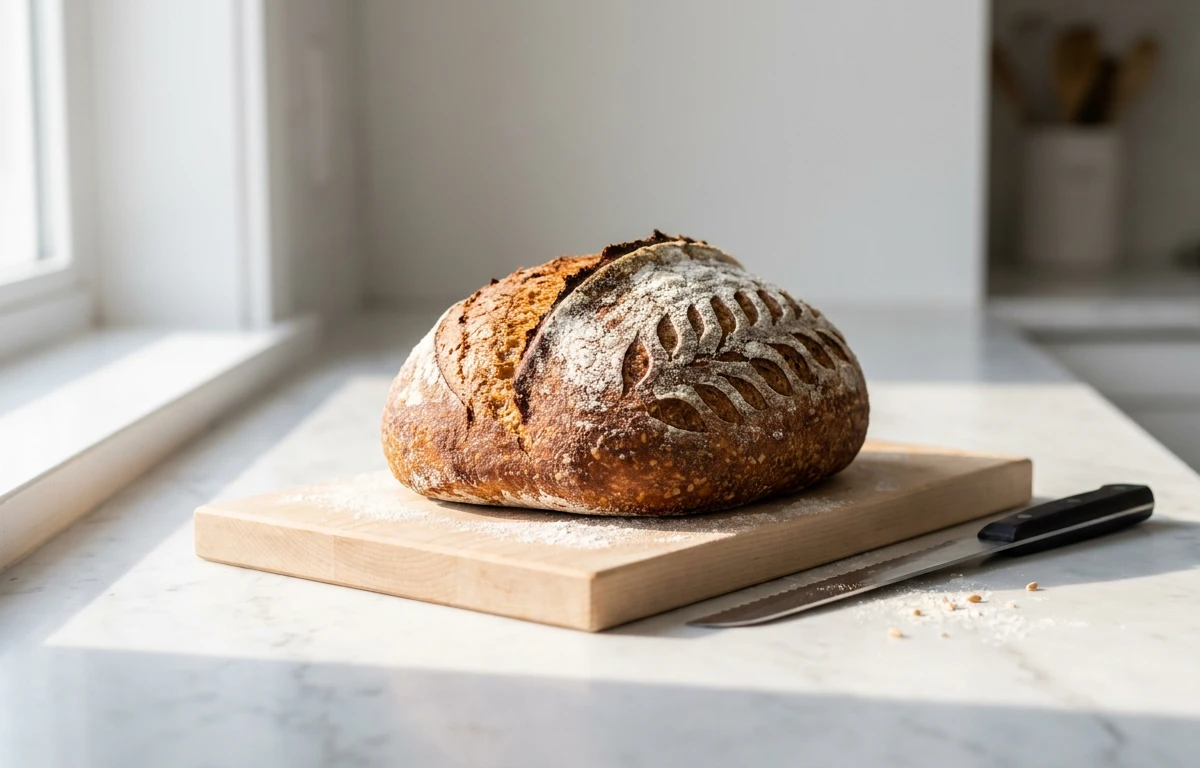
Rustic Whole Wheat Sourdough
A hearty, crusty loaf with a deep, tangy flavor and a soft, open crumb. This sourdough uses a mix of whole wheat and bread flour for the perfect balance of nutty wheat taste and airy texture. The long, slow fermentation brings out natural sweetness and makes it easier to digest. It’s the kind of simple, honest bread that turns a bowl of soup into a meal.
For 12 servings
- mix · ~30 min
Mix the dough.
1.In a large bowl, combine the sourdough starter with 350g of the lukewarm water. Mix with your fingers until the starter is mostly dissolved and milky.2.Add the whole wheat flour and bread flour to the bowl.3.Use your hands or a dough whisk to mix until no dry flour remains. The dough will look shaggy and feel sticky.4.Cover the bowl with a damp towel and let it rest for 30 minutes.TIPThe 30-minute rest (autolyse) lets the flour fully hydrate and starts gluten development without any work. - mix · ~2 min
Add the salt and incorporate.
1.Sprinkle the salt evenly over the dough's surface.2.Pour the remaining 25g of water over the salt to help it dissolve.3.Use your fingers to pinch and fold the dough repeatedly, working the salt and water into the dough until it feels uniform.4.Cover the bowl again.TIPAdding salt after the autolyse prevents it from tightening the gluten too early, giving you a more extensible dough. - rest · ~240 min
Bulk ferment with stretch and folds.
1.Let the dough ferment at room temperature for about 4 hours, or until it has nearly doubled in size and shows bubbles on the surface.2.During the first 2 hours, perform a stretch and fold every 30 minutes. To do this, wet your hand, grab one side of the dough, stretch it up, and fold it over the top. Turn the bowl 90 degrees and repeat until you've done 4 folds.3.After the last fold, leave the dough undisturbed for the remaining 2 hours.TIPIf your kitchen is cool, the fermentation will take longer. Watch the dough, not the clock. - prep · ~20 min
Pre-shape the dough.
1.Lightly flour your work surface and turn the dough out onto it.2.Use your bench scraper to gently round the dough into a loose ball. Let it rest uncovered for 20 minutes.TIPPre-shaping builds tension and gives the dough a structural 'memory' before the final shape. - prep · ~5 min
Final shape the loaf.
1.Lightly dust the top of the rested round with flour.2.Use your bench scraper to flip it over so the floured side is down.3.Fold the top edge down to the center, then the bottom edge up. Fold the left and right sides into the center to create a tight, smooth ball.4.Flip the shaped loaf seam-side up into a well-floured banneton.TIPThe seam-side up creates a natural split as it bakes, giving you that rustic 'ear' and open crumb. - rest · ~720 min
Proof the loaf overnight.
1.Dust the top of the loaf with flour and cover the banneton loosely with a plastic bag or shower cap.2.Place it in the refrigerator to cold-proof for 12 to 18 hours.TIPCold-proofing develops a deeper, more complex flavor and makes the dough much easier to score. - bake · ~60 min
Preheat the oven and score the loaf.
1.Place your Dutch oven and its lid inside the oven and preheat to 500°F (260°C) for one full hour.2.When the oven is ready, remove the dough from the fridge. Place a piece of parchment paper over the banneton and invert it onto a cutting board.3.Use a sharp lame or razor blade to make one decisive slash, about ½-inch deep, across the surface of the dough.TIPA single, confident slash at a shallow angle creates the best ear. Don't saw back and forth. - bake · ~45 min
Bake in the Dutch oven.
1.Carefully take the hot Dutch oven out of the oven and remove the lid.2.Use the parchment paper as a sling to lower the dough into the pot.3.Cover with the lid and bake for 25 minutes.4.Remove the lid, reduce the oven temperature to 450°F (230°C), and bake for another 20 minutes until the crust is a deep, dark mahogany brown.TIPThe steam inside the covered pot is the secret to a thin, crispy, crackly crust. - rest · ~120 min
Cool the bread completely.
1.Lift the loaf out of the pot using the parchment and transfer it to a wire rack.2.Let it cool for at least 2 hours before slicing.TIPThe bread is still cooking inside when it comes out of the oven. Cutting into it early will give you a gummy crumb.
What to keep in mind.
6 tips from the recipe — small details that make a real difference to the final dish.
- 1Use a kitchen scale for precise measurements, as whole wheat absorbs water differently than white flour.
- 2Autolyse (the 30-minute rest) is crucial for whole wheat dough to hydrate fully and develop extensibility.
- 3Don't skip the stretch and folds—they strengthen the gluten without overworking the dough.
- 4Cold-proofing for 12-18 hours deepens the sourdough's tang and makes scoring much easier.
- 5Preheat your Dutch oven for a full hour at 500°F to guarantee maximum oven spring.
- 6Cool the loaf for at least 2 hours; cutting warm bread results in a gummy, dense crumb.
Adapt it for your goals.
Seeded whole wheat sourdough
Add 50g of toasted sunflower seeds, pumpkin seeds, and flaxseeds during the final stretch and fold for extra crunch, healthy fats, and fiber.
spelt and whole wheat mixSpelt and whole wheat mix
Substitute 100g of the whole wheat flour with spelt flour for a slightly sweeter, more tender loaf with a delicate, nutty flavor.
lower gluten versionLower-gluten version
Replace the 200g of bread flour with an additional 200g of whole wheat flour; expect a denser, more compact crumb and a stronger wheat taste.
add dried fruit and nutsAdd dried fruit and nuts
Fold in 100g of chopped walnuts and 80g of dried cranberries after the last stretch and fold for a festive, sweet-tangy loaf.
Why this is on our healthy list.
Higher Fiber Content
Whole wheat flour retains the bran and germ, providing more dietary fiber than refined white bread, which supports digestive health and satiety.
Natural Prebiotics
The long fermentation of sourdough produces organic acids that act as prebiotics, feeding beneficial gut bacteria.
Lower Glycemic Impact
Sourdough fermentation reduces the bread's glycemic index compared to commercially yeasted bread, helping to stabilize blood sugar levels.
Rich in B Vitamins
Whole wheat is a good source of B vitamins (like niacin and folate) which are essential for energy metabolism.
Frequently asked questions
Whole wheat dough often needs extra hydration and a longer bulk ferment. Ensure you're using at least 350g water and letting it ferment until nearly doubled in volume, not just for a set time.