
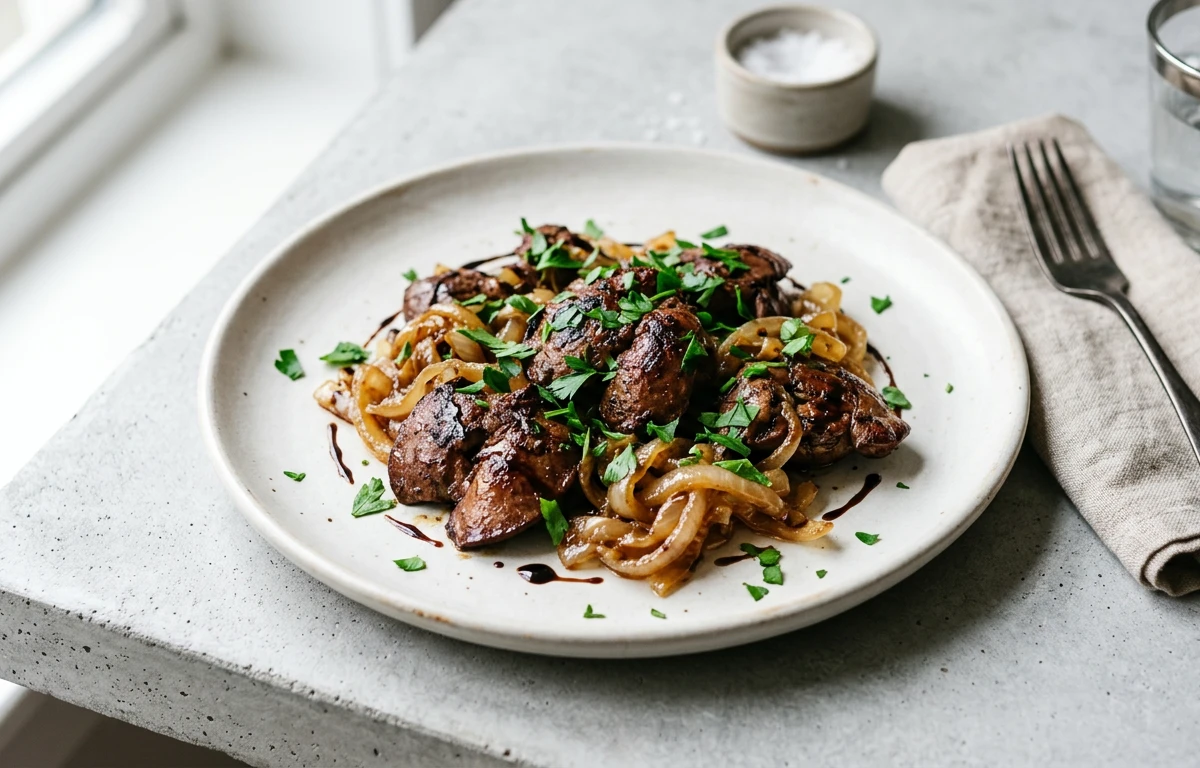
Sautéed Livers with Onions
Tender, melt-in-your-mouth chicken livers seared quickly and tossed with caramelized onions in a buttery pan sauce. This old-fashioned comfort dish is ready in under 20 minutes, delivering rich, earthy flavor with a hint of sweetness from slow-cooked onions.
For 4 servings
- prep · ~5 min
Trim and dry the chicken livers.
Rinse the chicken livers under cold water. Trim away any connective tissue or green spots, then halve the larger lobes so all pieces are roughly uniform. Pat very dry with paper towels — excess moisture prevents browning.
TIPLeaving a bit of the connective tissue is fine; it softens during cooking. - prep · ~2 min
Season and dust the livers.
In a shallow bowl, mix the flour with 0.25 teaspoon of the salt and a pinch of black pepper. Toss the livers lightly in the seasoned flour, shaking off any excess.
- saute · ~10 min
Caramelize the onions.
1.Heat the oil and 1 tablespoon of butter in a large skillet over medium heat.2.Add the sliced onions and a pinch of salt. Cook, stirring occasionally, until deep golden brown and softened (8-10 minutes).3.Add the minced garlic and sauté until fragrant (30 seconds).TIPDon't rush the onions — low and slow brings out their natural sweetness. - saute · ~1 min
Remove onions and increase the heat.
Transfer the caramelized onions to a plate and set aside. Add the remaining 1 tablespoon of butter to the skillet and raise the heat to medium-high.
- fry · ~6 min
Sear the chicken livers.
Place the floured livers in a single layer in the hot skillet. Sear for 2-3 minutes per side until nicely browned on the outside but still slightly pink inside. They should feel firm but springy to the touch.
TIPAvoid overcrowding the pan — cook in two batches if needed. Overcooked livers turn grainy and bitter. - simmer · ~1 min
Combine and finish cooking.
Return the caramelized onions to the skillet with the livers. Add the remaining salt and a pinch of black pepper. Toss everything together and cook for 1 more minute, letting the flavors meld.
- garnish · ~1 min
Finish with lemon and parsley.
Remove from heat. Squeeze the fresh lemon juice over the livers and onions, and scatter the chopped parsley on top. Toss once and serve immediately.
TIPThe lemon juice brightens the rich, earthy liver flavor — don't skip it. - serve
Serve hot.
Spoon the sautéed livers and onions onto a warm platter or plates. Serve as is or with crusty bread or mashed potatoes on the side.
What to keep in mind.
6 tips from the recipe — small details that make a real difference to the final dish.
- 1Pat the chicken livers extremely dry before flouring to ensure a deep golden sear.
- 2Sear livers in a single layer and avoid overcrowding; cook in batches if needed.
- 3Cook livers until just firm and springy — about 2-3 minutes per side — to keep them tender.
- 4Caramelize the onions slowly over medium heat for 8-10 minutes to bring out their natural sweetness.
- 5Serve immediately after adding lemon and parsley; livers toughen quickly as they cool.
- 6Leftover sautéed livers can be refrigerated for up to 2 days and reheated gently in a skillet.
Adapt it for your goals.
Liver & bacon
Cook 4 slices of chopped bacon until crisp before caramelizing the onions, then use the rendered bacon fat in place of some butter for a smoky, savory twist.
herb infusedHerb-infused
Add 1 teaspoon of fresh thyme or sage leaves along with the garlic for an earthy aromatic layer that complements the liver.
low fatLow-fat
Replace the butter with additional vegetable oil or a non-stick cooking spray, and skip the flour dusting to reduce fat and calories.
spicySpicy
Add 1/2 teaspoon of red pepper flakes or a minced fresh chili along with the garlic for a gentle heat that cuts through the richness.
Why this is on our healthy list.
Rich in Iron
Chicken liver is an excellent source of heme iron, which is highly absorbable and supports healthy red blood cells.
High in Vitamin A
Liver provides a concentrated amount of vitamin A, essential for vision, immune function, and skin health.
Good Source of B Vitamins
Chicken liver is packed with B12, folate, and riboflavin, which help with energy production and nerve function.
High-Quality Protein
This dish delivers a dense serving of complete protein, supporting muscle maintenance and repair.
Frequently asked questions
They should feel firm but springy to the touch and be slightly pink inside — about 2-3 minutes per side. Overcooking makes them grainy.


