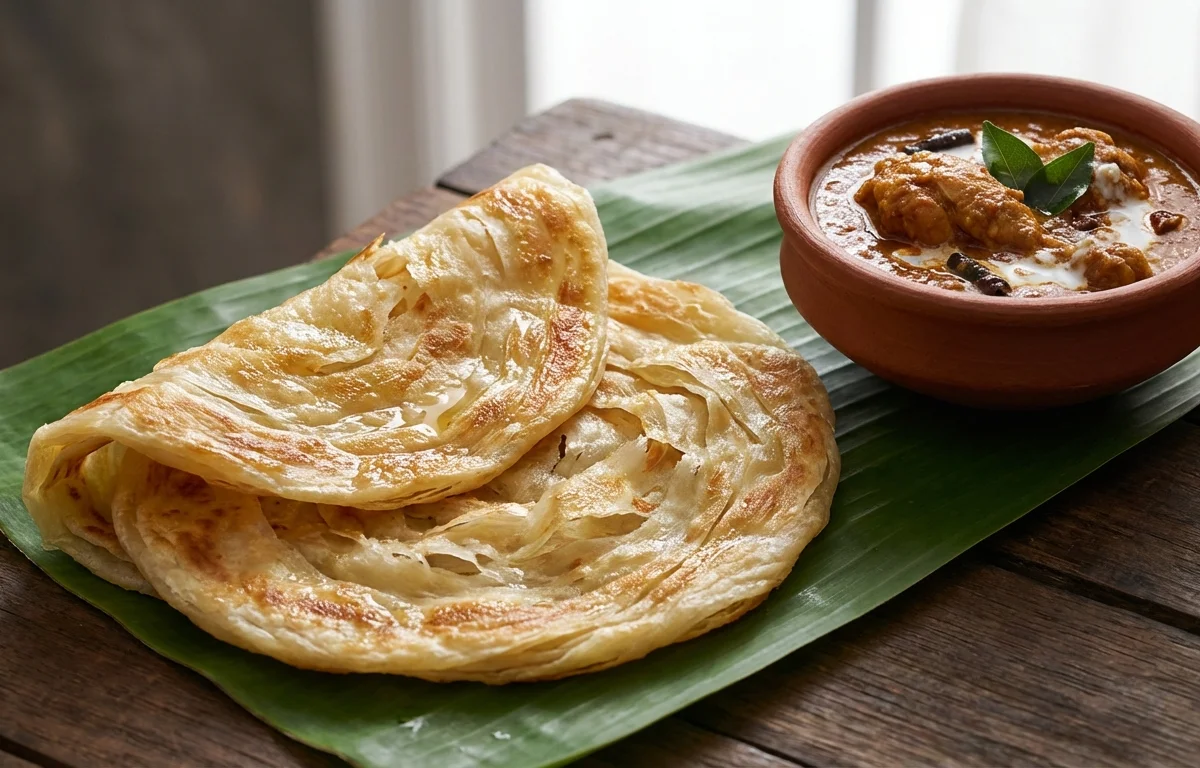
Veechu Parotta
A soft, flaky Tamil-style layered flatbread made by stretching the dough thin, pleating it, and cooking it on a hot tawa. The light layers and chewy bite make it perfect with salna or kurma.
For 8 servings
- mix · ~5 min
Mix the flour, sugar, salt, and oil.
Add the all-purpose flour, sugar, salt, and 2 tbsp oil to a wide bowl. Rub lightly with your fingers, then pour in the lukewarm water little by little to bring the dough together.
- knead · ~10 min
Knead the dough until soft and smooth.
Knead for 8 to 10 minutes until the dough turns supple, stretchy, and slightly soft. It should feel smoother than chapati dough so the parottas can be stretched thin later.
TIPA soft dough gives better flakes. If it feels tight, knead in 1 to 2 tsp more water. - rest · ~30 min
Rest the dough.
Divide the dough into 8 equal balls and coat them lightly with a little of the oil meant for layering. Cover and rest for 30 minutes so the gluten relaxes.
TIPDo not skip the rest or the dough will shrink back while stretching. - prep · ~8 min
Stretch each dough ball into a thin sheet.
1.Grease the work surface with a little oil.2.Place one dough ball on the surface and flatten it with your fingers.3.Stretch and gently pull the dough outward until it becomes very thin and almost translucent.4.Drizzle a little oil over the sheet to keep the layers separate.TIPStretch gently from the edges to avoid tearing. Small holes are fine. - assemble · ~6 min
Pleat and coil the dough.
1.Fold the thin sheet into pleats from one end to the other like a fan.2.Stretch the pleated strip lightly to lengthen it.3.Roll it into a loose coil.4.Tuck the end underneath and keep it covered. - rest · ~10 min
Rest the shaped coils briefly.
Let the coiled dough rest for 10 minutes, covered, so it relaxes again before rolling.
- prep · ~7 min
Flatten the coils into parottas.
Take each coil and gently press or roll it into a round parotta about 6 to 7 inches wide. Keep the layers intact and do not press too hard.
- fry · ~16 min
Cook the parottas on a hot tawa.
1.Heat a tawa over medium heat.2.Place one parotta on the tawa and cook until light spots appear on the bottom.3.Drizzle a little oil around the edges and flip.4.Cook both sides, pressing lightly, until golden brown spots appear and the layers are cooked through.TIPUse medium heat so the inside cooks before the outside gets too dark. - assemble · ~2 min
Clap the parottas to open the layers.
Stack 2 or 3 hot parottas together and gently clap them between your palms or crush them lightly from the sides to separate the flakes.
- serve
Serve hot.
Serve the veechu parotta hot with salna, kurma, or a simple vegetable gravy.
What to keep in mind.
7 tips from the recipe — small details that make a real difference to the final dish.
- 1Keep the dough softer than chapati dough; a slightly loose dough stretches thinner and gives better flakes.
- 2Oil the counter and your hands instead of dusting with flour, or the layers can dry out and stick together.
- 3If the sheet tears while stretching, do not restart; small holes disappear once you pleat and coil it.
- 4Resting after coiling is key, otherwise the round will spring back and become thick instead of layered.
- 5Flatten the coils gently with your fingers first, then roll lightly so you do not crush the laminated layers.
- 6Cook on medium heat with golden spots, not deep brown patches, so the inside stays soft and chewy.
- 7Clap the hot parottas right after cooking to loosen the layers before they steam and settle.
Adapt it for your goals.
Less-oil
Use a lighter hand with oil while cooking and rely on a well-seasoned tawa; you will get a slightly less flaky but lighter parotta.
atta mixAtta-mix
Replace part of the maida with whole wheat flour for a nuttier taste and more fiber, though the layers will be a bit less delicate.
mini parottaMini-parotta
Divide into smaller balls and make street-style mini parottas that are easier to serve with salna or kurma.
ghee finishedGhee-finished
Brush the cooked parottas lightly with ghee for a richer aroma and softer finish, especially for festive meals.
Why this is on our healthy list.
Quick Energy Base
Made mainly with flour, this parotta provides readily available carbohydrates that pair well with protein-rich gravies.
Moderate Ingredient List
This flatbread uses only basic pantry ingredients without additives, making it easy to control what goes into it.
Satisfying with Curries
Its layered, chewy texture makes a filling accompaniment, helping turn vegetable kurma or salna into a more complete meal.
Frequently asked questions
Usually the dough is too stiff, the sheet was not stretched thin enough, or the coil was pressed too hard while flattening.