
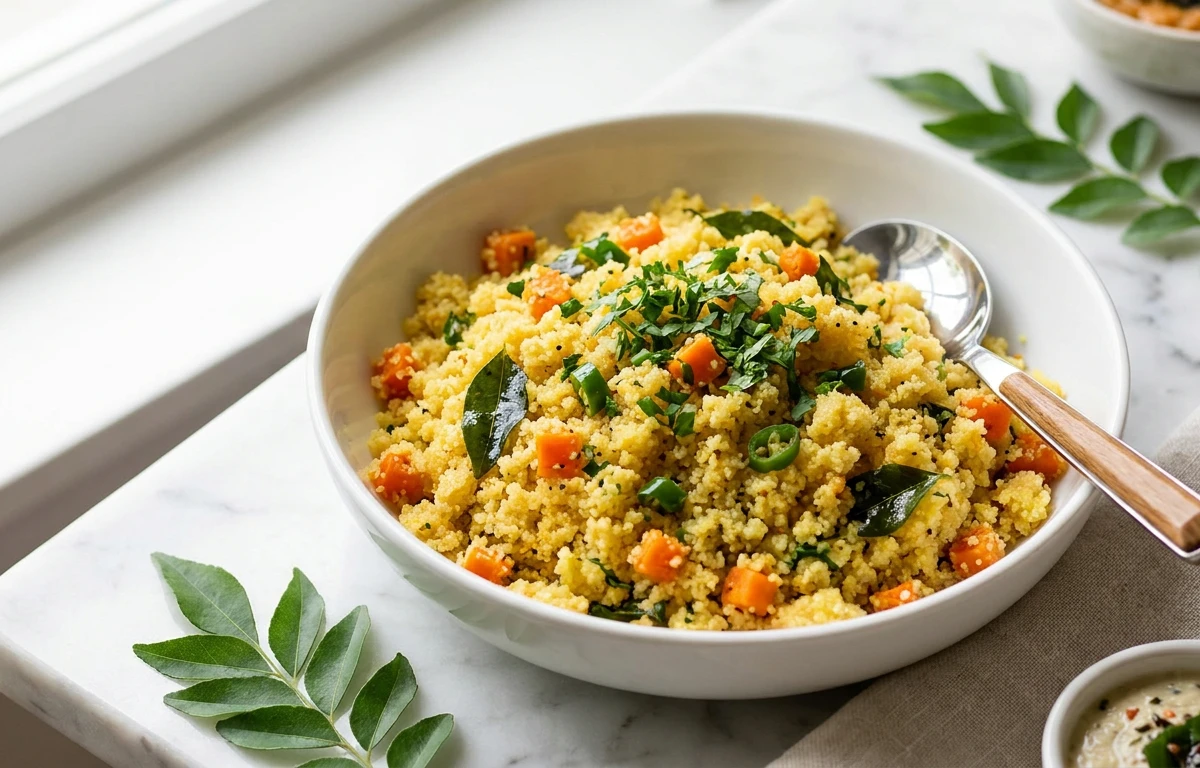
Vegetable Suji Upma
A warm, savory South Indian breakfast made by roasting semolina until fragrant, then steaming it with colorful vegetables and a gentle tempering of mustard seeds, curry leaves, and green chilies. Light, fluffy, and ready in under 30 minutes—perfect with a spoonful of coconut chutney.
For 4 servings
- roast · ~6 min
Dry roast the suji.
1.Heat a kadhai over low-medium heat and add 1 cup suji.2.Roast, stirring continuously, until fragrant and very lightly golden—about 5-6 minutes.3.Transfer the roasted suji to a plate and set aside.TIPConstant stirring prevents uneven browning. The suji should smell nutty, not turn brown. - temper · ~2 min
Make the tempering.
1.In the same kadhai, heat 2 tbsp oil over medium heat.2.Add 1 tsp mustard seeds and let them splutter (about 30 seconds).3.Add 1 tsp urad dal and sauté until golden (about 30 seconds).4.Tear in 8 curry leaves and add 2 slit green chilies.TIPStand back when adding curry leaves—they pop and release a burst of flavor. - saute · ~7 min
Sauté the aromatics and vegetables.
1.Add 1 inch finely chopped ginger and 1 finely chopped onion. Sauté until the onion turns translucent—about 3-4 minutes.2.Add 1 finely diced carrot, ¼ cup chopped green beans, and ¼ cup green peas.3.Sprinkle 0.5 tsp salt over the vegetables and sauté for 2-3 minutes until they begin to soften.TIPKeep the vegetables diced small so they cook quickly and blend evenly into the upma. - boil · ~3 min
Boil the water.
Pour 3 cups of water into the pan with the vegetables. Stir once and bring the mixture to a rolling boil over high heat.
TIPUse freshly boiled water from a kettle to save time—add it hot straight from the stove. - mix · ~3 min
Add the suji and cook.
1.Lower the heat to the minimum setting.2.Slowly add the roasted suji in a thin, steady stream, stirring vigorously with the other hand to prevent lumps.3.Stir until all the water is absorbed and the mixture pulls away from the sides of the pan—about 2-3 minutes.TIPNever walk away during this step. Low heat + continuous stirring = fluffy, lump-free upma. - steam · ~2 min
Steam the upma.
Cover the kadhai with a tight lid and let the upma steam undisturbed for 2 minutes on the lowest possible heat. Turn off the flame and let it rest covered for another minute.
- garnish
Finish and serve.
1.Remove the lid and fluff the upma gently with a fork.2.Add 2 tsp lemon juice and 1 tsp ghee; fold through lightly.3.Sprinkle 2 tbsp chopped coriander leaves on top and serve hot.TIPGhee added at the very end keeps its full aroma and adds a glossy finish.
What to keep in mind.
7 tips from the recipe — small details that make a real difference to the final dish.
- 1Roast semolina on low heat until fragrant, not browned, for a light, fluffy texture.
- 2Use hot water directly from a kettle to speed up cooking and maintain heat.
- 3Add roasted suji in a thin stream while stirring constantly to prevent lumps.
- 4Keep vegetables finely diced so they cook quickly and distribute evenly.
- 5Finish with a drizzle of ghee after steaming for maximum aroma and shine.
- 6Let the upma rest covered for 1-2 minutes after steaming for a tender crumb.
- 7Leftover upma can be refrigerated and reheated with a splash of water for softness.
Adapt it for your goals.
Protein-Packed
Add 1/4 cup roasted peanuts or cooked chickpeas along with the vegetables for a boost of plant protein and a crunchy bite, making the dish more filling.
VeganVegan
Simply replace the ghee with an extra teaspoon of vegetable oil or coconut oil in the tempering, and skip the ghee finish—this keeps the recipe completely plant-based.
Nut FreeNut-Free
Omit the urad dal from the tempering (or replace with chana dal) and ensure no nut-based garnishes are used; the dish remains naturally nut-free with the standard ingredients.
Low OilLow-Oil
Reduce oil to 1 tablespoon and skip the ghee finish; use a non-stick pan to sauté the aromatics and vegetables, lowering fat content without losing essential flavour.
JainJain
Omit onions, garlic, and any root vegetables (like carrot); use only peas, beans, and other non-root vegetables; replace onion with a pinch of asafoetida (hing) in the tempering for a similar savoury note.
Why this is on our healthy list.
Rich in Plant-Based Protein
The combination of semolina and urad dal provides a complete amino acid profile, supporting muscle repair and satiety, especially for vegetarian diets.
Good Source of Dietary Fibre
Vegetables like carrots, green beans, and peas add fibre that aids digestion and promotes a steady release of energy after eating.
Low in Saturated Fat
This recipe uses primarily unsaturated oils and a minimal amount of ghee, keeping saturated fat content low while still delivering flavour.
Naturally Gluten-Friendly Option
Semolina (suji) is derived from durum wheat, which has a lower gluten content than many flours, making it easier to digest for those with mild gluten sensitivities (not for celiac disease).
Packed with Micronutrients from Vegetables
Carrots provide beta-carotene (vitamin A), green beans offer vitamin K and folate, and peas supply vitamin C—all supporting immune and bone health.
Frequently asked questions
Lumps usually form if the suji is added too quickly or the heat is too high. Add it in a thin stream while stirring vigorously over low heat, and always use a steady hand.


