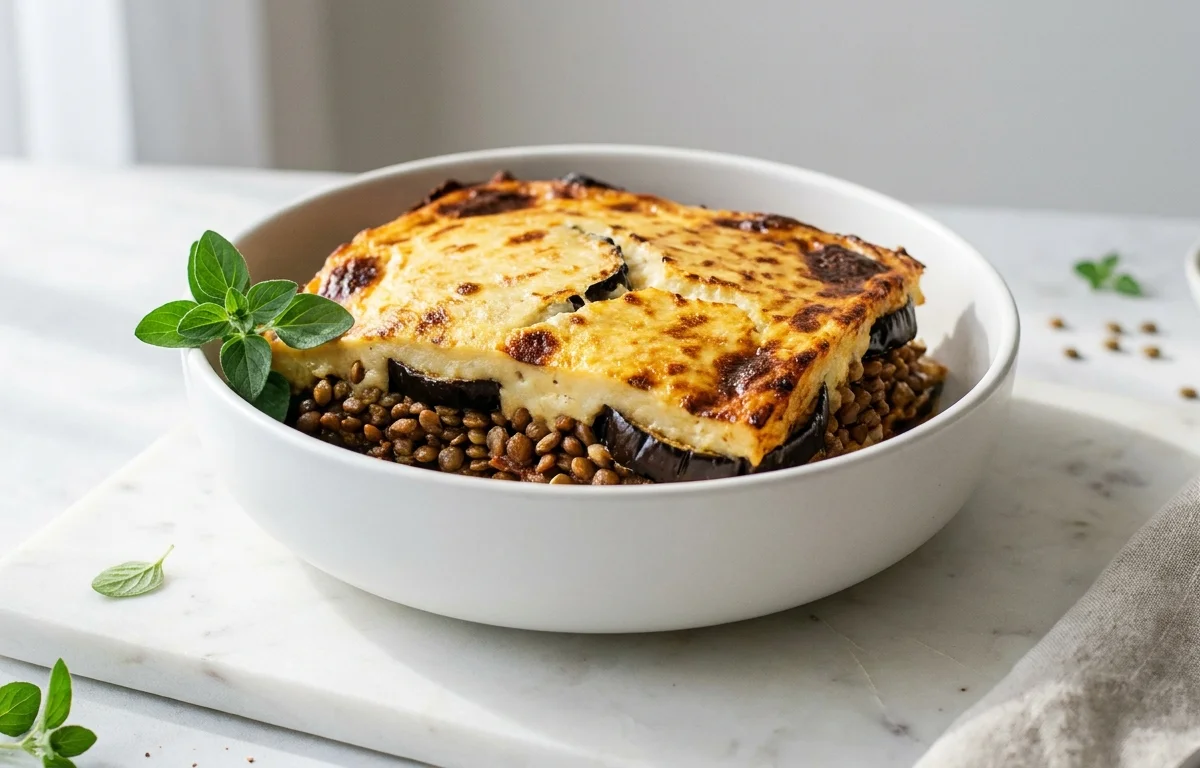
Vegetarian Lentil Moussaka
Layers of tender roasted eggplant and a savory lentil-tomato filling, all crowned with a velvety béchamel sauce. This meatless take on the classic Greek casserole delivers all the comfort and richness of the original. Perfect for a cozy family dinner or impressing guests at a Mediterranean feast.
For 8 servings
- prep
Preheat the oven and prepare the eggplant.
1.Preheat oven to 400°F (200°C).2.Arrange eggplant slices in a single layer on baking sheets.3.Brush both sides with 3 tablespoons olive oil and season with a pinch of salt. - roast · ~25 min
Roast the eggplant slices.
Roast eggplant for 20-25 minutes, flipping halfway, until tender and lightly golden. Remove from oven and set aside. Reduce oven temperature to 350°F (175°C).
TIPDon't overlap the slices — they'll steam instead of roast. Use two baking sheets if needed. - boil · ~25 min
Cook the lentils.
Combine rinsed lentils and 2 cups water in a medium saucepan. Bring to a boil, then reduce heat and simmer for 20-25 minutes until tender but not mushy. Drain any excess water.
TIPLentils should hold their shape — al dente is what you want. Overcooking makes a watery filling. - saute · ~10 min
Build the lentil filling.
1.Heat remaining 1 tablespoon olive oil in a large skillet over medium heat.2.Add chopped onion and sauté until softened (5-7 minutes).3.Add minced garlic and cook until fragrant (1 minute).4.Stir in crushed tomatoes, tomato paste, cinnamon, oregano, salt, and pepper. - simmer · ~10 min
Simmer the lentil mixture.
Add the cooked lentils to the skillet and stir everything together. Simmer for 10 minutes, stirring occasionally, until the mixture thickens and flavors meld. Taste and adjust seasoning.
TIPThe filling should be thick enough to mound on a spoon. If it's too wet, keep simmering. - simmer · ~10 min
Make the béchamel sauce.
1.Melt butter in a medium saucepan over medium heat.2.Whisk in flour and cook, stirring constantly, for 1-2 minutes to form a pale roux.3.Gradually pour in warm milk while whisking continuously to prevent lumps.4.Bring to a gentle simmer and cook until thickened enough to coat the back of a spoon (5-7 minutes).5.Remove from heat and stir in nutmeg and a pinch of salt.TIPWarm the milk before adding — cold milk in hot roux creates lumps. Microwave for 90 seconds. - mix · ~3 min
Finish the béchamel with eggs.
Let the béchamel cool for 3 minutes, then quickly whisk in the beaten eggs until smooth and glossy. This enriches the sauce and helps it set beautifully when baked.
TIPDon't skip cooling the sauce slightly — adding eggs to boiling liquid will scramble them. - assemble
Assemble the moussaka.
1.Arrange half the roasted eggplant slices to cover the bottom of a 9x13-inch baking dish.2.Spread all of the lentil mixture evenly over the eggplant layer.3.Place remaining eggplant slices on top of the lentils.4.Pour the béchamel sauce over the top, spreading it to the edges with a spatula.5.Sprinkle grated parmesan cheese evenly over the surface. - bake · ~40 min
Bake until golden and bubbly.
Bake at 350°F (175°C) for 35-40 minutes, until the béchamel is puffed and the top is beautifully golden brown. The edges should be bubbling slightly.
TIPIf the top browns too fast, tent loosely with foil during the last 10 minutes. - rest · ~20 min
Rest before slicing and serve.
Remove from the oven and let moussaka rest at room temperature for at least 20 minutes. This helps the layers set so it slices cleanly. Cut into 8 portions and serve warm.
TIPMoussaka is even better the next day — the flavors deepen overnight. Perfect for make-ahead meals.
What to keep in mind.
7 tips from the recipe — small details that make a real difference to the final dish.
- 1Salting and sweating the eggplant slices for 30 minutes before roasting draws out bitterness and prevents sogginess.
- 2Grate nutmeg fresh from a whole nutmeg for a far more aromatic béchamel than pre-ground powder.
- 3Let the lentil filling simmer until it's thick enough to mound on a spoon — excess moisture will make the moussaka watery.
- 4Warm your milk before adding it to the roux to avoid lumps in the béchamel sauce.
- 5Cool the béchamel for a full 3 minutes before whisking in the eggs, or they will scramble on contact.
- 6Rest the baked moussaka for at least 20 minutes before slicing so the layers set cleanly and don't collapse.
- 7This moussaka keeps beautifully for 4 days in the fridge and tastes even better reheated as the flavors meld.
Adapt it for your goals.
Vegan
Swap butter for vegan butter or olive oil in the béchamel, use unsweetened oat or soy milk, replace eggs with 2 tbsp cornstarch mixed with 3 tbsp water, and omit the parmesan. Perfect for a fully plant-based dinner.
gluten freeGluten-free
Replace all-purpose flour with a 1:1 gluten-free flour blend (or rice flour) in the béchamel, and ensure your crushed tomatoes are certified gluten-free. Ideal for those with gluten sensitivities.
low oilLow-oil
Skip brushing the eggplant with oil; instead, roast on a parchment-lined sheet at 425°F until tender. Reduce olive oil in the filling to 1 tsp and sauté the onions in a splash of vegetable broth.
high proteinHigh-protein
Add 1 cup of crumbled firm tofu or tempeh to the lentil filling along with the tomatoes for extra protein. Great for post-workout meals without losing the classic moussaka texture.
Why this is on our healthy list.
Rich in Plant Protein
Brown lentils provide a hearty dose of plant-based protein and fiber, making this moussaka a satisfying main dish that supports muscle health and digestion.
Low in Saturated Fat
With olive oil as the primary fat and only 3 tablespoons of butter for the béchamel, this dish is significantly lower in saturated fat than traditional meat-based moussaka.
High in Dietary Fiber
Both lentils and eggplant contribute substantial fiber, promoting steady blood sugar levels and prolonged fullness after eating.
Packed with Antioxidants
Eggplant skin is rich in nasunin, an antioxidant that supports brain health, while tomatoes and oregano add additional immune-boosting compounds.
Frequently asked questions
Brown lentils are best because they hold their shape after cooking. Red lentils break down into mush, and green lentils stay firmer but take longer to cook. Stick with brown for the ideal texture.