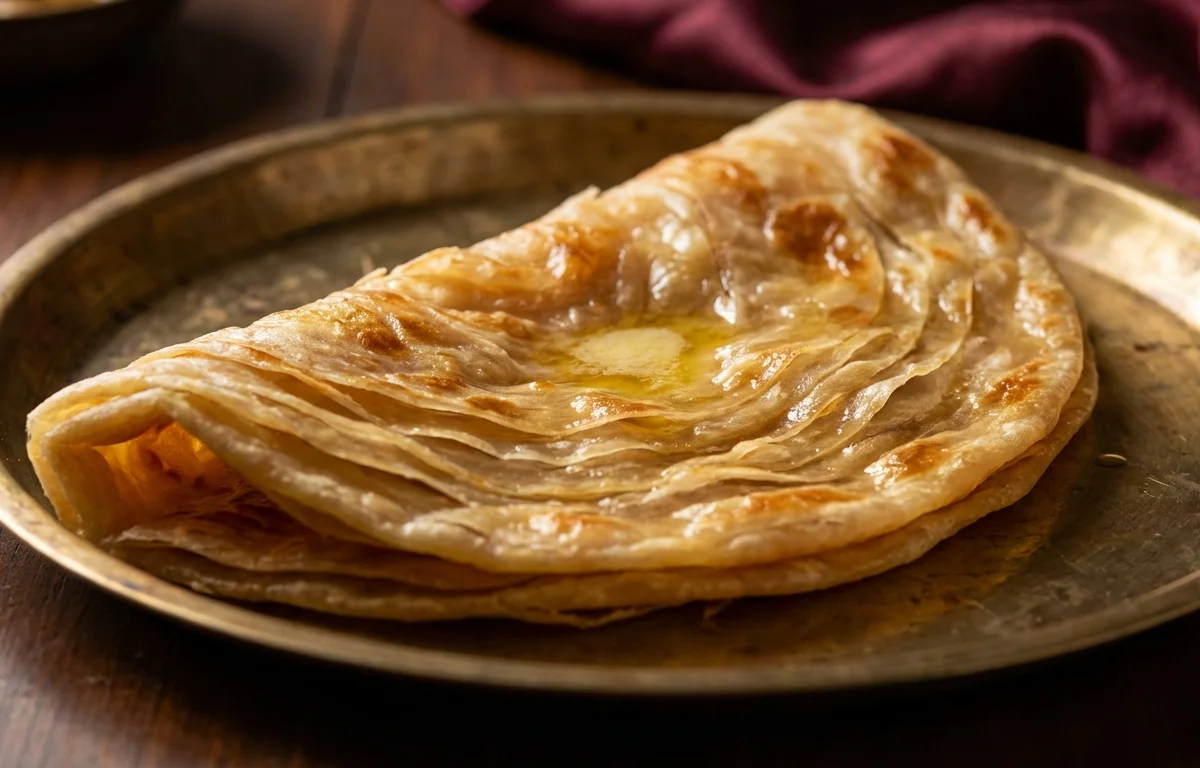
Warqi Paratha
A flaky layered paratha with delicate crisp edges and soft inner folds, Warqi Paratha is made by rolling, pleating, and cooking a simple dough with ghee. It is especially good with rich Mughlai curries and kebabs.
For 8 servings
- knead · ~8 min
Knead the dough.
1.Add 3 cups all-purpose flour and salt to a wide bowl.2.Rub in 1 tbsp ghee until the flour feels lightly sandy.3.Pour in lukewarm water little by little and knead to a soft, smooth dough.4.Cover the dough with a damp cloth. - rest · ~20 min
Rest the dough.
Let the dough rest for 20 minutes so the gluten relaxes and the parathas roll out easily.
TIPA rested dough gives cleaner layers and helps prevent the paratha from shrinking back. - prep · ~3 min
Divide the dough and prepare the layering fat.
1.Divide the dough into 8 equal balls.2.Keep the balls covered so they do not dry out.3.Set the remaining 3 tbsp ghee and 2 tbsp flour nearby for layering and dusting. - assemble · ~4 min
Roll and pleat the first paratha.
1.Roll one dough ball into a very thin round on a lightly floured surface.2.Spread a little ghee all over the surface.3.Dust lightly with flour.4.Make small accordion pleats from one side to the other.5.Coil the pleated strip into a tight spiral and tuck the end underneath.TIPRoll the dough as thin as you comfortably can; thin sheets create the best flaky layers. - rest · ~10 min
Rest the shaped spirals.
Repeat with the remaining dough balls, then let all the spirals rest for 10 minutes under a cloth.
- assemble · ~5 min
Roll the spirals into parathas.
Take one spiral at a time and gently roll it into a 6 to 7 inch round, keeping the layers intact and the thickness even.
- fry · ~12 min
Cook the parathas on a hot tawa.
1.Heat a tawa or heavy pan over medium heat.2.Place one rolled paratha on the hot surface and cook until light bubbles appear.3.Flip and spread a little ghee around the edges and on top.4.Flip again and cook, pressing gently, until both sides have golden spots and the layers are cooked through.TIPUse medium heat so the layers cook through before the surface gets too dark. - serve
Crush lightly and serve hot.
Clap each hot paratha gently between your palms or crush it lightly from the sides to open the layers, then serve right away.
What to keep in mind.
7 tips from the recipe — small details that make a real difference to the final dish.
- 1Keep the dough softer than for regular roti; a firm dough resists thin rolling and gives tighter layers.
- 2When pleating, brush a thin even film of ghee rather than thick patches, or the coils can slip while rolling.
- 3Resting the coiled spirals is key; if they spring back, give them 5 more minutes before the final roll.
- 4Roll the spiral from the center outward with light pressure so the laminated layers do not merge together.
- 5Cook on medium heat only; too hot a tawa browns the outside before the inner folds turn tender and flaky.
- 6After cooking, lightly clap the hot paratha between your palms to separate the layers and create the classic warqi texture.
- 7If making ahead, half-cook the parathas, cool, stack with paper between them, and reheat on the tawa with a little ghee.
Adapt it for your goals.
Low-oil
Use less ghee during pan-cooking and keep the layering light for a less rich paratha that still has some flake.
attaAtta
Swap part or all of the all-purpose flour with whole wheat flour for a nuttier, heartier flatbread with slightly less delicate layers.
stuffed keemaStuffed-keema
Add a thin layer of dry cooked keema before pleating for a richer Mughlai-style paratha that can be served as a meal on its own.
ajwainAjwain
Mix a little ajwain into the dough for a subtle savory aroma that pairs especially well with heavy curries and kebabs.
Why this is on our healthy list.
Energy-Giving Carbohydrates
The flour-based dough provides steady cooking-friendly energy, making these parathas satisfying alongside protein-rich curries.
Satiety From Ghee
The ghee in the dough and layers adds richness and helps the paratha feel filling, so a little goes a long way.
Simple Ingredient Recipe
Made from flour, water, salt, and ghee, this dish avoids highly processed add-ins and keeps the ingredient list straightforward.
Frequently asked questions
Usually the dough was rolled too thick, the ghee-flour layering was uneven, or the final paratha was rolled with too much pressure. Clapping it while hot also helps release the layers.