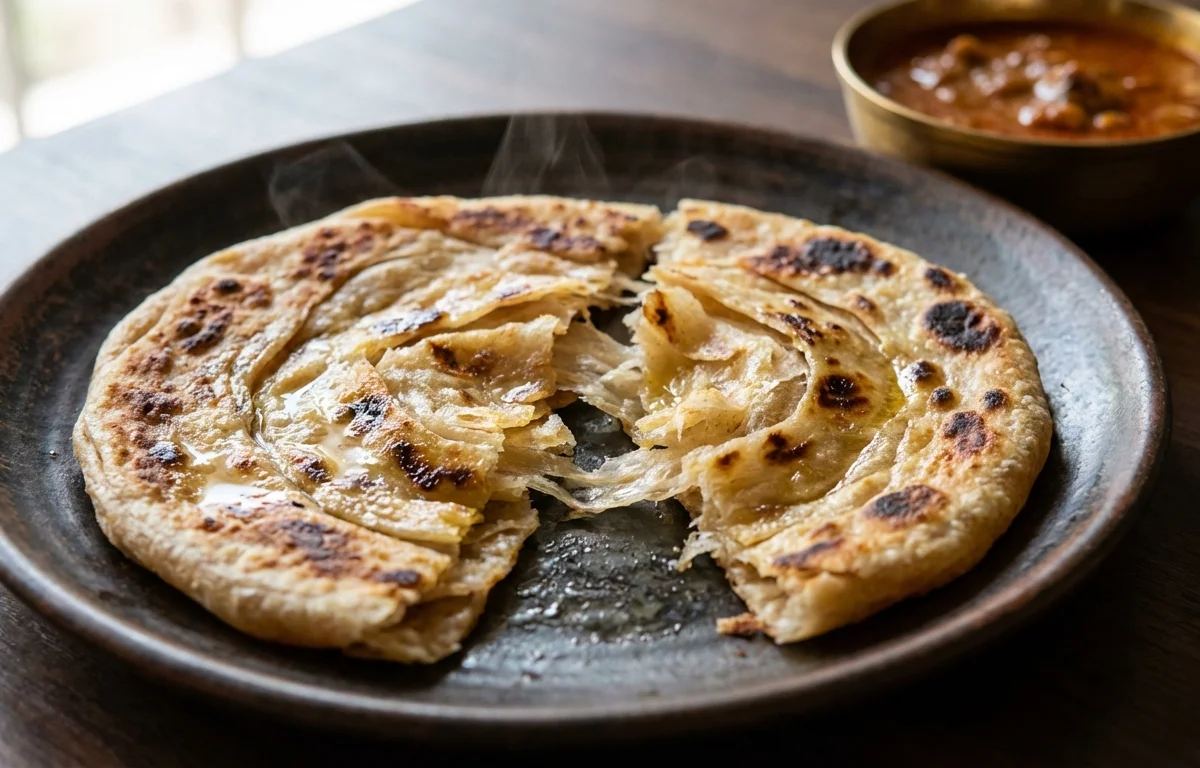
Wheat Parotta
Layered whole wheat parottas with a soft inside and lightly crisp edges, made by resting, coiling, and rolling the dough. They pair beautifully with kurma, salna, or any simple curry for a comforting meal.
For 8 servings
- mix · ~5 min
Mix the dough ingredients.
1.Add whole wheat flour, salt, and sugar to a wide bowl.2.Pour in 2 tbsp oil and rub it into the flour.3.Add lukewarm water a little at a time and bring the dough together. - knead · ~8 min
Knead the dough until soft.
Knead for 6 to 8 minutes until the dough turns smooth, soft, and slightly pliable. It should be softer than chapati dough but not sticky.
TIPA soft dough helps the layers open up after cooking. - rest · ~20 min
Rest the dough.
Coat the dough lightly with a little oil, cover, and let it rest for 20 minutes.
- prep · ~3 min
Divide the dough.
Divide the rested dough into 8 equal balls and keep them covered so they do not dry out.
- assemble · ~15 min
Shape the layered parottas.
1.Take one dough ball and roll it into a thin oval or rectangle on a lightly oiled surface.2.Brush a little oil over the surface.3.Pleat it into thin folds like a fan.4.Roll the pleated strip into a coil and tuck the end underneath.5.Rest the coil for 5 minutes, then gently roll it into a medium-thick disc.TIPUse oil instead of dry flour while shaping so the layers stay distinct and the dough stays supple. - fry · ~16 min
Cook the parottas on a hot tawa.
1.Heat a tawa over medium heat.2.Place one rolled parotta on the tawa and cook until small bubbles appear.3.Flip, drizzle a little oil around the edges, and cook both sides until golden spots appear.4.Press gently with a spatula so the layers cook evenly.TIPKeep the heat at medium so the parotta cooks through before the outside gets too dark. - assemble · ~2 min
Clap the parottas to open the layers.
While still hot, place each cooked parotta between your palms and gently clap it a few times to separate the layers slightly.
- serve
Serve the wheat parottas hot.
What to keep in mind.
7 tips from the recipe — small details that make a real difference to the final dish.
- 1Keep the dough softer than chapati dough; a firm dough will resist pleating and give dense parottas.
- 2Use oil, not dusting flour, while rolling and folding so the layers stay separate and don't turn dry on the tawa.
- 3After coiling, give each dough spiral the full 5-minute rest so it rolls out without springing back.
- 4Roll the final disc gently from the center outward; pressing too hard will flatten the laminated layers.
- 5Cook on medium heat only—high heat browns the outside before the thicker center finishes cooking.
- 6Clap the parottas while still hot to loosen the layers; once cool, they won't separate as well.
- 7To store, cool completely and stack with parchment between each parotta before refrigerating or freezing.
Adapt it for your goals.
Low-oil
Use a lighter brush of oil between folds and cook with minimal oil on a well-seasoned tawa if you want a less rich everyday parotta.
veganVegan
This recipe is already vegan as written, making it a good flatbread option for pairing with vegetable kurma or salna.
stuffedStuffed
Add a thin layer of spiced potato or finely chopped sautéed vegetables before coiling for a more filling parotta-style meal.
spicedSpiced
Mix crushed cumin, pepper, or finely chopped curry leaves into the dough for extra aroma that still suits South Indian curries.
Why this is on our healthy list.
Whole Grain Goodness
Made with whole wheat flour, this parotta retains more of the grain than refined-flour versions and offers a more wholesome base.
More Satisfying Texture
Whole wheat flour gives the parotta a heartier bite that can feel more filling alongside curry or kurma.
Plant-Based Side
With no dairy or eggs in the dough, this parotta fits easily into a plant-based meal when served with vegetable-based sides.
Frequently asked questions
Usually the dough is too stiff, the sheet was not rolled thin enough, or too little oil was used between folds. Gentle rolling after coiling also helps preserve the layers.