Baguette
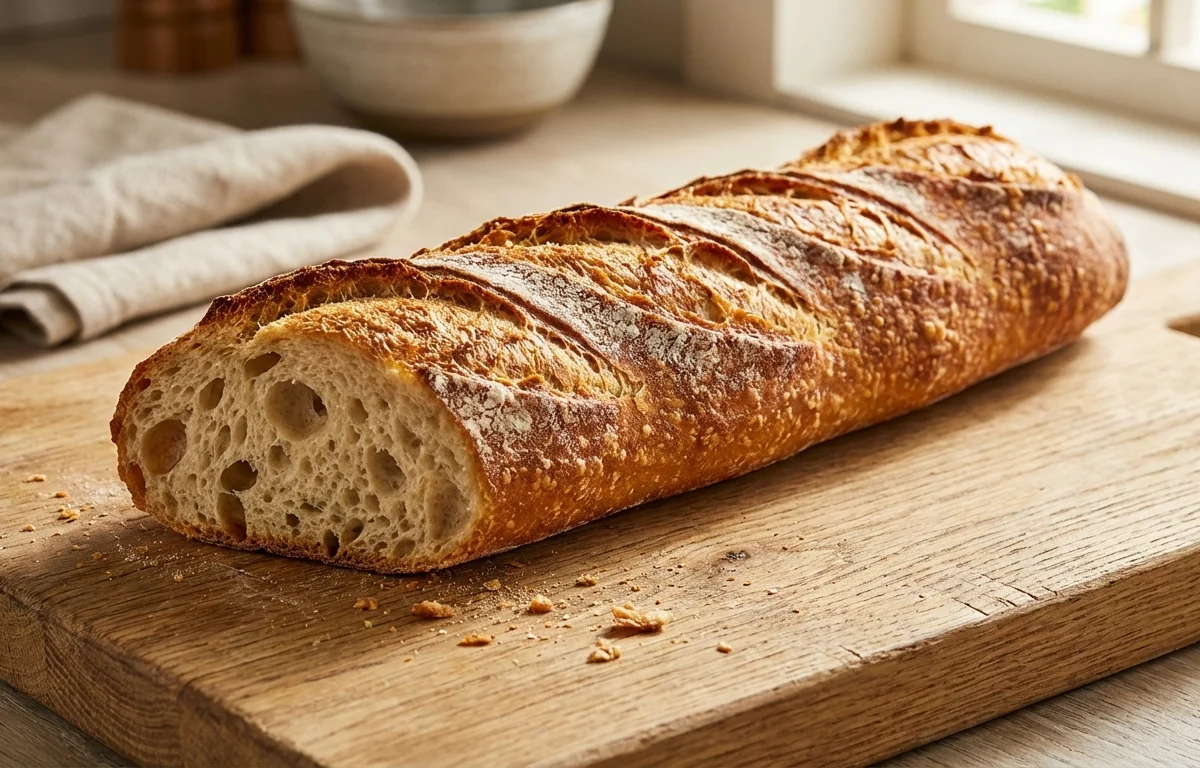
A classic French baguette with a shatteringly crisp golden crust and a soft, airy crumb riddled with irregular holes. This slow-fermented bread develops deep wheat flavor with just four pantry staples. Perfect for tearing at the dinner table, making sandwiches, or serving alongside soups and salads.
For 4 servings
- mix · ~30 min
Mix the dough.
1.In a large mixing bowl, stir yeast into cool water until dissolved.2.Add all bread flour and mix with a wooden spoon until a shaggy dough forms and no dry flour remains.3.Cover bowl tightly with a kitchen towel and let rest for 30 minutes.TIPThis rest — called autolyse — hydrates the flour and kickstarts gluten development with no kneading. - mix · ~30 min
Incorporate the salt.
1.Sprinkle salt over the rested dough.2.Dip your hand in cool water to prevent sticking, then fold the dough over itself 4 to 5 times to work in the salt.3.Cover again and let rest 30 minutes.TIPWet hands handle sticky dough better than floured hands. - mix · ~120 min
Stretch and fold the dough.
1.With a wet hand, reach under one side of the dough, pull it up, and fold it over the top.2.Rotate the bowl 90 degrees and repeat. Do this 4 times total — one full rotation.3.Cover and rest. Repeat this stretch-and-fold set 2 more times at 30-minute intervals.4.After the final fold, cover the bowl and let the dough rise at room temperature until doubled and bubbly, about 1 hour.TIPGentle folds build an open, airy crumb. Resist the urge to punch down the dough. - rest · ~720 min
Cold-ferment the dough overnight.
1.Transfer the covered bowl to the refrigerator.2.Chill for at least 12 hours and up to 18 hours. The dough will continue to rise slowly.TIPA long cold fermentation develops the deep wheaty flavor and crackly crust that define a good baguette. - prep · ~30 min
Divide and pre-shape the dough.
1.Turn the cold dough out onto a very lightly floured surface. It will be easier to handle cold.2.Use a bench scraper to divide the dough into 4 equal pieces, about 200 g each.3.Pat one piece into a rough rectangle. Fold the top third down to the center and the bottom third up over it.4.Pinch the seam, then flip seam-side down. Cover loosely with a kitchen towel and rest 30 minutes.TIPHandle the dough gently. You want to degas it as little as possible to keep those large air pockets. - prep · ~45 min
Shape the baguettes.
1.Take a rested piece, seam side up. Pat it into a rectangle slightly shorter than your baking sheet.2.Fold the top long edge down to the center and press lightly with your fingertips.3.Fold the bottom long edge up to meet it and pinch the seam all along its length.4.Roll the cylinder gently under your palms from the center outward, creating tapered ends.5.Place shaped baguettes seam-side down on a parchment-lined baking sheet, well-spaced.6.Cover with a towel and proof until puffy and a finger pressed into the dough slowly springs back, about 45 minutes.TIPIf you don't have a couche, a floured kitchen towel pleated between the loaves supports their shape while proofing. - bake · ~20 min
Preheat the oven and prepare for steam.
1.While baguettes proof, position a rack in the middle of the oven. Preheat to 475°F.2.Place a metal pan on the bottom rack to heat up — this will create steam.TIPSteam is the secret to a crackly crust. Without it, the crust sets before the loaf can fully expand. - prep · ~2 min
Score the baguettes.
1.Hold a lame or sharp knife at a shallow 30-degree angle.2.Make 3 to 4 quick, overlapping slashes down the length of each loaf. Cuts should be about ¼-inch deep.3.Mist the tops lightly with water from a spray bottle.TIPDon't press down — let the blade glide. Good scoring lets the dough open dramatically in the oven. - bake · ~25 min
Bake with steam.
1.Slide the baking sheet onto the middle rack.2.Immediately pour 1 cup of hot water into the hot pan on the bottom rack and shut the door quickly.3.Bake for 10 minutes. Do not open the door.4.After 10 minutes, remove the steam pan. Continue baking until baguettes are deep golden brown and sound hollow when tapped, 12 to 15 minutes more.TIPThe hollow thump test is foolproof — if it doesn't sound like a drum, give it 2 more minutes. - rest · ~30 min
Cool on a wire rack.
1.Transfer baguettes to a wire rack. The crackling sound as they cool is perfectly normal.2.Cool for at least 30 minutes before slicing. The crumb continues to set during this time.TIPSlicing into a steaming baguette feels irresistible but smashes the crumb. Wait until just warm.
What to keep in mind.
7 tips from the recipe — small details that make a real difference to the final dish.
- 1Use a digital scale for precise flour and water measurements — volume measures differ widely.
- 2Chill the dough overnight for at least 12 hours to develop deep flavor and a crackly crust.
- 3Wet your hands, not the work surface, when handling the sticky dough to avoid adding extra flour.
- 4Create steam in the oven by pouring hot water into a preheated pan — this is key for a shattery crust.
- 5Score the loaves with a sharp lame at a shallow 30-degree angle; let the blade glide without pressing down.
- 6Cool baguettes on a wire rack for at least 30 minutes to set the crumb and prevent sogginess.
- 7Store leftover baguettes in a paper bag at room temperature for up to 1 day; refresh in a 350°F oven for 5 minutes.
Adapt it for your goals.
Whole Wheat Baguette
Replace 150g of bread flour with whole wheat flour for a nuttier flavor and denser crumb. Add an extra 15-20ml water since whole wheat absorbs more moisture.
Herb and Garlic BaguetteHerb and Garlic Baguette
Fold 2 tablespoons of finely chopped fresh rosemary or thyme and 1 minced garlic clove into the dough during the stretch-and-fold stage for an aromatic, savory twist.
Sourdough BaguetteSourdough Baguette
Substitute the active dry yeast with 100g of active sourdough starter (100% hydration) and reduce water and flour to maintain hydration. Omit the commercial yeast and extend the bulk fermentation until the dough is bubbly and doubled.
Why this is on our healthy list.
Low in Added Sugars
This baguette contains no added sugars, relying entirely on the natural fermentation of flour for flavor.
Source of Complex Carbohydrates
Bread flour provides complex carbohydrates that release energy slowly, making this a satisfying base for meals.
Minimal Ingredients, No Preservatives
Made with just four pantry staples — no preservatives, dough conditioners, or artificial additives.
Frequently asked questions
A dense crumb usually means the dough was under-fermented or over-worked during shaping. Ensure the dough doubles in size during bulk fermentation and handle it gently to preserve air bubbles.