
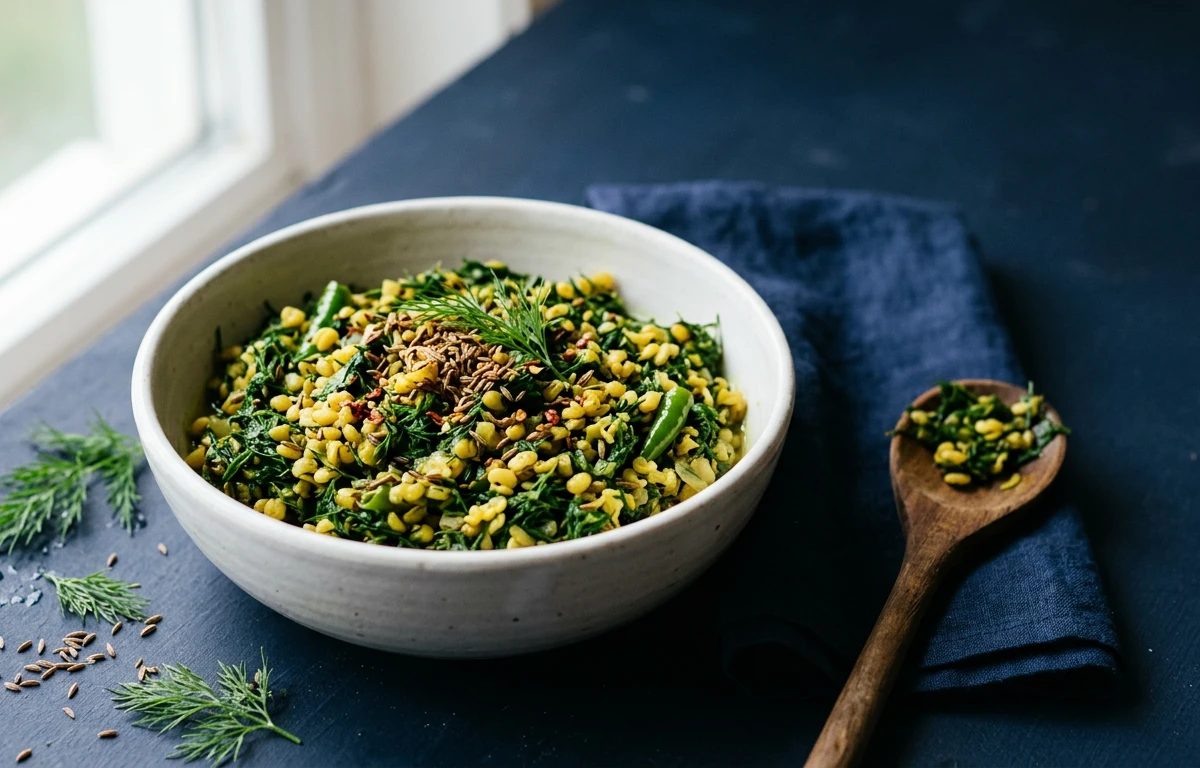
Shepu Bhaji with Moong Dal
A simple, homestyle Maharashtrian dish where fragrant fresh dill leaves are cooked with protein-packed yellow moong dal. Lightly spiced and mildly tangy, this dry-style sabzi comes together quickly and pairs beautifully with roti or steamed rice.
For 4 servings
- prep · ~32 min
Soak and cook the moong dal.
1.Wash the moong dal thoroughly under running water until water runs clear.2.Soak the dal in fresh water for 30 minutes, then drain completely.3.Add the soaked dal to a pressure cooker with 1/4 cup water and turmeric powder.4.Pressure cook on medium heat for 2 whistles or until soft but not mushy. Set aside.TIPDon't overcook the dal into a paste — the grains should hold their shape for a dry bhaji. - prep · ~5 min
Prep the dill leaves.
Pick the dill leaves, discard the thick stems, and wash them well. Roughly chop the fronds and tender stems.
- temper · ~3 min
Make the tempering.
1.Heat oil in a kadai over medium heat until shimmering.2.Add mustard seeds and let them pop completely (about 30 seconds).3.Add cumin seeds and asafoetida, letting them sizzle for 10 seconds.TIPMustard seeds should pop vigorously — if they don't, your oil isn't hot enough. - saute · ~9 min
Build the aromatic base.
1.Add chopped garlic and slit green chilies. Sauté until garlic turns light golden (1 minute).2.Add chopped onion and cook until translucent (3-4 minutes).3.Add chopped tomato and a pinch of salt. Cook until tomato softens and oil separates (3-4 minutes).TIPA small pinch of salt at this stage helps the tomatoes break down faster. - saute · ~4 min
Cook the dill leaves.
Add the chopped dill leaves to the pan. Stir well and cook for 3-4 minutes until they wilt completely and reduce in volume. The dill will release its aroma.
- mix · ~2 min
Combine dal with the dill mixture.
1.Add the cooked moong dal to the wilted dill mixture.2.Add the remaining salt, kokum pieces, and jaggery.3.Mix everything gently to avoid mashing the dal grains. - simmer · ~6 min
Simmer to marry the flavors.
Cover the pan and let it cook on low heat for 5 minutes. This allows the dill and lentil flavors to meld together. Remove the lid, check if any moisture remains, and cook for another minute on high heat to dry it out completely if needed.
TIPThe bhaji should be dry with no standing liquid. - garnish · ~1 min
Garnish and serve.
Transfer to a serving bowl. Sprinkle with fresh grated coconut and chopped coriander leaves. Serve hot with roti or steamed rice.
What to keep in mind.
6 tips from the recipe — small details that make a real difference to the final dish.
- 1Don't overcook the dal into a paste — cook just until soft but the grains remain intact.
- 2Pick tender dill stems for cooking; discard only thick woody ones for a better texture.
- 3Add a pinch of salt to the tomatoes while sautéing to help them break down faster.
- 4Kokum adds authentic Maharashtrian tanginess — soak it in warm water for a few minutes before using.
- 5For a drier bhaji, cook off any remaining moisture uncovered on high heat for the final minute.
- 6To make this dish in advance, store the bhaji without the fresh coconut garnish and add it just before serving.
Adapt it for your goals.
Vegan
This recipe is already vegan as written — the optional jaggery and fresh coconut are plant-based. No changes needed for a fully vegan dish.
low oilLow-oil
Reduce oil to 1 teaspoon and dry-roast the mustard and cumin seeds in the pan before adding the garlic — the moisture from the tomatoes and dal will keep the bhaji from sticking.
no kokum/tamarindNo-kokum/tamarind
Skip the kokum or tamarind and add a teaspoon of lemon juice at the end for a similar tangy finish; this is a common shortcut in some Maharashtrian homes.
protein boostProtein-boost
Add 1/4 cup of crumbled paneer or tofu in the final simmering step for extra protein without overpowering the delicate shepu flavor.
gluten freeGluten-free
The recipe is naturally gluten-free as written — just ensure your asafoetida brand is labeled gluten-free, as some commercial blends contain wheat flour.
Why this is on our healthy list.
High in Plant Protein
Moong dal is a rich source of plant-based protein and fiber, supporting muscle health and digestive regularity without the heaviness of animal proteins.
Rich in Antioxidants
Fresh dill (shepu) provides a good dose of flavonoids and essential oils that have antioxidant and anti-inflammatory properties.
Digestive Aid
Asafoetida and cumin seeds are traditional digestive aids in Indian cooking; they help reduce bloating and improve nutrient absorption from lentils.
Low in Fat
With only 2 teaspoons of oil and no cream or butter, this bhaji is a low-fat, cholesterol-free side dish suitable for heart-conscious diets.
Good Source of Vitamins
Dill leaves contain vitamin C and vitamin A, while tomatoes add additional lycopene — a powerful antioxidant for skin and immune health.
Frequently asked questions
Fresh dill is the heart of this dish — dried dill lacks the fragrant, grassy punch needed. Frozen dill is a better substitute if fresh is unavailable, but use double the quantity as it releases water.


