
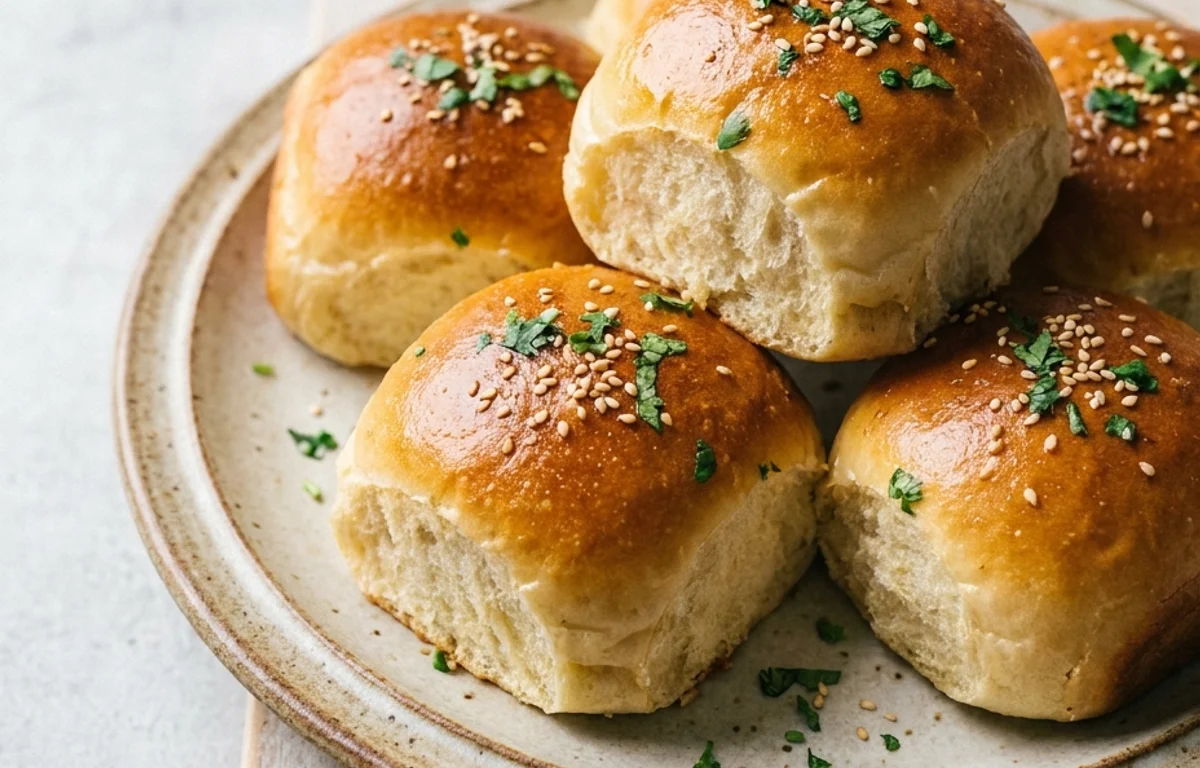
Soft Pav Buns
Soft, pillowy Indian dinner rolls with a golden-brown crust and a tender, melt-in-your-mouth crumb. These bakery-style pav buns are the perfect companion for pav bhaji, vada pav, or simply slathered with butter. A Mumbai street-food staple that's surprisingly simple to make at home.
For 8 servings
- prep · ~10 min
Activate the yeast.
1.In a small bowl, combine warm milk and sugar. Stir until sugar dissolves.2.Sprinkle instant yeast over the milk mixture and let it sit undisturbed for 10 minutes until frothy and bubbly.TIPMilk should be warm to the touch, not hot — about 110°F. Too hot will kill the yeast. - mix · ~1 min
Mix the dry ingredients.
In a large mixing bowl, combine all-purpose flour and salt. Whisk briefly to distribute the salt evenly.
- mix · ~3 min
Combine wet and dry ingredients.
1.Make a well in the center of the flour. Pour in the frothy yeast mixture and softened butter.2.Mix with your hands or a wooden spoon, gradually incorporating flour from the edges.3.Add warm water a tablespoon at a time until the dough comes together into a shaggy mass. - knead · ~12 min
Knead the dough until smooth and elastic.
1.Turn the dough onto a lightly floured surface.2.Knead by pushing, folding, and turning for 10 to 12 minutes until the dough is soft, smooth, and springs back when poked.3.The dough should pass the windowpane test — stretch a small piece; it should form a thin translucent membrane without tearing.TIPThis dough is enriched with butter and milk. Resist adding too much extra flour — a slightly sticky dough yields softer pav. - rest · ~70 min
First proof — let the dough double.
Place the dough in a greased bowl, turning once to coat. Cover with a damp kitchen towel and let it rise in a warm, draft-free spot for 60 to 75 minutes, or until doubled in size.
- prep · ~5 min
Punch down and shape the pav.
1.Gently punch down the risen dough to release air.2.Divide into 8 equal portions and roll each into a smooth, tight ball.3.Place the balls on a parchment-lined baking tray, arranged in 2 rows of 4 with about half an inch gap between them — they should be close enough to touch once risen. - rest · ~35 min
Second proof — let the shaped pav rise.
Cover the tray loosely with a kitchen towel and let the dough balls rise again for 30 to 35 minutes, until puffy and nearly doubled. Meanwhile, preheat the oven to 375°F (190°C).
- prep · ~1 min
Apply milk wash before baking.
Gently brush the tops of the risen pav buns with a little warm milk. This gives them a soft, golden-brown crust.
- bake · ~20 min
Bake until golden brown.
Bake in the preheated oven at 375°F (190°C) for 18 to 20 minutes, or until the tops are a deep golden brown and the buns sound hollow when tapped on the bottom.
TIPRotate the tray halfway through baking for even browning. If the tops brown too quickly, tent loosely with foil. - rest · ~10 min
Brush with butter and cool.
Remove from the oven and immediately brush the hot pav buns with softened butter for a soft, glossy crust. Let them cool on the tray for 10 minutes, then pull apart and serve warm.
TIPCover the baked pav with a clean kitchen towel as they cool — this traps steam and keeps the crust incredibly soft.
What to keep in mind.
7 tips from the recipe — small details that make a real difference to the final dish.
- 1Weigh your flour for consistent results; 3 cups is roughly 375 grams.
- 2If your kitchen is cool, proof the dough in the oven with the light on (turn the oven off first).
- 3Do not skip the windowpane test — under-kneaded dough will yield dense, bready pav.
- 4Arrange the shaped balls close together on the tray; the soft sides from touching create authentic tear-apart pav.
- 5For an extra-glossy crust, brush with melted butter twice — once right after baking and again after 5 minutes.
- 6Leftover pav stays fresh for 2 days in an airtight container at room temperature; reheat in a 300°F oven for 5 minutes.
- 7This dough can be refrigerated after the first proof and shaped the next day for deeper flavor.
Adapt it for your goals.
Whole-wheat pav
Replace 1 cup of all-purpose flour with whole-wheat flour and add an extra tablespoon of water for a nuttier, higher-fiber version.
Garlic butter pavGarlic butter pav
Mix 2 minced garlic cloves and a pinch of dried parsley into the butter before brushing the baked buns for a savory twist.
Vegan pavVegan pav
Substitute the milk with unsweetened almond milk and use vegan butter; the texture will be slightly lighter but still soft.
Why this is on our healthy list.
Source of quick energy
All-purpose flour provides carbohydrates that fuel your body, making these buns a good option before or after physical activity.
Contains calcium from milk
The warm milk in the dough contributes a modest amount of calcium, which supports bone health.
Moderately low in added sugar
With only 2 tablespoons of sugar for 8 rolls, these pav have minimal sweetness compared to many commercial buns.
Frequently asked questions
Most likely the dough was under-kneaded or over-floured. Knead until the windowpane test passes, and keep the dough slightly tacky.


