When you think of milk, you're probably picturing cow's milk. But the secret to the creamiest mozzarella, the richest kulfi, and the most luxurious cup of chai isn't from a cow. It's from a water buffalo. Indian buffalo milk is a different beast entirely: thicker, creamier, and packing a lot more nutrition into every drop. It's not just 'fattier milk' — its unique composition of higher protein and fat makes it behave differently in your body and in the kitchen.
↑ Buffalo milk is naturally creamier and higher in milk solids.
Not your average milk
Buffalo milk is, quite simply, richer. It has a higher concentration of everything: fat, protein, and natural sugars, which means it has a lower water content. This is why it feels so much more substantial and creamy in the mouth compared to the thinner consistency of most cow's milk.
That richness is also why it's prized by chefs and home cooks. The high butterfat content makes it ideal for producing dairy products like ghee, paneer, and yogurt that are naturally thick and stable without needing additives. It's a workhorse in the kitchen, but how does it stack up as a glass of milk?
IN ONE LINE
Thicker, creamier, and with more protein, fat, and calories than cow's milk, buffalo milk is a nutrient-dense choice best enjoyed with portion size in mind.
Buffalo milk nutrition facts
Here's the nutritional breakdown for a 100g serving of Indian buffalo milk, which is a little less than half a cup.
The two numbers that jump out are the protein and fat. At 3.8g and 7.5g respectively, they are significantly higher than typical whole cow's milk (which is usually around 3.2g protein and 3.5g fat). This combination is what makes buffalo milk more calorie-dense and also more satiating.
Buffalo milk's glycemic index
Glycemic index (GI) tells us how quickly a food's carbohydrates raise blood sugar. While there isn't one single, universally cited GI value for buffalo milk, we can make a very confident estimation. All plain milk is considered low-GI.
The reason is simple: the carbohydrate in milk is lactose, and it arrives packaged with plenty of protein and fat. Both protein and fat dramatically slow down digestion and the rate at which sugar enters the bloodstream. Given that buffalo milk has even more fat and protein than cow's milk, its glycemic impact is guaranteed to be low.
Don't confuse plain milk with sweetened products. A mango lassi or flavored milk drink is a dessert, and its glycemic index will be much, much higher.
Buffalo milk has a low glycemic impact
Its low carbohydrate content and high fat and protein levels place buffalo milk firmly in the low-GI category, meaning it provides steady energy without a significant blood sugar spike. It would sit comfortably at the very low end of the scale.
GLYCEMIC INDEX · BUFFALO MILK vs COMMON FOODS
Buffalo milk sits in the low-GI band
Apple
whole fruit
LOW
Mango
whole fruit
LOW
Pineapple
whole fruit
MEDIUM
White bread
refined
HIGH
Cornflakes
refined
HIGH
SCALE 0–90
04590
The smart way to use it
Because it's so rich, you use buffalo milk a little differently. It's less of a thirst-quencher and more of a potent ingredient.
01
Think small portions.
It's nearly 100 calories per 100g. Use it as a creamer in coffee or a small base for a smoothie, not by the large glassful if you're watching calories.
02
Leverage its creaminess.
It makes the best homemade yogurt (dahi) — thick and rich without any straining or additives. It's also perfect for rich sauces or soups.
03
Upgrade your hot drinks.
A splash in chai or coffee adds a luxurious mouthfeel that low-fat milks just can't replicate.
04
Make better desserts.
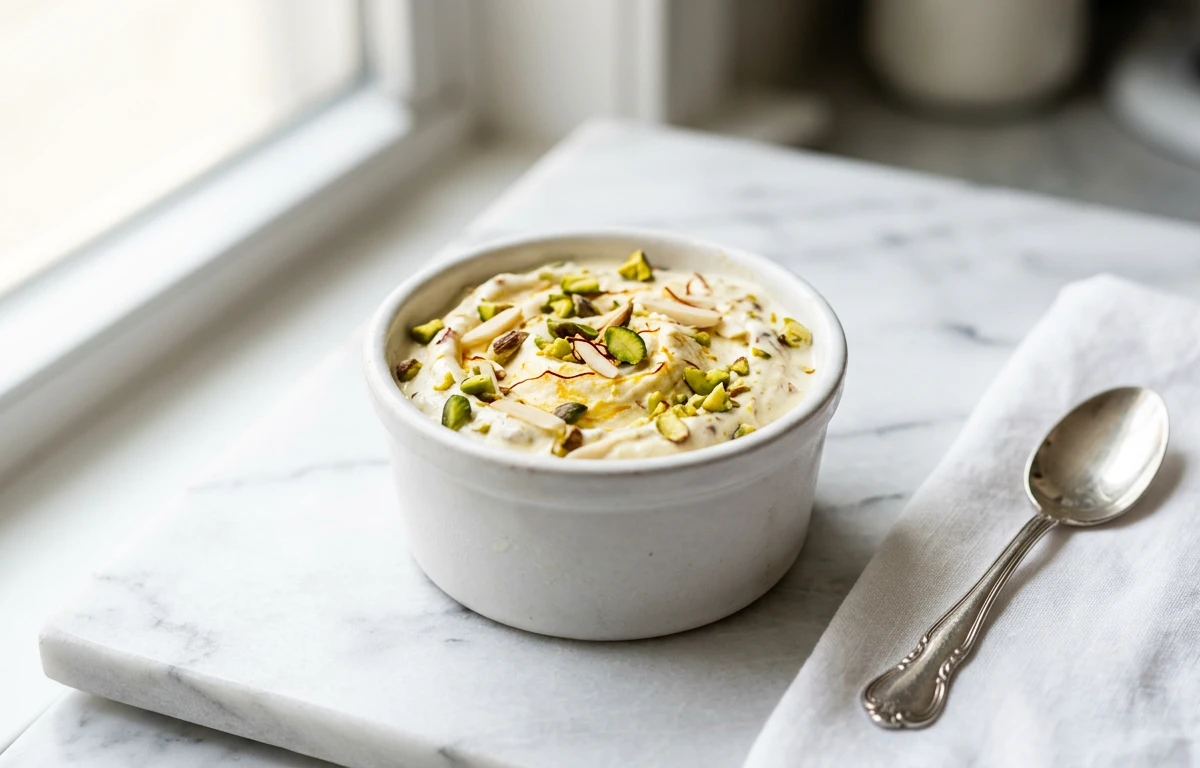
It's the traditional, and best, choice for dense, creamy Indian desserts like kulfi, rabri, and payasam.
05
Always choose plain.
The nutritional benefits are in the plain, unsweetened milk. Flavored or sweetened versions are effectively liquid desserts.
What buffalo milk is good for
01
More Satiating Protein
With about 20% more protein than cow's milk, it helps you feel fuller for longer and supports muscle health.
3.8g
protein / 100g
02
Rich in Healthy Fats
The high fat content provides sustained energy and is essential for absorbing fat-soluble vitamins. It's what makes the milk so satisfying.
7.5g
fat / 100g
03
Nutrient Density
It packs more calories, protein, fat, and minerals like calcium and phosphorus into a smaller volume. This is great for athletes or those needing to gain weight.
97
calories / 100g
04
Superior for Cooking
The higher percentage of milk solids means you get a better yield and creamier texture when making cheese, yogurt, or ghee.
Low
water content
05
Low Glycemic Energy
With very few carbs and plenty of fat and protein to buffer them, it provides steady energy without the blood sugar rollercoaster.
4.9g
carbs / 100g
How to use buffalo milk
Buffalo milk isn't just for drinking. Its richness makes it a fantastic ingredient that transforms other foods.
Drink freely — or be mindful?
Three ways to use it
Go beyond just drinking it. Here are three simple ways to let buffalo milk's unique properties shine.
.webp)

Want rich, satisfying meals worked into a balanced week?
Our meal planner can incorporate nutrient-dense foods like full-fat dairy into a plan where portions and macros are already calculated for you, complete with a single grocery list.
Build my weekly plan →SOURCES & REFERENCES · 3
One more thing
Eating well is rarely about willpower. It’s about having a short list of dinners you actually want to eat. Pick two from this list. Make them next week. The rest will follow.
If you want these on autopilot, our weekly meal planner can drop the picks above into your calendar with one click and build a single grocery list from the merged ingredients.
FREQUENTLY ASKED QUESTIONS
Frequently asked questions
Is buffalo milk healthier than cow's milk?
It's not 'healthier' or 'unhealthier'—it's different. Buffalo milk has more protein, fat, calories, and calcium. If your goal is nutrient density, it's superior. If your goal is lower calories and fat, cow's milk is a better choice. 'Healthy' depends entirely on your personal dietary needs.
Can I drink buffalo milk if I'm lactose intolerant?
Almost certainly not. Buffalo milk contains lactose, just like cow's milk. The symptoms of lactose intolerance will be the same. It is not a suitable alternative for a lactose-free diet.
Does buffalo milk cause weight gain?
Any food can cause weight gain if consumed in excess. Because buffalo milk is significantly more calorie-dense than cow's milk (97 vs. ~60 calories per 100g), it's easier to consume a surplus of calories. Portion control is essential if weight management is a concern.
Why is buffalo milk white and not yellowish?
Unlike cow's milk, buffalo milk lacks beta-carotene (the pigment that gives a yellowish tint to cream and butter). Buffalo can convert beta-carotene into Vitamin A, so the vitamin is still present, but the pigment is not, resulting in a stark white color.

ABOUT THE AUTHOR
Shreya Chatterjee
NUTRITION WRITER
Shreya is a nutrition writer and the voice behind The Nutrition Pen, where she turns evidence-based nutrition into simple, repeatable eating habits. Her writing focuses on practical food guidance — what to actually put on the plate — for readers who want to eat well without the noise.
Meet the editorial team →METHODOLOGY
How this article was created
Built using verified nutrition databases, culinary research, and traditional cooking knowledge — every claim is cross-referenced against the sources listed in the article.
· USDA data· Culinary research· Quality reviewed
Read our methodology →TRANSPARENCY
About this content
Articles are curated using trusted food databases (USDA FoodData Central, IFCT), culinary literature, and dietary guidelines, then structured by our editorial team for clarity, accuracy, and usefulness.
· Verified data sources· Culinary research· Quality reviewed
Read our editorial policy →RELATED RECIPES
Cook from this article
EXPLORE OUR MEALS
Meals that fit this article

AMERICAN · 1677 CAL
Almonds with Sliced Apple + supplement + iron

MEDITERRANEAN · 809 CAL
Greek Yogurt with Berries Almonds and Granola + supplement + iron

GENERAL_HEALTHY · 705 CAL
Banana with Peanut Butter Pregnancy + supplement + iron

MODERN · 982 CAL
Hummus with Crudits and Pita with Fresh Orange Snack + supplement + iron
TAGGED
KEEP READING