FIRST, THE FINE PRINT
This is general education, not a prescription. Diabetes is individual — medications, especially insulin and sulfonylureas, change what’s safe for you. Use this to have a better conversation with your doctor or dietitian, not to replace one.
Why the plate matters more than the list
Most diabetes advice arrives as a list of villains: no sugar, no white rice, no potatoes, no fruit. Lists like that are easy to print and almost impossible to live by, because they tell you what to fear without telling you what to actually eat. They also miss the real mechanism. Blood sugar doesn’t respond to a single food in isolation — it responds to the whole meal: how much carbohydrate is on the plate, and what fiber, protein, and fat are sitting next to it to slow everything down.
That’s why the modern, evidence-based approach is built around the structure of a plate rather than a banned-foods list. Get the proportions right — plenty of non-starchy vegetables, a solid serving of protein, a controlled portion of high-quality carbohydrate — and you blunt the spike automatically, without weighing every gram. The list shrinks to a handful of genuine "limit" items, and almost everything else becomes a question of portion and pairing, not permission.
THE CORE IDEA
It’s not “which foods are banned.” It’s “how much carbohydrate, and what’s next to it.” Fiber, protein, and fat slow digestion and flatten the blood-sugar curve — so a smart plate does the heavy lifting that a willpower list never could.
The diabetes plate method
The single most useful tool in diabetes eating needs no app and no scale — just a standard nine-inch dinner plate, divided into three. It’s the method taught in diabetes education programs because it controls carbohydrate by geometry instead of arithmetic. Fill the plate this way and the portion of blood-sugar-raising food is capped before you’ve counted a thing.
50%
Non-starchy veg
Leafy greens, broccoli, peppers, tomatoes, cauliflower — fiber and volume, almost no blood-sugar impact
25%
Lean protein
Fish, chicken, eggs, tofu, paneer, beans, lentils — slows digestion, builds fullness
25%
Quality carbs
Whole grains, beans, starchy veg, fruit — kept to a quarter of the plate
Half the plate is the part people skip and the part that does the most work: non-starchy vegetables bring fiber, water, and volume that fill you up for almost no glucose cost. A quarter goes to protein, which steadies appetite and blunts the post-meal rise. The last quarter — and only a quarter — is your carbohydrate: rice, roti, bread, potato, or fruit. Same foods you already eat; the structure is what changes. Add water or an unsweetened drink and you have a complete, blood-sugar-friendly meal.
WHY IT WORKS
By capping carbohydrate at a quarter of the plate and surrounding it with fiber and protein, the plate method limits both the amount of glucose and the speed it arrives — the two things that drive a spike — without a single calculation.
What to eat, what to limit
Here’s the honest reference table. The verdict column isn’t about “good” and “bad” foods — it’s about how easily each fits the plate. "Best" foods you can build meals around freely; "OK" foods belong in that quarter-plate carb slot in sensible portions; "Limit" foods spike fast and are worth keeping occasional. Glycemic load (GL) reflects the real-world blood-sugar hit of a normal serving, which matters more than glycemic index alone.
Non-starchy vegetables
Greens, broccoli, peppers, beans
Low
High
Very low GL
best
Lentils, beans & chickpeas
Protein + fiber + slow carbs
Med
High
Low GL
best
Whole grains (oats, barley, quinoa)
Intact fiber slows the rise
Med
High
Low–Med GL
good
Whole fruit (berries, apple, pear)
Fiber intact; eat whole, not juiced
Low–Med
Med
Low–Med GL
good
Brown / parboiled rice, whole roti
Better than white; still a carb
Med
Med
Med GL
good
White rice, white bread, potato
Fine in a quarter-plate portion
Med
Low
High GL
ok
Sugary drinks, juice, sweets
Fast glucose, little fullness
High
None
Very high GL
limit
Refined snacks & fried packaged food
Spikes plus empty calories
High
Low
High GL
limit
THE ONE SWAP THAT MATTERS MOST
If you change a single thing, drink your sugar less. Sugary drinks and juice deliver fast glucose with no fiber to slow it and no fullness to show for it. Swapping them for water, unsweetened tea, or whole fruit is the highest-impact, lowest-effort move there is.
The building blocks of every meal
Once the plate method is second nature, building any meal comes down to choosing one item from each of four buckets. Mix and match these and you can make hundreds of diabetes-friendly meals without ever following a recipe.
01Pile on non-starchy vegetables
Make these the base and the bulk — half the plate, every meal. Leafy greens, broccoli, cauliflower, peppers, green beans, tomatoes, cucumber, mushrooms. Fiber and volume for almost no glucose.
02Anchor with protein
A palm-sized portion at each meal: fish, chicken, eggs, tofu, paneer, Greek yogurt, or — doing double duty — beans and lentils. Protein steadies appetite and softens the post-meal rise.
03Choose high-fiber, slow carbs
Keep carbs to a quarter-plate and make them whole: oats, barley, quinoa, whole-wheat roti, brown or parboiled rice, sweet potato, beans. The intact fiber is what makes them "slow."
04Add a little healthy fat
Olive oil, nuts, seeds, avocado, oily fish. Fat slows stomach emptying and adds satiety — a drizzle or a handful, not a flood, since it’s calorie-dense.
½ plate
non-starchy vegetables at lunch & dinner
25–35g
daily fiber target for steadier blood sugar
¼ plate
the cap on carbohydrate per meal
Every meal
should contain a protein source
A full 7-day menu
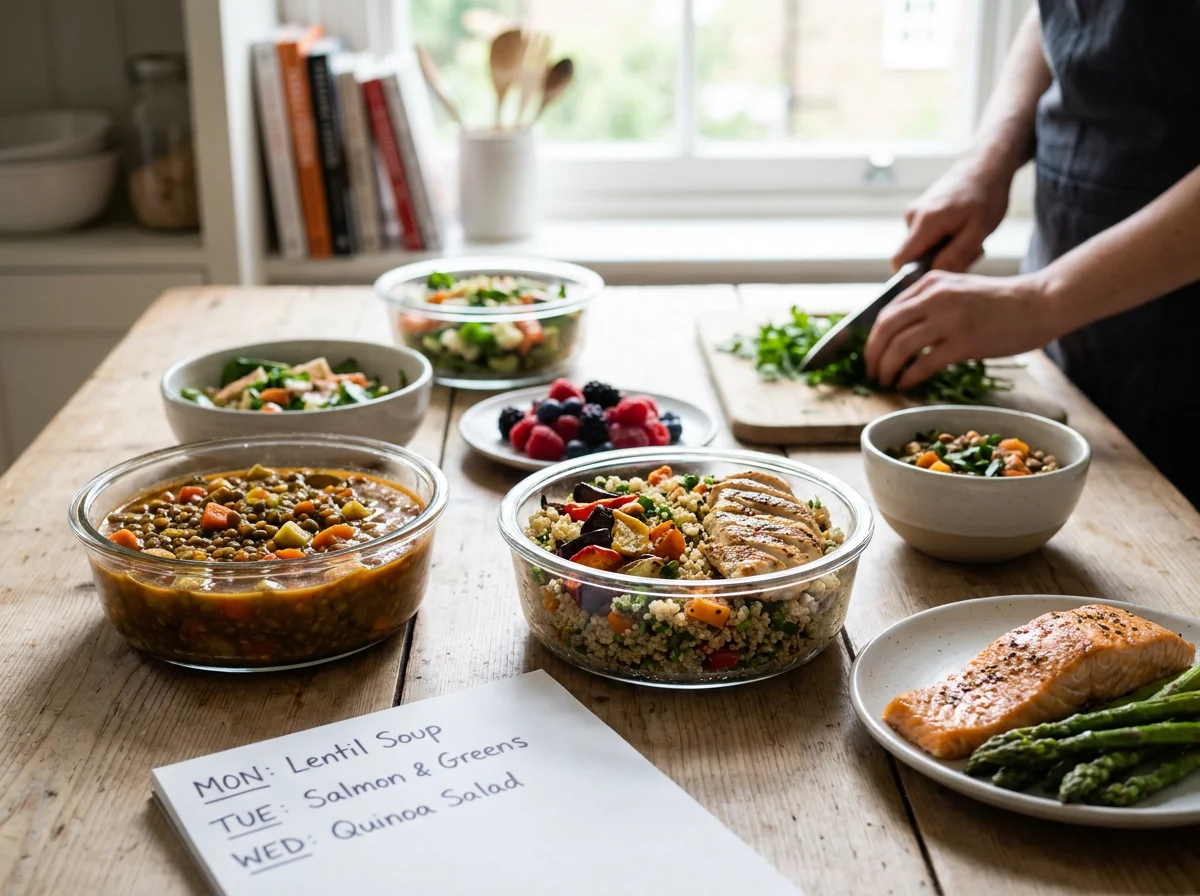
Here’s a week that puts all of it together — balanced plates, fiber-rich carbs in controlled portions, protein at every meal, and a snack that won’t spike you. It’s a template, not a rule: swap in the vegetables and proteins you actually like, and scale portions to the carbohydrate target your dietitian set for you. Notice the rhythm more than the specifics — every day follows the same shape.
Mondaybalanced plate
BREAKFAST
Veggie omelette (2 eggs, spinach, tomato) + 1 slice whole-grain toast
LUNCH
Big chickpea & greens salad, olive-oil-lemon dressing, ¼-plate quinoa
DINNER
Baked fish, half-plate roasted vegetables, ½ cup brown rice
SNACK
Greek yogurt with a few berries
Tuesdayplant-forward
BREAKFAST
Steel-cut oats with chia, cinnamon & a handful of berries
LUNCH
Lentil soup, side salad, 1 small whole-wheat roti
DINNER
Tofu & vegetable stir-fry, ½ cup brown rice
SNACK
A small apple with a few almonds
Wednesdayclassic comfort
BREAKFAST
Greek yogurt, ground flaxseed, walnuts & sliced pear
LUNCH
Grilled chicken, big mixed salad, ¼-plate sweet potato
DINNER
Rajma (kidney beans), sautéed greens, 1 small roti
SNACK
Carrot & cucumber sticks with hummus
Thursdayquick & easy
BREAKFAST
Vegetable besan chilla (2) with mint chutney
LUNCH
Tuna or paneer salad bowl, lots of leaves, ¼-plate barley
DINNER
Chicken or chickpea curry (light oil), cauliflower rice + ½ cup brown rice
SNACK
A boiled egg; herbal tea
Fridayfish night
BREAKFAST
Smashed avocado on 1 slice rye, 2 poached eggs, tomato
LUNCH
Big bean & roasted-veg bowl, olive oil, lemon
DINNER
Baked salmon, half-plate broccoli & green beans, ½ cup quinoa
SNACK
A square of dark chocolate; a few nuts
Saturdayrelaxed
BREAKFAST
Vegetable upma (light oil) with peanuts; black coffee
LUNCH
Grilled paneer or chicken tikka, large kachumber salad, 1 roti
DINNER
Mixed-vegetable & lentil khichdi, side of yogurt & salad
SNACK
A small bowl of berries
Sundaymeal-prep day
BREAKFAST
Tofu or egg scramble with peppers, onions & mushrooms
LUNCH
Big mixed salad with beans, seeds, olive oil; ¼-plate sweet potato
DINNER
Roast chicken or stuffed peppers, half-plate greens, ½ cup wild rice
SNACK
Greek yogurt with cinnamon
NOTICE THE PATTERN
Every single day has vegetables at the center, a protein at each meal, carbs in a controlled portion, and a snack pairing carbohydrate with protein or fat. That repeating shape — not any one "diabetic recipe" — is what keeps blood sugar steady.
Carbs & portions, made simple
You don’t have to count carbohydrate grams to eat well with diabetes — the plate method handles most of it — but a rough sense of portions helps, especially for the foods that raise blood sugar most. These are everyday visual guides, not laboratory measures. Your own target depends on your medication, activity, and what your glucose readings show, so treat these as a sensible starting point to discuss with your care team.
Cooked rice / pasta
½–1 cupper meal
About a cupped handful; favor brown or parboiled
Roti / bread
1–2small
Whole-wheat; pair with dal or vegetables, not alone
Potato / sweet potato
1 smallfist-size
Counts as your carb portion, not a "free" vegetable
Whole fruit
1 pieceor ¾ cup
Eat whole for the fiber; never as juice
Beans / lentils
½–1 cupcooked
Carb + protein + fiber — the all-rounder
Nuts
25–30gsmall handful
A healthy fat, but calorie-dense — portion it
A USEFUL TRICK
Eat in the right order — vegetables and protein first, the carbohydrate last. Several studies suggest that finishing the meal with the starch, rather than starting with it, produces a noticeably gentler blood-sugar rise from the very same plate.
“My patients who do best almost never talk about foods they’ve "given up." They talk about a plate that became automatic — half vegetables, a protein, a small carb — so that eating well stopped requiring a decision at every meal.
— Dr. Lena Hoff, RD
Beyond the plate: timing & habits
What you eat is most of the picture, but a few habits around the food make a real, measurable difference to blood sugar — and they cost nothing.
01Keep meals roughly regular.
Eating at fairly consistent times helps your body — and your medication — manage glucose more predictably. Skipping meals can backfire, driving both lows and rebound overeating, especially on blood-sugar-lowering medication.
02Walk after you eat.
Even a 10–15 minute walk after a meal helps your muscles pull glucose out of the bloodstream, blunting the post-meal spike. It’s one of the most effective free tools you have.
03Pair every carb with a partner.
Never eat a carbohydrate naked. Fruit with nuts, toast with eggs, rice with dal and vegetables — the protein, fat, or fiber alongside slows the glucose down.
04Don’t drink your calories.
Sugary drinks and juice are the fastest route to a spike. Make water, unsweetened tea or coffee, and sparkling water your defaults; keep sweet drinks for genuine treats.
05Prioritize sleep and stress.
Short sleep and chronic stress both raise blood sugar through hormones, independent of food. They’re part of diabetes management, not a side issue.
06Use your meter to learn.
If you test, check before and about two hours after a new meal occasionally. Your own readings teach you which meals suit you better than any general list ever could.
Where your care team comes in
Food is powerful, but diabetes is a medical condition and this article can’t know your particular situation. Some details genuinely require a professional, and a few are matters of safety — especially if you take medication that can lower blood sugar too far.
01Before big diet changes on medication
If you take insulin or sulfonylureas, eating noticeably fewer carbs can cause hypoglycemia (low blood sugar) unless your doses are adjusted. Change the plan with your doctor, not ahead of them.
02For your personal carb target
There’s no single "right" carbohydrate amount for everyone with diabetes. A dietitian can set a target tailored to your body, medication, activity, and culture — and to the foods you actually want to eat.
03If you have other conditions
Kidney disease, heart disease, pregnancy (including gestational diabetes), and other issues change the recommendations. General advice may not be right — and could be wrong — for you.
04When readings stay high or swing wildly
Persistently high numbers, frequent lows, or unexplained swings are a signal to check in, not to white-knuckle it. They often mean the treatment plan — not your willpower — needs adjusting.
THE REASSURING TRUTH
Diabetes-friendly eating is not exotic or punishing. It’s a well-built version of food everyone benefits from — more vegetables, more fiber, protein at each meal, fewer sugary drinks. Get the plate right and you’re most of the way there.
Frequently asked questions
Get a diabetes-friendly week, built for you
Tell our planner your preferences and goals and it builds balanced, fiber-forward plates with carbohydrate kept in check — portions worked out, a grocery list ready, and your favorite foods still on the table. Steady blood sugar, without the daily guesswork.
Build my balanced week →