Let's be honest: dragon fruit looks like it's all style and no substance. That sci-fi exterior and shockingly pink flesh seem designed for Instagram, not for your actual kitchen. But behind the wild look is a surprisingly gentle, down-to-earth fruit. It's mild, low in sugar, and packs a genuinely useful amount of fiber. Forget the hype — dragon fruit's real value is in its quiet, steady nutritional profile.
↑ Dragon fruit's real magic isn't its looks, but its high-fiber, low-calorie profile.
The gentle giant of the fruit aisle
Dragon fruit, also known as pitaya, has a reputation for being bland. And it's true, it doesn't have the sugary punch of a mango or the sharp tang of a pineapple. The taste is mild, somewhere between a kiwi and a pear. But calling it bland misses the point. Its strength isn't a loud flavor, but a quiet, incredibly useful nutritional profile.
It's mostly water, very low in calories, and delivers a solid dose of fiber — including prebiotics that your gut bacteria love. It's one of the most versatile and easy-going fruits you can eat, especially if you're managing blood sugar or watching your weight.
IN ONE LINE
Dragon fruit is a low-calorie, high-fiber fruit with a low glycemic index, making it a fantastic choice for gut health, blood sugar management, and weight control.
Dragon fruit nutrition facts
Here's the nutritional breakdown for a 100-gram serving, which is about half of a typical medium-sized dragon fruit.
The two numbers that really matter here are the calories (just 60) and the fiber (a solid 3 grams). That combination of low energy density and high fiber is what makes dragon fruit so filling and satisfying for so few calories. The 10% daily value for magnesium is a nice bonus, as it's a mineral many of us don't get enough of.
Dragon fruit's glycemic index
While there isn't one single, universally agreed-upon GI value for dragon fruit, its nutritional profile—high in fiber and water, low in sugar—places it firmly in the 'low' glycemic index category. Foods with a GI under 55 are considered low, and dragon fruit almost certainly falls well below that mark.
This means it releases its sugar into the bloodstream slowly and steadily, avoiding the sharp spikes and crashes you get from refined carbs or sugary drinks. For anyone with diabetes or just looking for stable energy, it's an excellent choice.
GLYCEMIC INDEX · DRAGON FRUIT vs COMMON FOODS
Dragon fruit is a low-glycemic choice
Cherries
whole fruit
LOW
Dragon Fruit
whole fruit
LOW
Apple
whole fruit
LOW
Pineapple
whole fruit
MEDIUM
Watermelon
whole fruit
HIGH
SCALE 0–90
04590
How to choose and eat it
Getting into a dragon fruit is easier than it looks. No special tools required.
01
Choose a bright one.
Look for a fruit with vibrant, evenly colored skin. A few blemishes are fine, but avoid ones that are bruised, shriveled, or have lots of brown spots.
02
Give it a gentle press.
It should give slightly, like a ripe avocado or kiwi. If it's rock-hard, it's underripe; if it's mushy, it's past its prime.
03
Slice and scoop.
The easiest way is to slice it in half lengthwise. From there, you can scoop the flesh out with a spoon, or run a knife between the flesh and the skin to free it.
04
Don't eat the skin.
The leathery, bright pink skin is not edible. Just enjoy the white or red flesh dotted with tiny, edible black seeds.
05
Dice it or cube it.
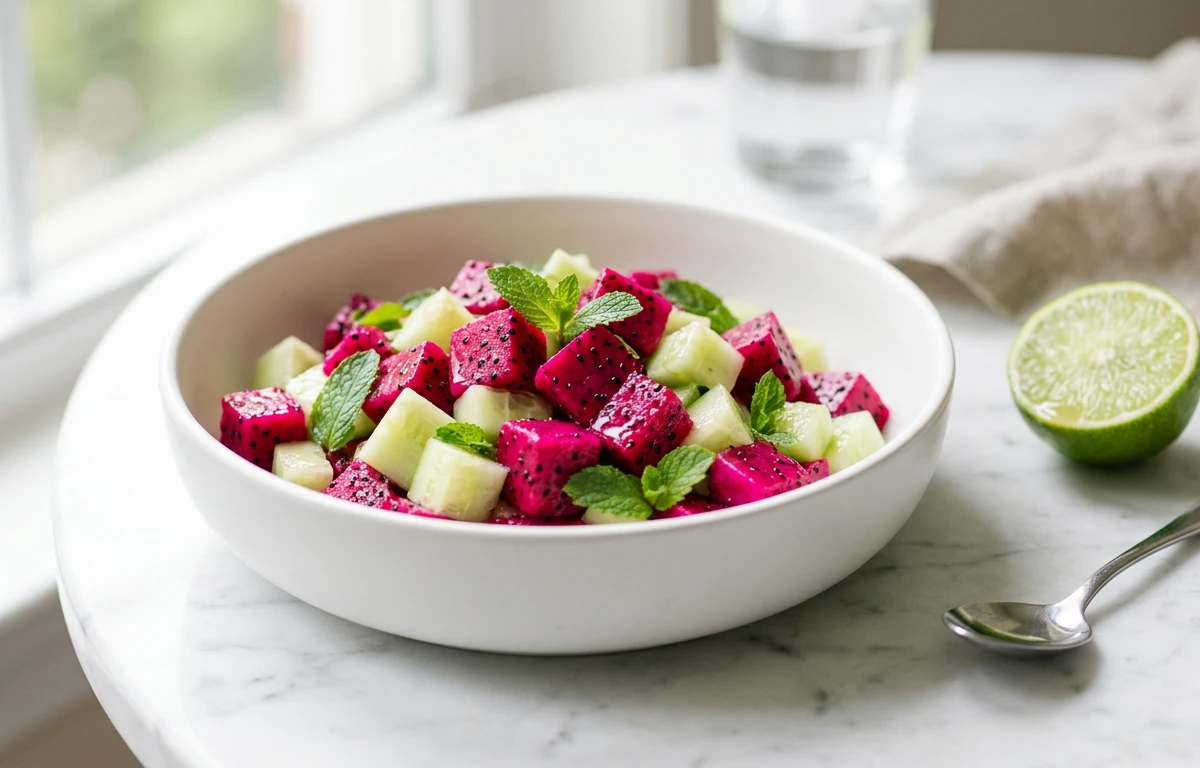
Once scooped, you can dice it for salads, smoothies, or yogurt bowls. The seeds are perfectly fine to eat and add a little crunch, like in a kiwi.
What dragon fruit is good for
01
Excellent for gut health
Dragon fruit is rich in fiber, including specific carbohydrates called oligosaccharides which act as prebiotics. These feed the good bacteria in your gut.
3 g
fiber
02
Aids in weight management
At just 60 calories per 100g and high in fiber and water, it's a very filling food. It helps you feel full on fewer calories, making it a great ally for weight control.
60
calories
03
Supports stable blood sugar
The combination of high fiber and a low glycemic index means dragon fruit helps prevent blood sugar spikes, providing a slow, steady release of energy.
Low
glycemic
04
Provides key antioxidants
The red and pink varieties are particularly rich in betacyanins, the same powerful antioxidants found in beets, which help fight oxidative stress.
Rich
antioxidants
05
A surprising source of magnesium
One serving provides about 10% of your daily magnesium, a crucial mineral for over 300 bodily functions, including muscle function, nerve health, and bone density.
10%
magnesium DV
What to pair dragon fruit with
Its mild flavor makes dragon fruit a team player. It won't overpower other ingredients, so you can pair it with almost anything.
Who should eat it?
Three simple recipes
Three easy ways to enjoy dragon fruit that go beyond just slicing and eating.


Want more smart food choices, made simple?
Our meal planner incorporates fiber-rich, low-GI fruits like dragon fruit into balanced weekly plans. Get the benefits without the guesswork, with calculated macros and a single grocery list.
Build my weekly plan →SOURCES & REFERENCES · 3
One more thing
Eating well is rarely about willpower. It’s about having a short list of dinners you actually want to eat. Pick two from this list. Make them next week. The rest will follow.
If you want these on autopilot, our weekly meal planner can drop the picks above into your calendar with one click and build a single grocery list from the merged ingredients.
FREQUENTLY ASKED QUESTIONS
Frequently asked questions
Is dragon fruit good for weight loss?
Yes, it's an excellent food for weight loss. It is very low in calories (about 60 per 100g) but high in fiber, which helps you feel full and satisfied, reducing the likelihood of overeating.
Does dragon fruit help with constipation?
Yes, it can be very effective. The 3 grams of fiber per 100g serving, along with its high water content, helps to promote regular bowel movements and relieve constipation.
What does dragon fruit taste like?
Dragon fruit has a very mild flavor, often described as a cross between a kiwi and a pear. The texture is soft, and the small black seeds are edible and provide a slight crunch, similar to a kiwi.
Which color dragon fruit is healthier, red or white?
Both are nutritionally similar and very healthy. However, the red-fleshed variety contains more antioxidants, specifically betacyanins, which give it its vibrant color and may offer additional anti-inflammatory benefits.
Can you eat the skin of a dragon fruit?
No, the skin of a dragon fruit is tough, leathery, and not considered edible. It should be discarded. Only the flesh and seeds inside are eaten.
METHODOLOGY
How this article was created
Built using verified nutrition databases, culinary research, and traditional cooking knowledge — every claim is cross-referenced against the sources listed in the article.
· USDA data· Culinary research· Quality reviewed
Read our methodology →TRANSPARENCY
About this content
Articles are curated using trusted food databases (USDA FoodData Central, IFCT), culinary literature, and dietary guidelines, then structured by our editorial team for clarity, accuracy, and usefulness.
· Verified data sources· Culinary research· Quality reviewed
Read our editorial policy →EXPLORE OUR MEALS
Meals that fit this article

AMERICAN · 1677 CAL
Almonds with Sliced Apple + supplement + iron

MEDITERRANEAN · 809 CAL
Greek Yogurt with Berries Almonds and Granola + supplement + iron

GENERAL_HEALTHY · 705 CAL
Banana with Peanut Butter Pregnancy + supplement + iron

MODERN · 982 CAL
Hummus with Crudits and Pita with Fresh Orange Snack + supplement + iron
TAGGED
KEEP READING