The Healthiest Indian Takeaway in the UK: What to Order at the Curry House
A UK curry-house ordering guide using Action on Salt, NHS and BHF numbers: which mains, sauces and sides keep a takeaway under 800 kcal and 3g of salt.
By Sourabh Garg, Content Creator
May 31, 2026 · Reviewed May 2026 · Updated Jun 2026
A Friday-night curry from a British Indian restaurant — what the trade calls a BIR — is one of the most-ordered takeaways in the UK. It is also one of the saltiest things most people eat in a week. The campaign group Action on Salt sampled 50 chicken tikka masalas with pilau and found the worst contained 6.81g of salt in a single portion; once you add a poppadom, chutney, a side and a naan, a typical takeaway can clear 20g of salt — more than three times the 6g daily ceiling that the UK Scientific Advisory Committee on Nutrition and the NHS recommend for adults [1][2][3].
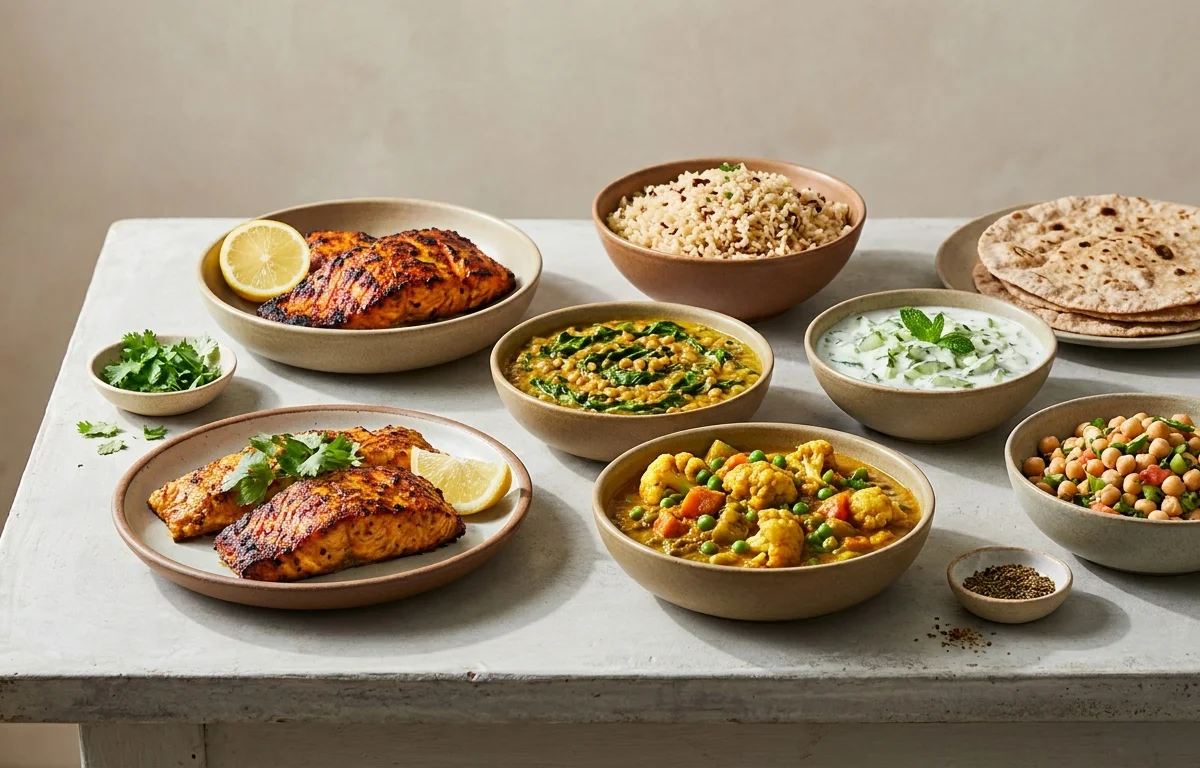
The good news is that the same menu also contains the lightest mains you will find in any cuisine. Tandoori dishes are dry-roasted in a clay oven so most of the fat drips away, and tomato-based curries — jalfrezi, madras, rogan josh, bhuna — run roughly 200-300 kcal per portion against 600-800 for the cream- and coconut-based korma, pasanda and butter chicken [4][5]. This guide is the ordering pattern, not a list of forbidden foods: which main, which sauce family, which side, what to say at the counter, and where the hidden salt actually lives.
Most British Indian takeaway menus are 70 percent creamy curries, fried starters and oil-cooked rice, and the conventional Friday-night order — tikka masala, pilau, naan, poppadom, chutney — can deliver more than three days of an adult's salt limit in one meal. The same menu also contains the lightest mains on offer in any cuisine. The fix is not to stop ordering Indian; it is to learn which side of the menu you are ordering from.
The four UK numbers to hold in your head
6 g
UK adult daily salt ceiling — SACN, endorsed by NHS [2][3]
6.81 g
salt in one chicken tikka masala portion — worst sample, Action on Salt curries survey [1]
20+ g
salt in a full takeaway with rice, naan, side and chutney — more than 3 days of UK ceiling [1][3]
~600 kcal
calorie gap between a chicken jalfrezi (~480) and a chicken tikka masala (~800-1,200) [4][5]
Why a BIR menu drifts heavy and salty
The British-Indian-Restaurant menu evolved in the 1960s and 70s to suit a British palate trained on cream, butter and big portions. Many kitchens build the entire savoury line off two or three large-batch base gravies — a 'curry base' and a 'masala base' — that are pre-seasoned for salt and pre-thickened with cream, ghee or coconut. A korma, a pasanda and a butter chicken share more of their fat and salt content with each other than the menu suggests; the protein and the spicing change, the base does not.
What that means for an ordering guide is that the lever you actually have is the sauce family, not the dish name. Once you pick a tandoori, a tomato-onion gravy or a pulse-based dish, you have already done most of the work — the rest is a question of how many carbs and how many salty extras you stack on top.
Common BIR mains, ranked light to heavy
1
Tandoori chicken (4 pieces, no sauce)~350-450 kcalhigh protein, low fat
Dry-roasted in the clay oven; most of the fat drips off. The headline winner. Best paired with kachumber and mint raita, not chips or pilau.
2
Fish tikka or paneer tikka~300-450 kcalno creamy sauce
Same dry-heat advantage as tandoori chicken. Paneer tikka is the best vegetarian main on most BIR menus — high in protein and calcium, low in added fat.
3
Chana masala / dal tadka~350-500 kcalhigh fibre + plant protein
Pulse-based dishes give the longest satiety for the lowest calorie cost. Ask whether ghee or oil is used in the tadka — many kitchens will switch on request.
The NHS-recommended tomato-based curries. Chicken jalfrezi is roughly 480 kcal versus 800+ for chicken tikka masala in the same kitchen [4][5].
5
Chicken rogan josh / dopiaza~500-700 kcalyogurt + tomato base
Slightly heavier than jalfrezi because of yogurt enrichment, but still significantly lighter than cream-based curries.
6
Chicken saag / palak paneer~500-700 kcalspinach-based; check for cream
Built on spinach rather than cream — but some BIR kitchens finish with double cream. Ask. Saag chicken made with yogurt is one of the cleanest creamy-style dishes available.
7
Chicken tikka masala~800-1,200 kcal1.8-6.81 g salt per portion [1]
Britain's most-ordered curry, and a textbook study in cream + butter + tomato + cashew. Action on Salt sampled portions over 6.8 g of salt — more than a day's allowance in one dish.
Coconut cream, double cream and cashew paste. Vegetable korma is not lighter than chicken korma — the cream is the load, not the protein.
The four sauce families on a BIR menu
Dry-heat (tandoori, tikka)
Tandoori chicken, paneer tikka, fish tikka, seekh kebab. The leanest mains on the menu. NHS-recommended over creamy curries [4].
Marinated, clay-oven roasted
~150-450 kcal
Lean protein + yogurt marinade
best
Tomato + onion gravy
Jalfrezi, madras, bhuna, rogan josh, dopiaza, chettinad. NHS-recommended sauce family for lower-calorie curries [4][5].
Onion-tomato base simmered with spices
~200-500 kcal
Lean protein + cooked tomato + small oil
good
Pulse / yogurt-based
Dal tadka, chana masala, saag chicken (yogurt-finished), tarka dal. Highest fibre on the menu — best for satiety.
Lentils or chickpeas simmered; yogurt finish
~300-500 kcal
Plant protein + fibre + a little fat
good
Cream / coconut / cashew
Korma, pasanda, butter chicken, tikka masala, malai kofta, shahi paneer, vegetable korma. Save for occasional, not weekly.
Pre-thickened base with cream or coconut
~600-900+ kcal
Double cream, ghee, cashew paste, coconut milk
limit
The five-step ordering sequence that works on any BIR menu
01
Pick the main from the dry-heat or tomato-sauce side of the menu.
Tandoori, tikka, jalfrezi, madras, bhuna, rogan josh, dopiaza, dal, chana. Skip korma, pasanda, butter, malai, makhani, shahi, masala and creamy paneer dishes unless it is a special occasion. The NHS guidance is explicit on this swap [4].
02
Pick one carb, not two.
Either a single chapati/roti (~120 kcal) or a small boiled rice (~300 kcal). Skip the pilau, the biryani rice, and the second naan. The carb stack is where most BIR meals quietly become 1,500-kcal meals.
03
Ask for 'less oil and less ghee, please.'
Most kitchens will accommodate, and the saving on a curry portion is typically 200-300 kcal without changing the dish. Do not ask for 'less spicy' if you mean 'less oily' — front-of-house often substitutes cream for chilli.
04
Order one vegetable side, not three.
Tarka dal, bhindi (okra), bombay aloo (ask for less oil), saag, kachumber salad or a small raita. Skip cheese naan, garlic butter naan, peshwari naan, and any 'side' that is fried (samosa, pakora, onion bhaji, chips).
05
Treat poppadoms, pickles and chutneys as a salt budget.
One poppadom per person, mint or coriander chutney over lime pickle and mango chutney, and skip the pickles entirely if you are managing blood pressure. This is where Action on Salt found the easiest grams of salt to save [1][3].
PRO TIP
Before you start eating, push half the curry and half the rice/bread to one side of the plate and box it for tomorrow's lunch. UK takeaway portions are typically 1.5-2 NHS reference servings, so the second half is not a missed indulgence — it is the lunch you would otherwise have bought. Halving the plate at the start is the single highest-yield habit in this guide, and it works whether you ordered the korma or the jalfrezi [6].
The smart-order side dish swap pantry
Starter: kebab or salad, not fried. Choose seekh kebab, chicken tikka, paneer tikka or kachumber salad. Skip samosa (~250 kcal each), onion bhaji (~150 kcal each) and chicken pakora — all deep-fried in batter.
Carb: chapati or boiled rice. One chapati (~120 kcal) or a small boiled basmati (~300 kcal). Pilau (~600-800 kcal), biryani rice (~800-1,000 kcal) and stuffed/peshwari/cheese naan (~500-700 kcal) are all whole meals in themselves.
Vegetable side: dal or sabzi, not creamy. Tarka dal, bhindi do pyaza, jeera aloo (ask for less oil), saag (no cream), kachumber. Avoid saag paneer if it is cream-finished, malai kofta and any 'makhani' side.
Cooling element: raita, not creamy dip. Mint or cucumber raita (yogurt-based, low calorie). Skip the heavy mayo dip some BIR menus have started to add to bhaji platters.
Poppadoms and dips: budget them. One poppadom per person (70-90 kcal); mint chutney or coriander chutney over lime pickle and mango chutney. Pickles are where the salt and sugar are densest [1][3].
Drink: water, fizzy water or unsweetened lassi. A pint of lager is 180-220 kcal, a sweet lassi is 200-300 kcal, a 175 ml glass of wine is 130-160 kcal. The drink will frequently outweigh a side.
SALT WARNING
The hidden salt in an Indian takeaway is not mainly in the curry — it is in the extras you order without thinking. A single tablespoon of lime pickle or mango chutney can carry 1-2 g of salt. A naan carries 1-2 g of salt in the dough. A poppadom plus pickles plus a naan can clear half the 6 g daily UK ceiling before the curry arrives [1][2][3]. If you are managing high blood pressure or have been told to stay near the 4 g target for raised CVD risk, the highest-yield change is not the curry — it is dropping the pickles and the second bread.
“
A bought curry with all the extras — rice, naan, saag aloo, poppadom and chutney — could provide over 20.5 g of salt, the equivalent of over three times your maximum recommended intake of 6 g a day.
— Action on Salt, Curries Survey
Build a week of curry-house-style meals at home, under your salt ceiling
Tell us your weekly salt and calorie targets and the curry styles you actually order. Our planner builds a seven-day menu of BIR-style dishes (tandoori, jalfrezi, dal, saag) that land inside the 6 g UK daily salt limit, with one shopping list and the swaps already baked in.
✓Anyone who orders an Indian takeaway once a week or more and wants the same shop, the same menu, to land closer to NHS guidance on calories and salt.
✓Adults managing high blood pressure or pre-hypertension who have been told to stay under 6g of salt a day and want a curry-house pattern that fits inside that ceiling [2][3].
✓People aiming for modest weight loss who do not want to drop takeaways entirely — swapping korma-and-pilau for tandoori-and-chapati typically halves the meal's calorie load [4][5].
✓Vegetarians and vegans navigating BIR menus, where paneer-based and lentil-based dishes vary widely in cream and ghee content and need the same ordering discipline as meat dishes.
LIMIT OR AVOID IF
Skip this if
!You have chronic kidney disease, advanced heart failure or are on a strict potassium-restricted diet — the lentil, spinach and tomato-heavy choices recommended here are higher in potassium than cream-based curries, and your dietitian's targets override generic UK salt guidance.
!You have a clinically diagnosed eating disorder or are in treatment for one. Calorie-counting takeaway dishes can interfere with recovery; follow your clinician's framework instead.
!You are pregnant and have been told to avoid undercooked or low-pasteurised dairy — confirm with the restaurant that paneer and yogurt-based raitas are made from pasteurised milk before ordering.
PRACTICAL TIPS
✓Order tandoori or tikka mains over creamy curries when you can — they are dry-heat cooked and most of the fat drips off in the clay oven. The NHS specifically suggests jalfrezi, madras or tandoori in place of korma, pasanda or masala [4].
✓Ask for 'less oil and less ghee, please' at the order point. Most BIR kitchens will obligingly cut both. This single sentence often saves 200-300 kcal from a curry portion without changing the dish you ordered.
✓Pick one carb, not three. A typical BIR meal of pilau + naan + a poppadom or two is roughly 1,100-1,400 kcal of carb alone, before the curry. A single chapati or a small portion of boiled rice is closer to 250-300 kcal. Choose one.
✓Treat poppadoms, mango chutney, lime pickle and tamarind chutney as a salt budget. A single poppadom is 70-90 kcal but lime pickle and chutneys can carry 1-2g of salt per tablespoon — easy to clear half a day's limit on the starter alone [1][3].
✓Split the plate in half before you start eating. UK takeaway portions are typically 1.5 to 2 NHS reference servings; halving the plate at the start makes the second half tomorrow's lunch instead of tonight's second helping [6].
✓If you drink with your curry, count it: a pint of lager or IPA adds 180-220 kcal and a 175ml glass of wine adds 130-160 kcal. A lassi (sweetened) can add another 200-300 kcal. The drink frequently outweighs the side dish.
The pattern reduces to four moves. Pick one main from the tandoori or tomato-sauce side of the menu, not the cream side. Pick one carb (a chapati, a small rice, or half a naan) and skip the other two. Treat poppadoms, pickles and chutneys as a salt budget, not a free starter. And split the portion in half on the plate — most BIR mains are 1.5 to 2 servings by Public Health calorie guidance, and the second half is your lunch the next day [4][6].
If you take these moves to the same Friday-night menu, the same shop, the same delivery app, you will land at roughly 600-800 kcal and 2-3g of salt for the meal, instead of 1,400-1,800 kcal and 6-8g of salt. The food is no less Indian. It is just the ordering pattern that the BHF and Action on Salt have been recommending for years, applied at the counter rather than in the kitchen [3][6].
FREQUENTLY ASKED QUESTIONS
Frequently asked questions
Is Indian food just inherently unhealthy as a takeaway?
No — the cuisine has more lean, dry-heat and pulse-based dishes than almost any other takeaway category. What is unhealthy is the British-Indian-Restaurant (BIR) ordering convention: a creamy main, pilau or biryani, a buttered naan, a fried starter and chutneys. The same kitchen will happily plate a tandoori main, a chapati and a kachumber salad — that meal is around a third of the calories and half the salt of the conventional order [3][4].
Which sauce family is actually the lightest?
In order from lightest to heaviest: tandoori/tikka (dry-heat, no sauce, ~150-200 kcal); tomato- and onion-based curries (jalfrezi, madras, bhuna, rogan josh, dopiaza) at 200-300 kcal; lentil- and yogurt-based curries (dal, saag with yogurt finish) at 250-400 kcal; cream- and coconut-based curries (korma, pasanda, butter chicken, vegetable korma, malai kofta) at 600-800+ kcal per portion. The NHS specifically recommends jalfrezi, madras or tandoori over korma, pasanda or masala [4][5].
What about rice and bread — what is the best carb to order?
Boiled or steamed basmati is the lightest restaurant carb. Pilau, biryani and lemon rice are cooked in ghee or oil and run roughly 30-50 percent more calories per portion. Among breads, a plain chapati or roti is the lightest (~120 kcal), a plain naan is 320-420 kcal, and a stuffed/peshwari/cheese/garlic naan is 500-700+ kcal. The single most useful rule is one carb, not two — chapati or rice, not both, and never pilau plus naan.
Where is the hidden salt in a takeaway curry?
Five places, in roughly this order: chutneys and pickles (lime pickle and mango chutney can carry 1-2 g of salt per tablespoon); commercial curry pastes used at scale in BIR kitchens; naan dough (~1-2 g salt per naan); side dishes that look 'safe' like saag aloo or bombay aloo; and finally the curry itself. Action on Salt found one curry-and-extras meal at over 20 g of salt — more than three days of the UK 6 g ceiling [1][3].
Is the answer just 'order vegetable instead of meat'?
No — read the sauce, not the protein. A vegetable korma made with double cream and cashew paste can be heavier than a chicken jalfrezi. Lentil and chickpea dishes (dal tadka, chana masala, tarka dal) are genuinely lighter and protein-dense, but vegetable-creamy dishes (vegetable korma, paneer butter masala, malai kofta) are not. Paneer tikka — grilled, not in a creamy sauce — is one of the best vegetarian mains on a BIR menu.
How do I keep ordering takeaway every Friday without it adding up?
Three habits do most of the work. First, default to a tandoori or tomato-sauce main and skip the cream side of the menu unless it is a special occasion. Second, order one carb (chapati or small boiled rice), never two. Third, split the portion in half on the plate — most BIR mains are 1.5-2 NHS reference servings, so half tonight and half for lunch tomorrow halves the meal's calorie load without changing what you ordered [4][6].
Does ordering 'less spicy' make a curry healthier?
Often the opposite. In many BIR kitchens, 'mild' is shorthand for 'add cream' — chilli heat gets dialled down by stirring in more double cream or coconut. If you want a lighter dish, ask for 'less oil and less ghee' instead of 'mild'. Heat level and richness are separate dials, but front-of-house staff will frequently move both together if you do not specify.
ABOUT THE AUTHOR
Sourabh Garg
CONTENT CREATOR
Sourabh writes about Indian cuisine, budget cooking, and the everyday nutrition questions that come up in Indian kitchens — chapati portions, dal protein, how to keep dishes balanced without losing the flavours families actually want. His pieces lean on credible sources (ICMR-NIN, peer-reviewed studies) and home-cook reality in equal measure.
Built using verified nutrition databases, culinary research, and traditional cooking knowledge — every claim is cross-referenced against the sources listed in the article. Last reviewed May 2026.
Articles are curated using trusted food databases (USDA FoodData Central, IFCT), culinary literature, and dietary guidelines, then structured by our editorial team for clarity, accuracy, and usefulness.
· Verified data sources· Culinary research· Quality reviewed
!Your priority is sheer indulgence on a special occasion. This guide is for the regular Friday-night order, not for a once-a-year celebration where the calorie cost is the point.
ⓘ This guidance is general. Talk to a healthcare professional or registered dietitian for personalised dietary advice.