Is Dal Healthy? What's Actually in a Katori, Variety by Variety
What's actually in a cooked katori of dal — toor, moong, masoor, chana, urad — with per-serving calories, protein, and fibre based on ICMR-NIN IFCT 2017 and…
By Sourabh Garg, Content Creator
May 31, 2026 · Reviewed Jun 2026 · Updated Aug 2026
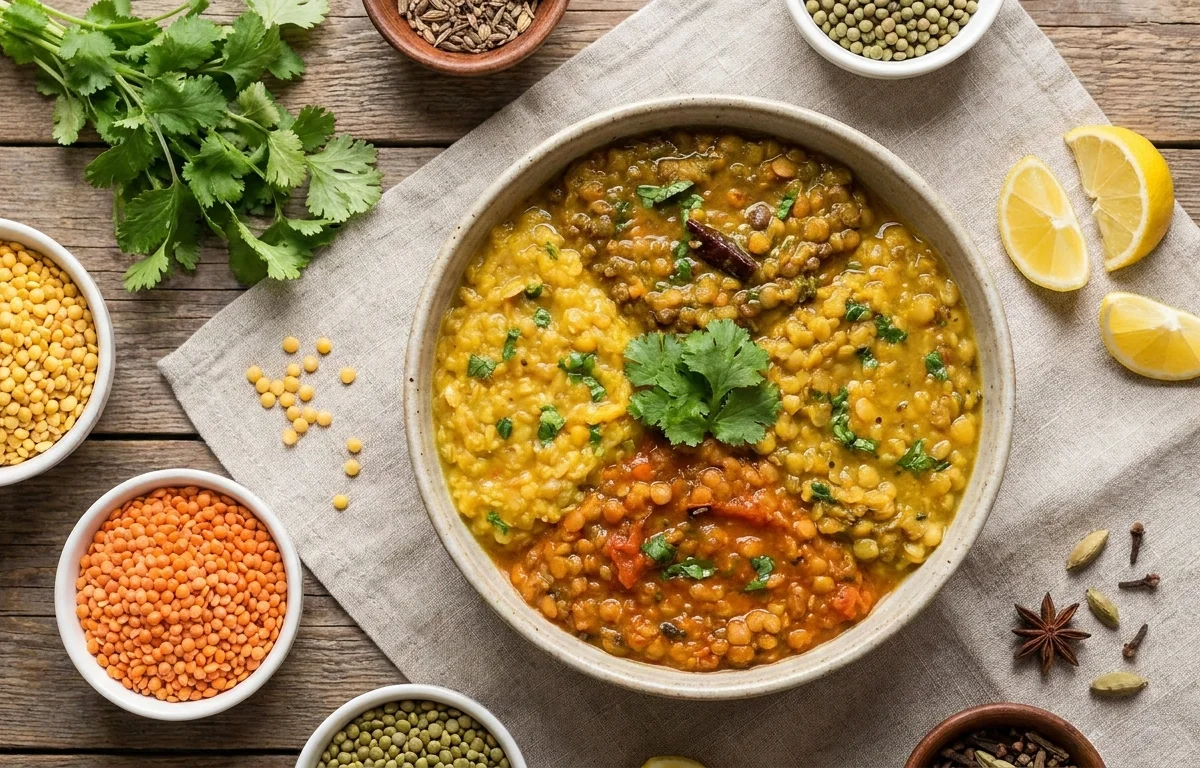
Most things written about dal compare it to chicken on a per-100g basis and call it a day. That comparison is unfair to both sides, and it almost always uses the wrong number for dal. The figure on the back of the toor dal packet — about 340 kcal and 22g protein per 100g — is for the dry, uncooked lentil. By the time it has been soaked, pressure-cooked, and tempered, the dal has absorbed roughly three times its weight in water, and a standard katori (about 150g of cooked dal) carries closer to 115-130 kcal and 7-9g of protein [1][3]. Most of the 'high-protein dal' headlines you see quietly use the dry-weight number.
Dal is still one of the best everyday foods on the Indian plate, but for different reasons than the headlines say. A katori of cooked dal contributes useful plant protein, 4-7g of fibre (most of it the soluble type that helps glycemic control and satiety), iron, folate, magnesium, and potassium, and lands on the low end of the glycemic index (most dals 25-45) [3][8]. It is also affordable, shelf-stable, and built into every regional Indian repertoire. This guide does three things: it puts honest per-katori numbers next to each common dal, it walks through which variety to reach for when, and it covers the upgrades (iron-vitamin C pairing, soaking, sodium-aware tadka) that turn an everyday katori into a better one.
Most things written about dal use the wrong number. The 22g of protein on the back of the toor dal packet is for the dry weight; by the time the dal has absorbed three times its weight in water and shown up as a katori on your plate, the real figure is closer to 7-9g. Here is what is actually in a cooked katori — for each common dal — and the upgrades that turn an everyday spoonful into a better one.
What is actually in a katori (150g cooked toor dal)
All dals are low-GI, and the variation between them is smaller than you'd think. Cooked moong dal sits around GI 31. Toor dal is ~29. Masoor (red lentil) is ~26. Chana dal is the standout at ~8 — among the lowest-GI foods in any cuisine on earth [3]. White rice, for context, is ~73.
This is dal's quiet superpower. It's not just protein and fibre; it's the slow, steady release of glucose that makes a katori of dal one of the most blood-sugar-friendly things you can put on a plate. The high soluble fibre content (around 5g per cooked katori for chana dal, 4g for moong) is what does the work — it slows gastric emptying and blunts the spike that the accompanying rice or roti would otherwise cause.
~26-31
GI of toor, moong, masoor dal (LOW) [3]
~8
GI of chana dal — among the lowest of any food
~73
GI of white rice — for comparison [3]
4-5g
soluble fibre per cooked katori — the blunting agent
THE BLOOD-SUGAR HACK
A katori of dal at every meal is one of the simplest blood-sugar interventions in Indian cooking. The soluble fibre in dal blunts the rice or roti's blood-sugar rise. This is why dal-chawal — eaten in modest portions — works for most people with diabetes when plain rice alone wouldn't.
The dry-vs-cooked truth no one mentions
Dry toor dal is roughly 340 kcal, 22g protein, 65g carb, and 15g fibre per 100g [1]. Cooked toor dal is roughly 115-130 kcal, 7-9g protein, 18-22g carb, and 4-7g fibre per 150g katori. Every number drops by about three-quarters because dal absorbs roughly three times its weight in water as it pressure-cooks.
This matters because almost every 'high-protein dal' Indian nutrition headline silently uses the dry-weight number. It makes dal look like an unbeatable protein source. It is not — it is a useful one. The corollary is that a daily katori of dal is contributing about 14% of an average adult's protein RDA (ICMR-NIN's adult target is 0.83 g/kg/day, or about 58g for a 70-kg adult) [2], which is meaningful but not sufficient on its own. Plan the rest of the day's protein around curd, paneer, eggs, soy, chicken, or fish, depending on your diet, and let the dal do what it does well: contribute fibre, iron, folate, magnesium, potassium, and the slow-release carbs that make a thali feel satisfying.
Five common dals, side by side (per 150g cooked katori)
Toor / Arhar (split pigeon pea)
The everyday default. Mild, slightly sweet, the base of sambar and most North Indian dals. Highest potassium of the group.
~115-130
7-8g
5-7g
best
Moong dhuli (yellow split moong)
The lightest and most digestible. First solid food for babies; first khichdi after illness.
~100-115
7-8g
4-5g
best
Masoor (red lentil)
Cooks in 15 minutes, highest protein and folate per katori of the five, highest iron too [3].
~115-130
8-9g
5-7g
best
Chana (split bengal gram)
Lowest GI of common dals; resistant starch supports gut microbiome and blood-sugar control [8].
~140-160
8-10g
5-7g
best
Urad (split black gram, dhuli)
Highest calcium of the group; base of dal makhani and idli-dosa batters. Whole urad is heavier on the gut; soak 8-12 hours.
~130-150
8-9g
4-6g
good
THE TRUTH
The 1971 idea that dal and rice must be eaten in the same meal to 'complete' the protein was based on early animal feeding studies and was walked back by the Institute of Medicine in its DRI on protein and amino acids: as long as you eat varied plant proteins across the day, your body maintains its own amino acid pool and does the matching for you [6]. Dal and rice in the same bowl is delicious and culturally correct — but you do not need to time it that precisely for the protein to count.
Five upgrades that turn a katori of dal into a better katori
01
Add vitamin C to unlock the iron
Dal is a non-heme iron source, which the body absorbs poorly on its own. A squeeze of lemon at the end, a chopped tomato in the tadka, or a side salad of raw onion and cucumber with lemon can lift iron absorption by 2-4x [3]. Avoid drinking chai or coffee within an hour of the meal — tannins do the opposite.
02
Soak whole dals, pressure-cook split dals
Whole dals (rajma, chana sabut, urad sabut) need an 8-12 hour soak followed by pressure cooking — this combination reduces phytate content by ~50% and largely defuses the oligosaccharide bloating problem [7]. Split, skinned dhuli dals only need a 30-minute rinse to clear surface starch.
03
Rotate the variety across the week
Different dals bring different micronutrients. A simple rotation — toor on weekdays, moong khichdi when light, masoor for a quick weeknight, chana dal once a week for the lower GI, urad in dal makhani or batter form — gives your gut a more varied prebiotic-fibre profile than eating one dal daily.
04
Treat dal as a side dish, not the protein
A katori is ~8g protein. To hit a main-meal target of ~25-30g, pair it with curd (an extra 6-8g per katori), paneer (15-18g per 100g), egg (6g each), soy chunks (10-12g per katori), or chicken/fish if you eat them. The dal contributes complementary lysine and a load of fibre; the second protein closes the gap.
05
Keep the tadka, cut the salt
A teaspoon of ghee or cold-pressed oil with cumin, mustard seed, hing, and dried chilli adds 30-45 kcal and is where the fat-soluble nutrients (curcumin from turmeric, capsaicin from chilli, most of the spice aromatics) become bioavailable. The thing to dial back is the salt — half a teaspoon for a 4-katori pot puts the dal at ~150-200 mg sodium per katori, well under the 600 mg restaurant equivalent.
Which dal when — a practical rotation
1
Moong dhuli khichdi7-8g protein/katorieasiest on the gut
The Monday-reset or post-illness default. Cooks in one pot in 20 minutes; pairs with curd and a vegetable.
2
Masoor dal tadka8-9g protein/katorihighest iron + folate
The weeknight winner. Cooks in 15 minutes flat; pair with a tomato-onion salad and lemon to absorb the iron.
3
Toor dal (sambar or dal fry)7-8g protein/katorihighest potassium
The everyday workhorse. Sambar pairs it with vegetables; North Indian dal fry pairs it with a generous tadka.
4
Chana dal fry8-10g protein/katorilowest GI of the group
Once a week for blood-sugar-aware days. Holds its shape; pairs well with lauki or methi.
5
Dal makhani (urad + rajma)9-11g protein/katorihighest calcium
Saturday-night dal. Soak the whole dals 12 hours, simmer long, keep the cream optional.
What a balanced dal-anchored thali looks like
50%
Vegetables and salad
Sabzi plus a small raw salad with lemon — half the plate, by volume, of cooked and raw plant foods.
20%
Whole grain (rice or roti)
One small katori of rice or 1-2 phulkas. Whole-grain options (brown rice, hand-ground atta) add fibre.
20%
Dal and pulses
One katori of dal, ~8g protein. The complementary lysine partner for the grain.
10%
Dairy or second protein
Curd, buttermilk, paneer, egg, soya chunks, chicken or fish — pushes the per-meal protein toward 25-30g.
THE TADKA
Curcumin (the active compound in turmeric), capsaicin (in chilli), and most of the warm-spice aromatics (cumin, mustard, fennel, fenugreek) are fat-soluble. They release into hot ghee or oil; they do not release into water. A teaspoon of fat at the tadka stage costs 30-45 kcal and unlocks compounds you simply will not absorb from a plain boiled dal. The thing to ration is the salt, not the tadka.
Build a week of meals anchored on the right dal each day
Our meal planner rotates moong, toor, masoor, chana, and urad across the week — paired with the right grain, vegetable, and a second protein — so the per-katori numbers actually add up to a balanced day.
✓Adults eating dal as a daily staple who want honest per-katori numbers instead of the inflated dry-weight figures that dominate Indian nutrition writing.
✓Vegetarians and vegans building a protein plan that uses dal as one component (typically 25-35g protein per day from pulses) alongside curd, paneer, soy, eggs (if eaten), and whole grains.
✓Anyone managing blood sugar — most cooked dals fall in the low-GI band (25-45) and the soluble fibre helps flatten the post-meal glucose curve, especially when paired with rice or roti [3][8].
✓Home cooks who want a one-page reference for which dal to choose when: moong for digestion and weeknights, masoor for the highest protein-to-cook-time ratio, chana for blood sugar, toor for everyday sambar/dal-chawal, urad for richness.
LIMIT OR AVOID IF
Skip this if
!You have chronic kidney disease (CKD) at stages 3-5 or are on a potassium-restricted diet. Whole dals (rajma, urad, chana) carry 350-500 mg potassium per cooked katori; split-and-skinned dals (moong dhuli, masoor) are gentler but portion still matters. Get a renal-friendly target from your dietitian.
!You have gout with frequent flares. Pulses are moderate-purine; recent evidence does not show legumes worsen gout in most patients, but if your urate is poorly controlled, work with your doctor on portion (and prefer washed, skinned dals over whole).
PRACTICAL TIPS
✓Use the cooked, not dry, numbers when you plan a meal: ~115-130 kcal, 7-9g protein, 4-7g fibre per 150g katori of toor or moong dal. Doubling the katori roughly doubles every number on that list [1][3].
✓Pair dal with a vitamin C source at the same meal to boost non-heme iron absorption — a squeeze of lemon, a tomato in the tadka, raw onion-tomato-cucumber salad, or amla-based pickle. Tea or coffee within an hour of the meal cuts iron absorption sharply; push them out 60+ minutes.
✓Soak whole dals (rajma, chana, urad, black masoor) for 8-12 hours and pressure-cook them. Soaking plus pressure cooking reduces phytate content by roughly 50% and substantially lowers oligosaccharide-driven bloating; split dals (moong dhuli, toor) only need a 30-minute rinse [7].
✓Rotate the variety across the week. Different dals have meaningfully different micronutrient profiles — chana is highest in resistant starch, masoor in iron and folate, moong gentlest on digestion, toor highest in potassium, urad richest in calcium. The most common nutrition mistake is eating only toor every day.
✓Watch the tadka salt. A restaurant-style dal often carries 800-1,200 mg sodium per katori from added salt; a home dal with a half-teaspoon of salt for a 4-katori pot lands closer to 200-300 mg. The tadka itself (1-2 tsp ghee or oil + cumin, mustard, hing, dried chilli) adds 30-60 kcal and is the most nutritionally efficient flavour in the kitchen — keep it; cut the salt instead.
✓Do not treat dal as your only protein source. ICMR-NIN's adult RDA is 0.83 g protein per kg body weight per day — about 58g for a 70-kg adult [2]. A katori of dal contributes ~8g, or roughly 14% of that. Pair it with curd, paneer, eggs, soy, chicken, or fish (per your diet) to actually hit the target.
So — is dal healthy? Yes, and on the right honest terms. A katori of cooked dal is 115-130 kcal, 7-9g of protein, 4-7g of fibre, and a useful dose of iron, folate, and magnesium [1][3]. It is not a 30g-protein protein bomb; the packet number is for the dry weight. Used as one component of a plate alongside rice or roti, a vegetable, and a curd or chicken or egg or paneer for the second protein, it does exactly what it has done for centuries on the subcontinent: makes the meal complete, affordable, and satisfying. Rotate the variety across the week (toor, moong, masoor, chana, urad each bring something a little different), soak whole dals to lower phytates, pair them with a tomato or lemon for the iron, keep the tadka generous on whole spices and modest on salt, and have at it. If you have chronic kidney disease, are on potassium-sparing medication, or have gout flares, talk to your doctor about which dals and what portion size fit your specific picture before changing your routine.
FREQUENTLY ASKED QUESTIONS
Frequently asked questions
How much protein is actually in a katori of dal?
About 7-9g per 150g cooked katori for moong, toor, and masoor. Chana dal sits a little higher at 8-10g. The 22g 'per 100g' figure most articles quote is the dry, uncooked lentil — once it absorbs water during pressure cooking, the per-katori number is roughly a quarter of that [1][3]. For perspective, the same protein you get from one katori of dal is what you get from one large egg or about 25g of cooked chicken.
Is dal a complete protein with rice?
Across the day, yes — lentils are low in methionine and high in lysine, while rice and wheat are the reverse, so the amino acid profile balances out over 24 hours. The Institute of Medicine's DRI on protein walked back the older Lappe-era idea that you need to combine them at the same meal; daily total amino-acid intake is what matters [6]. But this is about quality, not quantity: a single katori of dal still only delivers ~8g protein, so you also need other protein sources to hit the daily target.
Can I eat dal every day?
Yes, for most healthy adults. ICMR-NIN's My Plate guidance recommends 60-80g of pulses (dry weight) per day as part of an Indian-pattern diet [2]. The thing to vary is which dal — rotating toor, moong, masoor, chana, and urad gives you a broader mineral and prebiotic-fibre profile than eating the same one every day. People with CKD, gout under poor control, or IBS on a low-FODMAP protocol should personalise the portion.
Which dal is the easiest to digest?
Yellow split moong dal (moong dhuli) — skinned and split, with the outer husk removed, which is where most of the bloating-prone oligosaccharides sit. It is traditionally the first solid food given to babies and the go-to khichdi for recovery from illness. Toor dal is a close second. Whole dals (rajma, urad sabut, chana sabut) are the heaviest on the gut and benefit most from a long soak.
Is dal okay for diabetes?
Generally yes, and often actively helpful. Most cooked dals have a low glycemic index (25-45), and the soluble fibre slows glucose absorption from any rice or roti eaten alongside [3][8]. Chana dal has one of the lowest GIs of all common pulses. Watch the tadka for added ghee/oil in restaurant versions if you also need to manage calories; portion sizes still matter.
Is dal bad for uric acid or gout?
Pulses contain moderate purines, but recent epidemiology does not show that vegetable purines (including dal) meaningfully raise gout risk in most people — the heavier offenders are organ meat, certain seafood, beer, and fructose-sweetened drinks. If your urate is poorly controlled, talk to your doctor about portion, prefer washed/split dals (moong dhuli, masoor) over whole ones, and watch the overall pattern rather than dropping pulses entirely.
Polished or unpolished dal — does it actually matter?
Modestly. Polished dal is buffed (sometimes with water, sometimes with a small amount of oil) for a glossier appearance, which can strip a thin outer layer and some of the B-vitamins and minerals along with it. Unpolished dal retains more micronutrients and takes slightly longer to cook. If your shop sells both, unpolished is the better default — but the difference is small compared to choosing variety, portion, and how you cook it.
Is dal good for people with diabetes?
Yes — and it's one of the best Indian staples for blood-sugar management. All standard dals are LOW glycaemic index (chana dal as low as 8; moong, masoor, and toor in the 26-31 range) [3]. The soluble fibre slows digestion and blunts the post-meal glucose spike. Pair dal with vegetables and a modest portion of rice or roti for a balanced, diabetes-friendly meal. Anyone on insulin or sulfonylureas should still verify with their care team and monitor glucose response individually.
ABOUT THE AUTHOR
Sourabh Garg
CONTENT CREATOR
Sourabh writes about Indian cuisine, budget cooking, and the everyday nutrition questions that come up in Indian kitchens — chapati portions, dal protein, how to keep dishes balanced without losing the flavours families actually want. His pieces lean on credible sources (ICMR-NIN, peer-reviewed studies) and home-cook reality in equal measure.
Built using verified nutrition databases, culinary research, and traditional cooking knowledge — every claim is cross-referenced against the sources listed in the article. Last reviewed Jun 2026.
Articles are curated using trusted food databases (USDA FoodData Central, IFCT), culinary literature, and dietary guidelines, then structured by our editorial team for clarity, accuracy, and usefulness.
· Verified data sources· Culinary research· Quality reviewed
You have a documented legume allergy, or you are on a clinician-supervised low-FODMAP diet for IBS (whole and large-serving dals are high-FODMAP; small portions of canned, rinsed lentils or split moong are usually better tolerated).
ⓘ This guidance is general. Talk to a healthcare professional or registered dietitian for personalised dietary advice.