
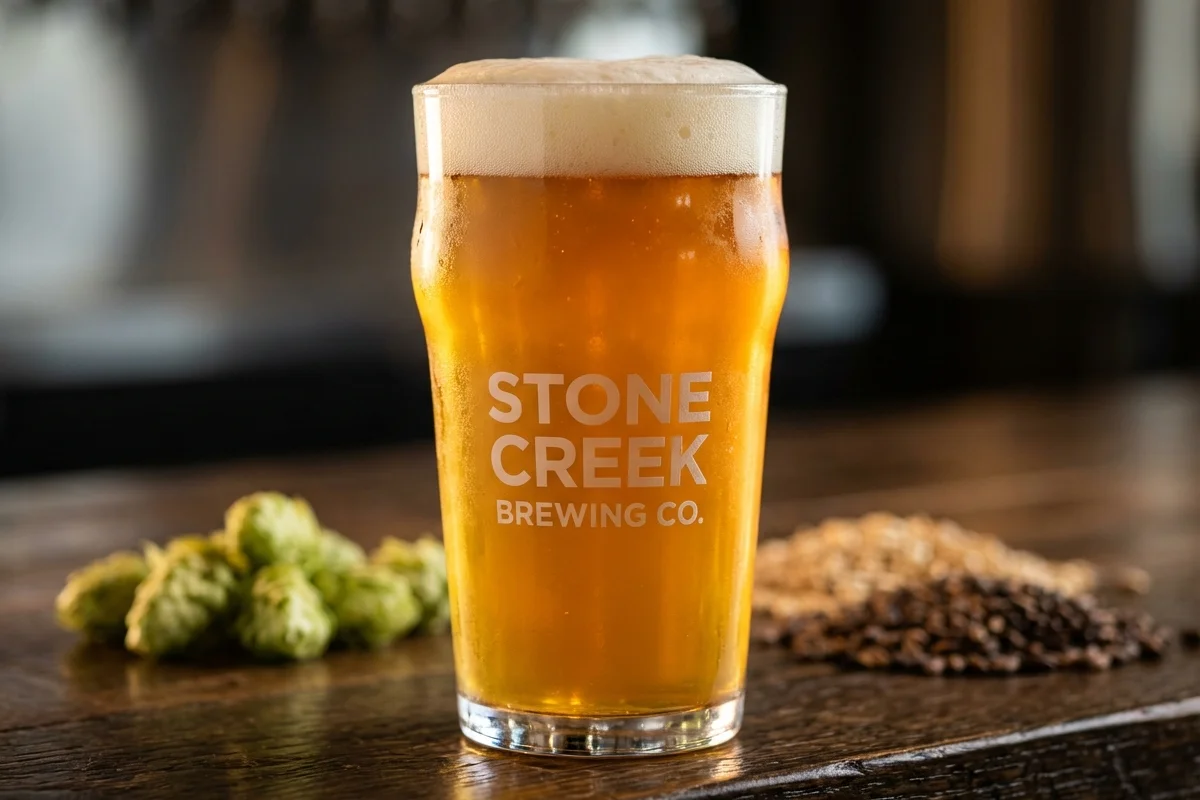
American Pale Ale
A crisp, moderately hoppy beer with a beautiful amber-golden hue. This classic American Pale Ale balances caramel malt sweetness with the bright, citrusy-pine notes of American hops. Brew it at home in about 5 weeks for a refreshing pint that rivals any craft brewery.
For 70 servings
- prep · ~20 min
Sanitize all equipment.
Thoroughly clean and sanitize the fermentation bucket, airlock, siphon, and anything that will touch the cooled wort. Use a no-rinse sanitizer like Star San according to the manufacturer's directions.
TIPSanitation is the single most important step in brewing. Most spoiled batches come from overlooked equipment. - prep · ~30 min
Heat the strike water.
Heat 15 liters of water in the brew kettle to 72°C.
- mix · ~60 min
Mash the grains.
Pour the crushed pale malt and crystal malt into the mash tun. Add the hot water and stir well until the grain is fully saturated. The temperature should stabilize at 66°C. Put the lid on and let it rest for 60 minutes.
TIPMaintain 66°C as closely as you can. If it drops below 64°C, add a splash of near-boiling water to bring it back up. - boil · ~40 min
Sparge and collect the wort.
Heat the remaining 10 liters of water to 76°C in your kettle. Slowly run off the sweet liquid from the mash tun into the kettle, then gently pour the sparge water over the grain bed to rinse out the remaining sugars. Collect about 23-25 liters of wort total.
TIPRecirculate the first few liters of runoff back into the mash tun until the liquid runs clear, not cloudy. - boil · ~20 min
Bring the wort to a rolling boil.
Place the kettle on high heat and bring the collected wort to a vigorous, rolling boil.
- boil · ~1 min
Add the first hop addition.
Once boiling, add 28 grams of Cascade hops. Stir them in and start a 60-minute timer. Keep the boil rolling the entire time.
TIPThis 60-minute addition provides the backbone bitterness. Mark the time — the remaining hop additions depend on it. - boil · ~1 min
Add Irish moss and the second hop addition.
With 15 minutes left on the timer, add 1 teaspoon of Irish moss and 14 grams of Cascade hops. Stir gently to incorporate.
TIPIrish moss helps proteins clump together and drop out, giving you a clearer finished beer. - boil · ~1 min
Add the final aroma hops.
At flameout — the moment you turn off the heat — add the remaining 14 grams of Cascade hops. This preserves the delicate aromatic oils that would be lost during a longer boil.
- other · ~20 min
Chill the wort rapidly.
Place the immersion chiller into the hot wort and run cold water through it. Stir the wort gently while it cools. Bring the temperature down to 20°C as quickly as possible — ideally within 20 minutes.
TIPA fast chill stops DMS production and locks in the hop character. If you don't have a chiller, place the covered kettle in an ice bath. - mix · ~10 min
Transfer to the fermenter and pitch the yeast.
Carefully siphon the cooled wort into the sanitized fermentation bucket, leaving the trub and hop debris behind. Shake or splash the bucket vigorously for 2 minutes to aerate the wort. Sprinkle the American ale yeast evenly across the surface and seal the lid with an airlock.
TIPYeast needs oxygen to build healthy cell walls for the first phase of fermentation. Don't skip the aeration step. - rest · ~20160 min
Ferment at a steady temperature.
Place the bucket in a dark spot where the ambient temperature stays between 18-20°C. Bubbling in the airlock should start within 24-48 hours and will slow down after 5-7 days. Leave it alone for 14 days total.
TIPTemperature control makes the difference between a good beer and a great one. Too warm, and you'll get fruity off-flavors. - prep · ~60 min
Bottle the beer.
After 14 days, check the final gravity — it should be stable around 1.012. Boil 100g of priming sugar in 2 cups of water, let it cool, and pour it into the sanitized bottling bucket. Siphon the beer on top to mix. Fill clean bottles to 2.5 cm from the top using the auto-siphon and bottle. Cap each bottle immediately.
TIPSiphon gently and avoid splashing at this stage — any oxygen introduced now will stale the beer. - rest · ~20160 min
Condition the bottles at room temperature.
Store the capped bottles at 20-22°C in a dark place for 14 days to allow carbonation to develop.
- rest
Chill and serve.
After conditioning, refrigerate the bottles for at least 24 hours. Pour into a glass, leaving the yeast sediment behind in the bottle, and enjoy your crisp, hop-forward American Pale Ale.
TIPDrink this beer fresh to enjoy the bright hop aroma at its peak. It's best within the first 2-3 months.
What to keep in mind.
7 tips from the recipe — small details that make a real difference to the final dish.
- 1Crush the grains just enough to crack the husks—too fine and you'll get a stuck sparge.
- 2Steadily sparge at 76°C to avoid tannin extraction; never exceed 78°C.
- 3Keep the boil vigorous: a lazy boil won't isomerize hops fully, reducing bitterness.
- 4Chill to 20°C in under 20 minutes—rapid cooling locks in hop aroma and prevents off-flavors.
- 5Don't dump the trub into the fermenter; siphon only the clear wort for a cleaner beer.
- 6Ferment at 18-20°C for 14 full days; temperature spikes create fruity fusel alcohols.
- 7Bottle gently after final gravity stabilizes at ~1.012—splashing now can oxidize the beer.
Adapt it for your goals.
Lower-ABV session ale
Reduce pale malt to 3500g and swap crystal malt for 200g of Munich malt; this lowers alcohol while preserving malt character and hop balance.
smoked amber aleSmoked amber ale
Replace 500g of pale malt with cherry-wood smoked malt; the subtle smoke pairs beautifully with Cascade's citrus for a campfire twist.
hop burst versionHop-burst version
Move the 60-minute bittering hop to 20g of Magnum, then add 28g of Cascade and 14g of Citra at 10 minutes and at flameout for intense hop aroma without harsh bitterness.
gluten reducedGluten-reduced
Add 1g of Clarity-Ferm to the mash; it breaks down gluten peptides while barely affecting flavor or body, making the beer suitable for many gluten-sensitive drinkers.
Why this is on our healthy list.
Source of B Vitamins
Barley malt naturally provides B vitamins including niacin and folate, which support energy metabolism and cell health.
Contains Soluble Fiber
The residual beta-glucans from barley in unfiltered beer contribute a small amount of soluble fiber, which can support heart health.
Polyphenols from Hops
Cascade hops deliver polyphenols like xanthohumol, compounds studied for their antioxidant and anti-inflammatory properties.
Frequently asked questions
The lid seal may be loose. Wait 48 hours and check gravity; if it has dropped by at least 20 points, fermentation occurred despite the leak.


