
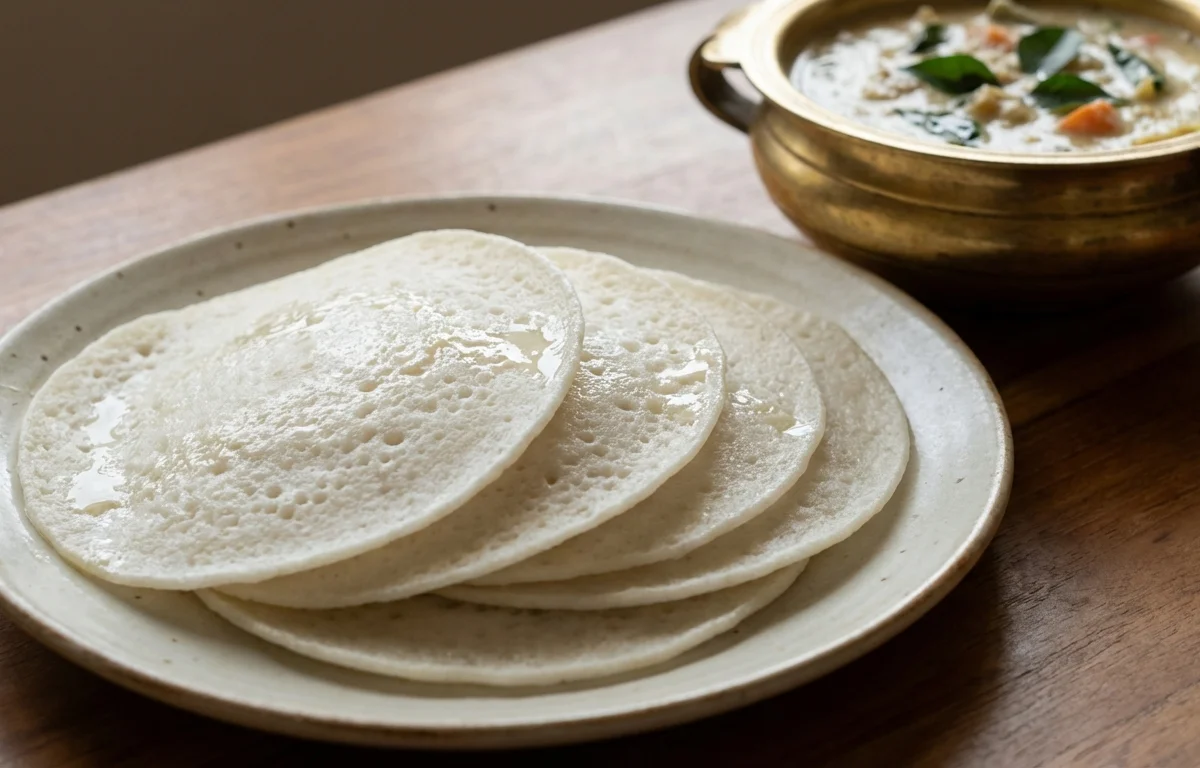
Ari Pathiri
Thin, soft rice flatbreads from Malabar made with a simple hot-water dough. They cook quickly on a tawa and pair beautifully with Kerala curries, roasted vegetables, or a mild coconut-based side.
For 8 servings
- prep
Measure the flour and season it.
Place the rice flour in a wide bowl and mix in the salt so it is evenly distributed before adding the hot water.
- boil · ~4 min
Heat the water until very hot.
Bring the water just to a boil in a small pot. The hot water helps the rice flour come together into a smooth, pliable dough.
- mix
Mix the dough with hot water.
Pour the hot water gradually into the rice flour, mixing with a spoon as you go. Stir until the flour is moistened and a shaggy dough forms.
TIPAdd the water little by little near the end so the dough stays soft but not sticky. - knead · ~4 min
Knead the dough until smooth.
When cool enough to handle, grease your palms lightly with oil and knead the dough for 3 to 4 minutes until smooth, soft, and crack-free.
TIPIf the dough feels dry, wet your fingers lightly and knead again instead of adding a lot of extra water. - rest · ~10 min
Cover and rest the dough.
Cover the dough and let it rest for 10 minutes. This makes it easier to divide and roll without cracking.
- prep
Divide the dough into small balls.
Divide the dough into 8 equal portions and keep them covered so they do not dry out while you shape the pathiri.
- assemble · ~10 min
Roll each pathiri thin.
1.Place one dough ball between two sheets of parchment paper or on a lightly floured board.2.Flatten it gently with your fingers first.3.Roll it into a thin round about 6 to 7 inches wide.4.Keep the rolled pathiri covered with a cloth while shaping the rest.TIPThin, even rolling gives the soft texture Ari Pathiri is known for. - fry · ~12 min
Cook the pathiri on a hot tawa.
1.Heat a tawa over medium heat and grease it very lightly with oil.2.Place one rolled pathiri on the hot tawa.3.Cook until small bubbles appear and the color turns opaque, about 30 to 40 seconds.4.Flip and cook the second side for 30 to 40 seconds, pressing lightly with a cloth or spatula.5.Remove before it browns too much, then repeat with the remaining dough.TIPDo not overcook or the pathiri will turn dry and stiff instead of soft. - serve
Serve the Ari Pathiri warm.
Stack the cooked pathiri in a covered container or wrap them in a clean cloth to keep them soft until serving.
What to keep in mind.
7 tips from the recipe — small details that make a real difference to the final dish.
- 1Use water that is just boiled; lukewarm water makes the rice dough harder to bring together smoothly.
- 2Knead while the dough is still warm, not fully cool, so the pathiri roll without edge cracks.
- 3Keep both dough balls and rolled pathiri covered with a cloth to prevent the surface from drying out.
- 4Roll each one very thin and even; thick spots stay gummy while thin spots cook into the classic soft texture.
- 5Cook on medium heat only until opaque with a few bubbles; too much browning makes ari pathiri stiff.
- 6Stack the cooked pathiri immediately in a covered box or cloth-lined plate so trapped steam keeps them pliable.
- 7If a rolled pathiri cracks at the edges, dab your fingers with water and re-roll instead of adding lots of flour.
Adapt it for your goals.
Oil-free
Skip the oil and cook on a well-seasoned tawa; useful if you want an even lighter flatbread.
thicker softThicker-soft
Roll slightly smaller and a bit thicker for a softer, more substantial pathiri that is easier for beginners to handle.
mini pathiriMini-pathiri
Divide into smaller balls and make petite rounds for snack platters or to serve alongside multiple Kerala curries.
Why this is on our healthy list.
Naturally Gluten-Free
Made from rice flour rather than wheat, this flatbread suits people who avoid gluten-containing grains.
Light, Simple Ingredients
With just rice flour, water, salt, and very little oil, ari pathiri is a minimally rich accompaniment to heavier curries.
Easy to Pair Balanced Meals
Its mild flavor works well with vegetable, lentil, fish, or chicken curries, making it easy to build a more varied plate.
Frequently asked questions
The dough is usually too dry or has cooled too much. Knead it again with lightly wet fingers and keep it covered so it stays soft.



.webp)
.webp)