
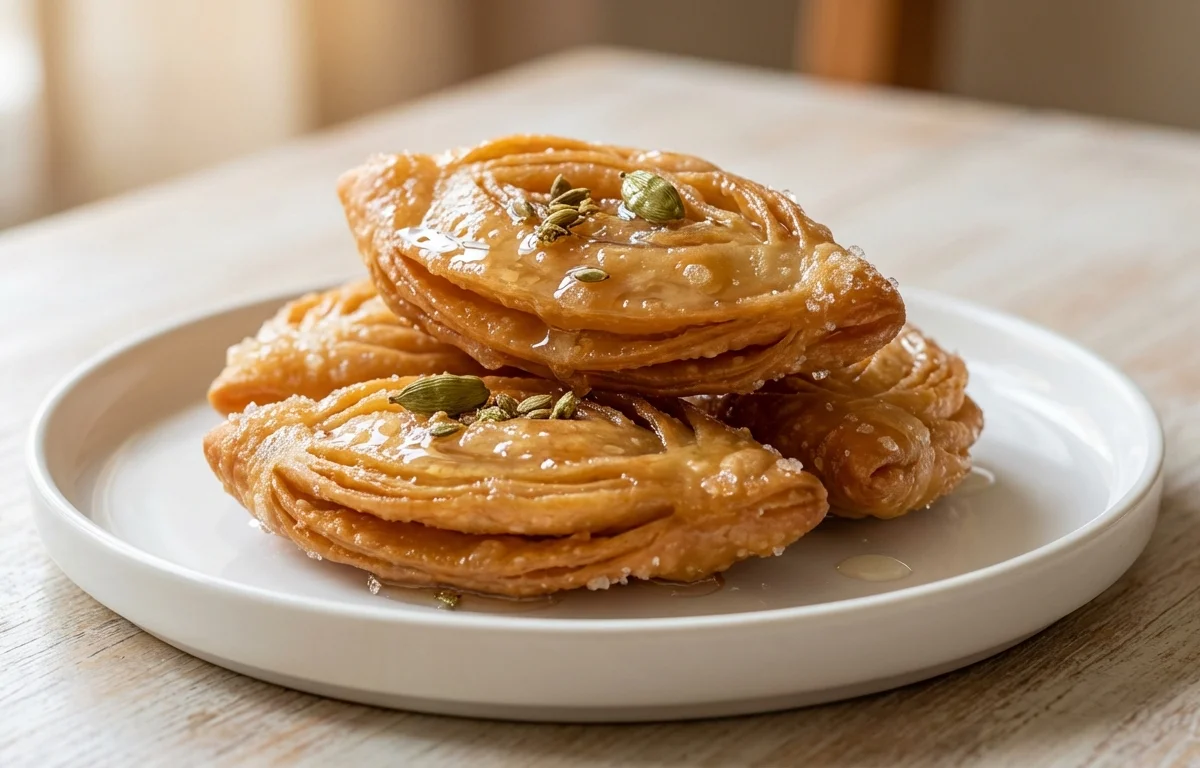
Bengali Goja
A crisp, flaky Bengali sweet made by folding and frying a simple dough, then dipping it in light sugar syrup. The outside stays glossy and crackly while the center has a gentle layered bite that makes it perfect for festive snacking.
For 8 servings
- mix · ~7 min
Mix the dough ingredients.
1.Add all-purpose flour, baking soda, and salt to a wide bowl.2.Rub in the ghee until the flour looks evenly crumbly.3.Add water little by little and bring it together into a stiff dough.TIPA stiff dough helps Goja keep its sharp shape and flaky bite during frying. - knead · ~15 min
Knead the dough.
Knead the dough for 3 to 4 minutes until smooth but firm. Cover and let it rest for 15 minutes.
- mix · ~1 min
Make a flour paste for sealing.
Mix the extra all-purpose flour with a little water to make a thick paste. Keep it ready for sealing the folded dough.
- prep · ~10 min
Roll and shape the Goja.
1.Divide the rested dough into 2 equal parts.2.Roll each part into a thick rectangle about 1/4 inch thick.3.Brush a little flour paste on one side and fold into thirds like a letter.4.Press lightly, then cut into 4 pieces from each rectangle.5.Pinch or press the edges gently so the layers hold while frying.TIPDo not roll the dough too thin or the pieces lose their layered center. - boil · ~8 min
Make the sugar syrup.
1.Add sugar, water, and green cardamom to a pan.2.Bring to a boil and simmer until slightly sticky but not thick.3.Add lemon juice and switch off the heat.TIPKeep the syrup light; a heavy syrup makes the Goja hard instead of glossy. - fry · ~15 min
Fry the Goja on low heat.
1.Heat the oil in a deep pan over low to medium-low heat.2.Slide in the shaped pieces without crowding the pan.3.Fry slowly, turning often, until puffed, crisp, and deep golden on all sides.4.Lift them out and let the excess oil drip off.TIPLow heat is the key here; fast frying browns the outside before the inside turns crisp. - assemble · ~4 min
Dip the fried pieces in syrup.
While still warm, dip each fried Goja in the warm sugar syrup for 20 to 30 seconds. Turn to coat well, then remove to a plate or rack.
- rest · ~20 min
Let the syrup set.
Leave the coated Goja undisturbed for 15 to 20 minutes until the surface turns glossy and lightly set.
- serve
Serve Bengali Goja at room temperature.
What to keep in mind.
7 tips from the recipe — small details that make a real difference to the final dish.
- 1Keep the dough stiff; a soft dough will spread in oil and blur the layered center.
- 2After rubbing in the ghee, the flour should hold briefly when pressed in your fist before adding water.
- 3Seal the folded edges well with the flour paste so the layers do not open while frying.
- 4Fry on low to medium-low heat only; Goja needs slow frying to crisp through before browning.
- 5Dip the pieces while they are still warm and the syrup is warm, so the coating clings evenly.
- 6If the syrup starts thickening as it sits, loosen it with a spoonful of hot water before dipping more pieces.
- 7Cool completely before storing, or trapped steam will soften the crackly sugar-coated exterior.
Adapt it for your goals.
Elaichi-forward
Increase the cardamom slightly for a more fragrant, festive Goja with a stronger traditional sweet-shop aroma.
mini gojaMini-goja
Cut smaller pieces for bite-size festive servings; they fry a little faster and are easy to share.
vanaspati freeVanaspati-free
Stick with ghee only for shortening and avoid hydrogenated fats if you want a cleaner dairy-rich flavor.
Why this is on our healthy list.
Energy-Rich Festive Sweet
Made with flour, ghee, and sugar, this sweet provides quick energy and is best suited to celebratory, occasional eating.
Cardamom-Infused Aroma
Green cardamom adds fragrance and depth, letting the syrup taste more rounded without needing extra flavorings.
No Artificial Additives
This traditional preparation relies on basic pantry ingredients like flour, ghee, sugar, lemon juice, and cardamom.
Frequently asked questions
The usual causes are dough that was too soft, oil that was too hot, or storing the pieces before they cooled fully. Slow frying and complete cooling are key.



-curry.webp)
.webp)