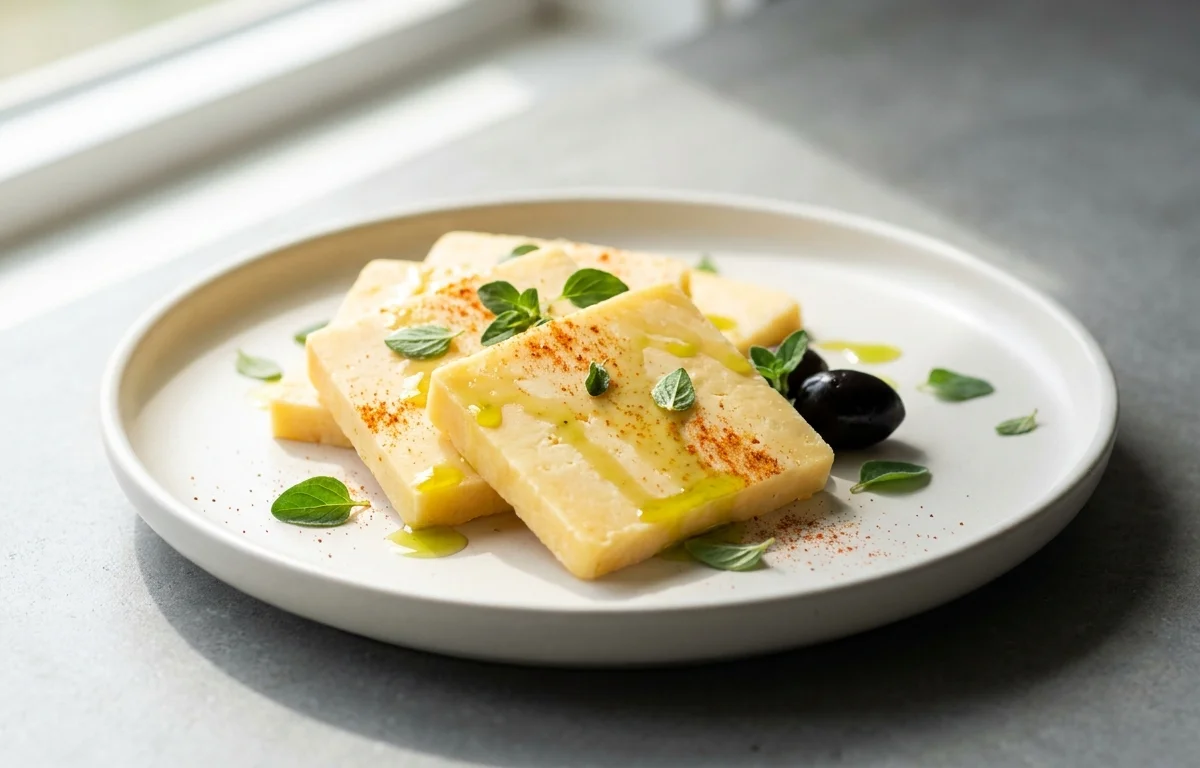
Cheddar Cheese
A firm, slightly crumbly cow's milk cheese with a rich, nutty flavor that sharpens with age. This homemade version walks you through culturing, cutting curds, cheddaring, and pressing—resulting in a beautiful mile-high block you can age for weeks or months. Slice it for sandwiches, melt it over burgers, or just snack on it with apple slices.
For 16 servings
- prep · ~10 min
Sanitize all equipment and warm the milk.
1.Sanitize all cheese-making equipment with boiling water or a dairy sanitizer.2.Pour 4 liters of whole milk into a large stockpot.3.Heat milk slowly over medium-low heat to 88°F (31°C), stirring gently to avoid scorching.TIPEven pasteurized milk works beautifully if it isn't ultra-pasteurized—check the label; ultra-pasteurized won't form a proper curd. - mix · ~45 min
Add cultures and let the milk ripen.
1.Sprinkle 0.25 tsp mesophilic starter culture over the warm milk's surface.2.Let the powder rehydrate for 2 minutes, then stir gently with an up-and-down motion to distribute.3.Cover the pot and let the milk ripen for 45 minutes at 88°F (31°C).TIPKeep the temperature steady during ripening—if it dips below 86°F, warm it gently back to 88°F before adding rennet. - mix · ~45 min
Add the rennet and set the curd.
1.Dilute 0.25 tsp liquid rennet in 2 tbsp cool water.2.If using pasteurized milk, dilute 0.5 tsp calcium chloride in another 2 tbsp cool water.3.Pour both into the ripened milk and stir gently for 30 seconds.4.Stop the milk entirely—cover and let sit undisturbed for 40–45 minutes until a clean break is achieved.TIPTest for a clean break: dip a clean finger or thermometer into the curd at a 45° angle and lift. The curd should split cleanly around the intrusion. - prep · ~10 min
Cut the curds.
1.With a long knife or curd harper, cut the curd into 0.5-inch cubes—first vertical cuts 0.5 inches apart, then horizontal cuts where you can reach.2.Let the cut curds rest 5 minutes to firm up slightly. - simmer · ~60 min
Cook the curds to 102°F.
1.Place the pot back on low heat and slowly raise the temperature to 102°F (39°C) over 30 minutes.2.Stir continuously but gently so curds don't knit together.3.Hold at 102°F for an additional 30 minutes, continuing to stir occasionally.4.The curds should shrink and look like small, bouncy pellets when ready.TIPRaise the temperature gradually—no more than 2°F every 5 minutes. Rushing this step traps whey and makes the cheese tart. - prep · ~70 min
Drain the whey and cheddar the curds.
1.Line a colander with cheesecloth and pour in the curds, letting the whey drain completely.2.Place the drained curd mat back into the empty pot (off heat) and let it rest in a warm spot.3.Flip the slab of curd every 15 minutes for 1 hour total—this is cheddaring.4.The curd should become firmer and take on a slightly shiny, chicken-breast texture.TIPKeep the curds warm during cheddaring (around 98°F). If your kitchen is cold, set the pot in a sink of warm water. - prep · ~5 min
Mill and salt the curds.
1.Break the cheddared slab into small thumbnail-sized pieces.2.Sprinkle 1 tsp non-iodized salt evenly over the curd pieces.3.Toss gently but thoroughly to coat every piece—salt draws out moisture and flavors the cheese.TIPNon-iodized salt is critical—iodine interferes with the cheese culture and can create off-flavors during aging. - other · ~780 min
Press the cheese.
1.Line a cheese mold with cheesecloth, pack the salted curds in tightly.2.Fold the cloth over the top, place the follower on, and transfer to your cheese press.3.Press at 10 lbs for 15 minutes.4.Remove the cheese, unwrap, flip it, rewrap, and press at 20 lbs for 30 minutes.5.Unwrap, flip, rewrap, and press at 30 lbs for 1 hour.6.Final press: unwrap, flip, press at 40 lbs for 12 hours (or overnight). - rest · ~4320 min
Air-dry the cheese.
1.Remove the cheese from the press and peel off the cloth.2.Place the wheel on a cheese mat or bamboo mat in a cool, well-ventilated area.3.Air-dry for 2–3 days, turning daily, until the rind is dry to the touch.4.The surface should feel smooth and slightly leathery, with no stickiness.TIPProtect the drying cheese under a mesh food tent or a clean inverted colander—it keeps dust and curious fingers off without trapping humidity. - rest
Age the cheddar.
1.Once dry, wax the cheese wheel or vacuum-seal it in a food-safe bag.2.Place in a dedicated cheese fridge or a cool spot at 50–55°F (10–13°C).3.Age for at least 4 weeks for mild cheddar, 3–6 months for sharp, or 12+ months for vintage.4.Turn the cheese weekly during aging for even moisture distribution.TIPA dorm-style mini fridge paired with a temperature controller makes a perfect cheese cave—set it to 52°F and you're in business.
What to keep in mind.
6 tips from the recipe — small details that make a real difference to the final dish.
- 1When testing the clean break, wait until the curd parts cleanly around your finger; a ragged break means curds need more time to set.
- 2Raise the curd temperature slowly during the cooking phase—no more than 2°F every 5 minutes—to avoid trapping excess whey and creating a sour cheese.
- 3During cheddaring, keep the curd slab warm (around 98°F) by resting the pot in a sink of hot water if your kitchen is drafty.
- 4Use only non-iodized salt for salting the milled curds; iodine can inhibit the starter culture and produce off-flavors during aging.
- 5After the final press, air-dry the cheese until the rind feels leathery and completely dry to the touch, which may take 2–3 days depending on humidity.
- 6Age your cheddar at a consistent 10–13°C (50–55°F); a temperature-controlled mini fridge makes an ideal cheese cave for long-term aging.
Adapt it for your goals.
Smoked cheddar
After the air-drying step but before aging, cold-smoke the cheese wheel at 70–80°F for 2–4 hours using hardwood chips like apple or hickory. This imparts a deep, savory smokiness that complements sharp cheddar flavor.
red pepper cheddarRed pepper cheddar
Add 2–3 tablespoons of coarsely ground dried chili flakes or paprika to the milled curds just before packing into the mold. This creates a spicy, colorful cheddar perfect for snacking or melting.
herb & garlic cheddarHerb & garlic cheddar
Fold 1–2 teaspoons of dried chives, rosemary, or sage, plus 1 minced garlic clove (dried or fresh), into the salted curds before pressing. The herbs mellow during aging, infusing the cheese with savory aromatics.
low salt cheddarLow-salt cheddar
Reduce the salt added to the milled curds to ½ teaspoon (from 1 teaspoon). This produces a milder, less salty cheese that's gentler on the palate but may require shorter aging (3–4 weeks) to avoid spoilage.
Why this is on our healthy list.
Rich in Calcium
Cheddar made from whole milk is an excellent source of calcium—essential for strong bones and teeth—with each ounce providing about 15% of the daily recommended intake.
Natural Probiotics
The live mesophilic starter culture introduces beneficial lactic acid bacteria into the cheese, supporting gut health and aiding digestion when consumed fresh (unaged) or within a few months.
High-Quality Protein
Aged cheddar is a concentrated source of complete protein, providing all essential amino acids needed for muscle repair and satiety in a dense, satisfying form.
Frequently asked questions
If your milk is ultra-pasteurized, the proteins are damaged and won't coagulate properly; use only whole milk labeled 'pasteurized' (not ultra-pasteurized), and ensure the milk is at exactly 88°F before adding rennet.