
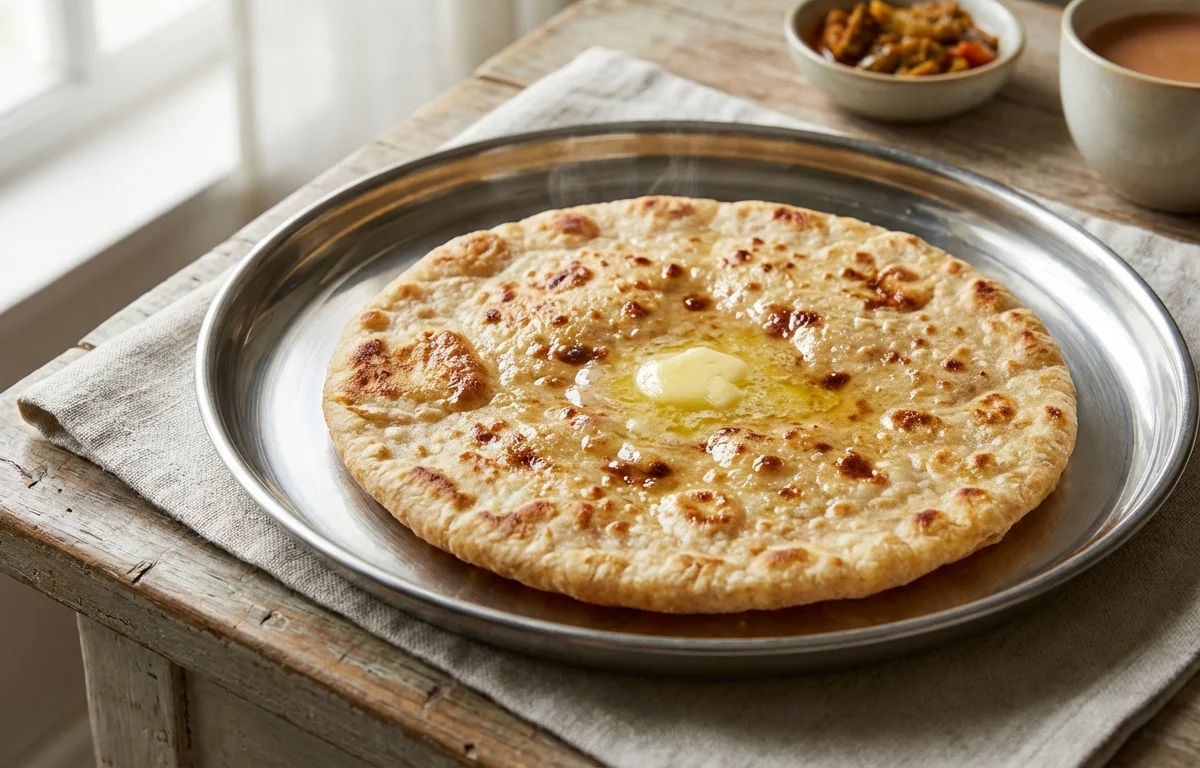
Gujarati Bhakhri
This Gujarati staple is a thick, crisp whole wheat flatbread with a gently flaky bite. It cooks slowly on the tawa with a little ghee until golden, making it perfect with pickle, yogurt, or a simple sabzi.
For 4 servings
- mix · ~3 min
Mix the flour, salt, and ghee.
Add whole wheat flour and salt to a wide bowl. Rub in 1 tablespoon ghee with your fingertips until the flour feels slightly sandy and holds shape when pressed.
- knead · ~5 min
Knead a stiff dough.
Add water little by little and knead into a firm, smooth dough. Bhakhri dough should be stiffer than roti dough so the breads stay thick and crisp.
TIPA stiff dough helps bhakhri cook slowly without turning soft like chapati. - rest · ~10 min
Cover and rest the dough.
Cover the dough and let it rest for 10 minutes so it relaxes slightly and becomes easier to shape.
- prep · ~7 min
Divide and shape the bhakhri.
1.Divide the dough into 4 equal portions.2.Roll each portion into a smooth ball.3.Flatten one ball with your fingers into a thick disc.4.Roll gently into a 4 to 5 inch round, keeping it thicker than a roti.TIPIf the edges crack, press them back together with your fingers instead of adding extra water. - fry · ~2 min
Cook the first side on a hot tawa.
Heat a tawa over medium-low heat. Place one bhakhri on it and cook until the surface changes color slightly and light spots appear, about 1 to 2 minutes.
- fry · ~4 min
Flip and roast with ghee.
1.Flip the bhakhri and spread a little ghee around the edges and on top.2.Press gently with a cloth or spatula so it cooks evenly.3.Flip again and roast the other side with a little more ghee.4.Cook until both sides are golden with brown spots and the bhakhri feels crisp.TIPKeep the heat medium-low so the inside cooks through before the outside gets too dark. - other · ~12 min
Repeat with the remaining dough.
Shape and cook the remaining bhakhri the same way, using the rest of the ghee for roasting.
- serve
Serve the bhakhri warm or at room temperature.
What to keep in mind.
7 tips from the recipe — small details that make a real difference to the final dish.
- 1Rub the moyan well into the flour; the mix should clump when pressed so the bhakhri turns flaky, not bready.
- 2Keep the dough stiffer than chapati dough or the bhakhri will soften instead of staying thick and crisp.
- 3Roll evenly from center to edge; thin spots will harden before the middle cooks through.
- 4Cook on medium-low heat only, so the inside dries out properly while the outside turns golden.
- 5Press gently around the edges after flipping to help the thicker rim cook as evenly as the center.
- 6Cool cooked bhakhri on a plate or rack without stacking immediately, or trapped steam will soften the crust.
- 7You can shape the discs ahead and keep them covered with a cloth for a short time before roasting.
Adapt it for your goals.
Low-ghee
Use less ghee while roasting and dry-cook most of the bhakhri first; good if you want a lighter everyday version.
masalaMasala
Add ajwain, crushed black pepper, or red chili powder to the dough for a more savory bhakhri to pair with chai or pickle.
veganVegan
Replace ghee with neutral oil for the moyan and roasting; the texture stays crisp with a slightly less rich finish.
methiMethi
Knead in finely chopped fresh methi leaves for an earthy, aromatic bhakhri that pairs especially well with yogurt.
Why this is on our healthy list.
Whole Grain Goodness
Made with whole wheat flour, this bhakhri provides the bran and germ of the grain, making it more filling than refined-flour flatbreads.
Steady, Satisfying Energy
The combination of whole wheat and a small amount of ghee makes this a sustaining staple that is satisfying with simple sides like curd or sabzi.
Simple Ingredient Recipe
With just whole wheat flour, water, salt, and ghee, this is a minimally processed homemade bread without unnecessary additives.
Frequently asked questions
The dough was likely too soft or the tawa too hot. Bhakhri needs a stiff dough and slow cooking on medium-low heat to dry out and crisp properly.



.webp)
.webp)
.webp)