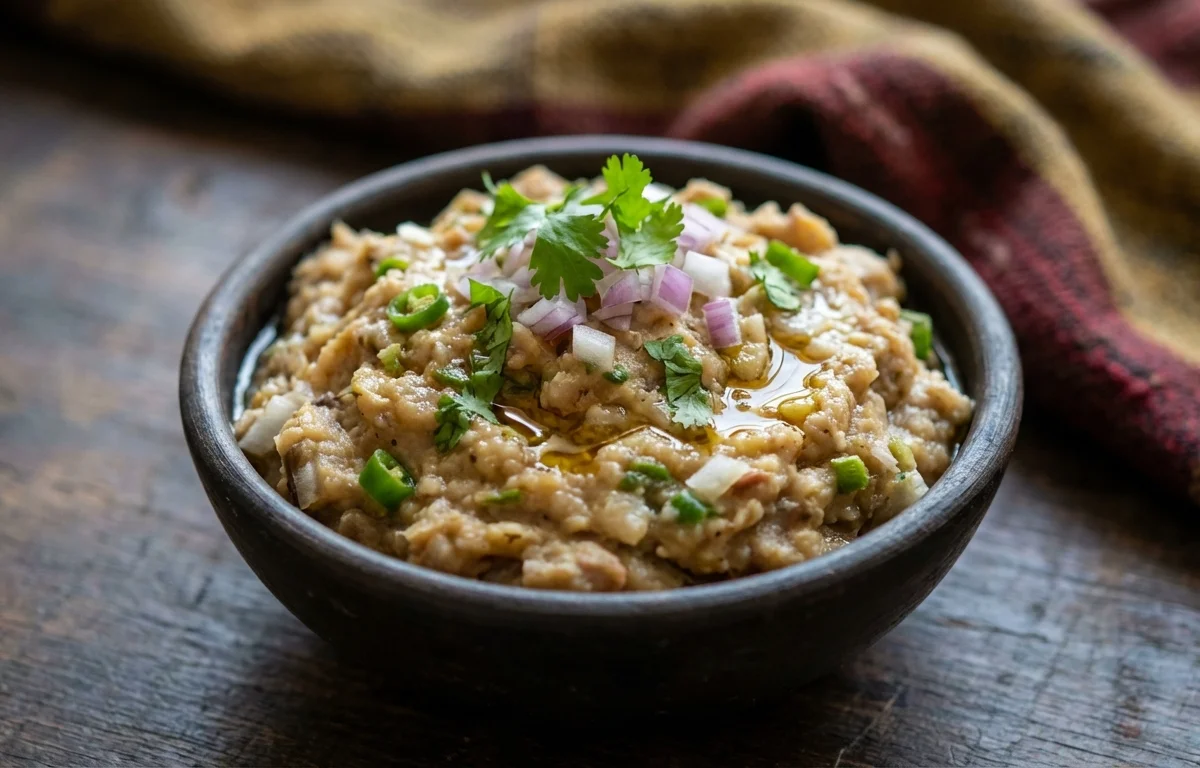
Kothalguti Pitika
A rustic, smoky Assamese mash where roasted jackfruit seeds are pounded with green chilies, mustard oil, and fresh coriander. Nutty, earthy, and deeply satisfying — this humble pitika turns a usually discarded treasure into a warm, comforting side.
For 2 servings
- prep
Clean and rinse the jackfruit seeds.
Remove the outer white skin from the fresh jackfruit seeds. Wash them thoroughly under running water and pat dry.
TIPUse a sharp paring knife to peel the thin outer layer — it comes off easily. - roast · ~20 min
Roast the seeds until charred and tender.
Place the seeds on a heavy skillet over medium heat or directly over an open flame. Roast for 15-20 minutes, turning occasionally, until the outer skin crackles, chars in spots, and a knife slides in easily.
TIPThe smoky roasted aroma is key — don't rush this step. - prep · ~5 min
Cool and peel the roasted seeds.
Let the roasted jackfruit seeds cool for 5 minutes until easy to handle, then peel away the remaining charred outer skin completely.
- mix · ~2 min
Mash the seeds with green chili and onion.
Place the peeled seeds in a mortar and pestle or mixing bowl. Add the green chilies and a pinch of salt. Pound gently with the pestle or mash with a fork until coarsely crushed but not a smooth paste — leave some chunky texture.
TIPCoarse texture is traditional — don't over-mash into a paste. - mix · ~1 min
Finish with mustard oil and coriander.
Add the finely chopped onion, fresh coriander leaves, and mustard oil to the crushed seed mixture. Mix everything together gently with a spoon until well combined. Taste and adjust salt if needed.
TIPRaw mustard oil's pungency is authentic — don't heat it. - serve
Serve the pitika at room temperature.
Transfer the Kothalguti Pitika to a serving bowl. Serve as a side with steamed rice and dal.
TIPIt tastes best after resting 10 minutes for the mustard oil to mellow slightly.
What to keep in mind.
6 tips from the recipe — small details that make a real difference to the final dish.
- 1Char the jackfruit seeds over an open flame for a deeper smoky flavour if you have a gas stove.
- 2Do not over-mash the seeds — a coarse, chunky texture is traditional and more satisfying.
- 3Let the pitika rest for 10 minutes after mixing so the mustard oil's pungency mellows slightly.
- 4Use cold-pressed mustard oil for authentic flavour; do not heat it as the raw pungency is key.
- 5Make-ahead: prepare the roasted and peeled seeds up to 1 day ahead and mash just before serving.
- 6If you can't eat raw mustard oil, substitute with toasted sesame oil for a different but delicious nuttiness.
Adapt it for your goals.
Low-oil / oil-free
Skip the mustard oil entirely and replace it with 1 tablespoon of fresh lemon or lime juice for a bright, tangy version that still has moisture and lift.
with garlicWith garlic
Add 1 small crushed garlic clove along with the green chilies for an extra layer of savoury warmth — common in some Assamese variations.
high proteinHigh-protein
Fold in 2 tablespoons of roasted peanuts or crushed roasted chickpeas (dalia) for added crunch and protein, keeping the nutty theme intact.
with greensWith greens
Stir in a handful of finely chopped fresh spinach or mustard greens (sarson ka saag) for a nutritional boost and a mild peppery flavour.
Why this is on our healthy list.
Rich in Plant Protein
Jackfruit seeds are a good source of plant-based protein, making this dish a satiating addition to vegetarian meals.
High in Dietary Fiber
The seeds provide a generous amount of fiber, which supports healthy digestion and helps maintain steady energy levels.
Contains Essential Minerals
Jackfruit seeds supply magnesium, potassium, and iron — important for muscle function, blood pressure regulation, and oxygen transport.
Good Source of B-Vitamins
These seeds are naturally rich in B vitamins like thiamine and riboflavin, which help convert food into energy.
Low in Saturated Fat
Made with only a small amount of mustard oil, this pitika is naturally low in saturated fat and free of cholesterol.
Frequently asked questions
No, fresh jackfruit seeds are essential — canned or frozen seeds are already cooked and lack the firm texture needed for charring and mashing.