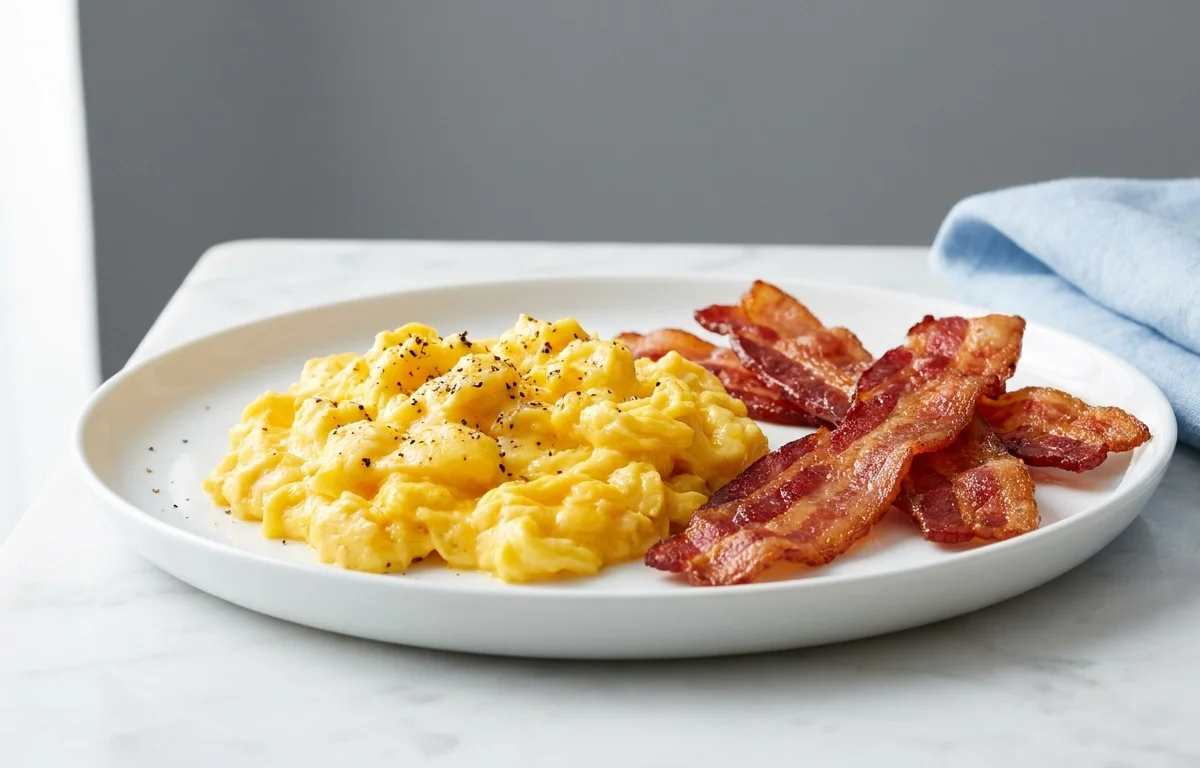
Scrambled Eggs with Bacon
Fluffy, buttery scrambled eggs paired with strips of crispy bacon. A classic American diner-style breakfast that comes together in under 20 minutes with just a handful of pantry staples.
For 4 servings
- fry · ~8 min
Cook the bacon until crisp.
1.Lay bacon strips in a cold non-stick skillet without overlapping.2.Set over medium heat and cook for 4–5 minutes, then flip.3.Cook the second side until deeply golden and crisp (another 3–4 minutes).4.Transfer to a paper towel–lined plate with a slotted spoon; keep the rendered fat in the pan.TIPStarting in a cold pan helps the fat render slowly for even crispness. - mix · ~1 min
Whisk the eggs.
In a large bowl, whisk the eggs, salt, and black pepper until uniformly pale and slightly frothy—about 30 seconds.
- prep · ~1 min
Set up the pan for scrambling.
Pour off all but 1 tablespoon of the bacon fat from the skillet. Add the butter and melt it over medium-low heat.
TIPMedium-low heat is key for soft, tender curds—high heat makes rubbery eggs. - saute · ~3 min
Scramble the eggs gently.
1.Pour the whisked eggs into the skillet.2.Let them set undisturbed for 15–20 seconds until the edges begin to firm.3.With a silicone spatula, push the eggs from the edges toward the center in slow, sweeping motions.4.Continue folding and pushing until the eggs form soft, custardy curds (2–3 minutes total).TIPPull the pan off the heat when the eggs still look slightly wet—carryover heat finishes them. - assemble · ~1 min
Crumble the bacon and fold it in.
Crumble or chop the crisp bacon into small pieces. Gently fold two-thirds of the bacon into the scrambled eggs, leaving a little for garnish.
- garnish · ~1 min
Garnish with chives and remaining bacon.
Divide the scramble among plates, scatter the reserved bacon pieces and fresh chives over the top, and serve immediately.
What to keep in mind.
6 tips from the recipe — small details that make a real difference to the final dish.
- 1For extra creamy curds, stir in a tablespoon of cold cubed butter right before the eggs finish cooking.
- 2Reserve a teaspoon of bacon fat to drizzle over the eggs just before serving for a richer smoky flavor.
- 3Let the bacon drain on paper towels for at least a minute so it stays crisp when folded into the eggs.
- 4Use a silicone spatula to gently push curds—metal or wood can scratch non-stick and break up the curds too much.
- 5If you prefer drier scrambled eggs, cook an extra minute over low heat, but stop before they turn brown.
- 6Make-ahead: cook the bacon up to 3 days ahead and reheat in a 350°F oven for 5 minutes before assembling.
Adapt it for your goals.
Low-fat
Replace half the bacon with turkey bacon and use only 1 tablespoon of butter to cut saturated fat while keeping a similar savory profile.
vegetarianVegetarian
Omit the bacon entirely and sauté 1/2 cup of diced mushrooms in the butter for umami depth; top with smoked paprika for a bacon-like note.
cheesyCheesy
Fold in 1/3 cup of shredded sharp cheddar or crumbled feta just as the eggs finish cooking for a melty, tangy twist.
spicySpicy
Add a diced jalapeño or a pinch of cayenne pepper to the egg mixture, and garnish with pickled red onions for heat and acidity.
dairy freeDairy-free
Use olive oil or coconut oil in place of butter and skip the cream to make this recipe lactose-free without sacrificing texture.
Why this is on our healthy list.
Rich in High-Quality Protein
Eggs and bacon together provide a complete protein profile with all essential amino acids, supporting muscle repair and satiety.
Source of B Vitamins
Eggs contain riboflavin and vitamin B12, while bacon provides thiamin and niacin, all crucial for energy metabolism.
Contains Choline for Brain Health
Egg yolks are one of the best dietary sources of choline, a nutrient important for memory and cognitive function.
Provides Selenium and Zinc
Bacon contributes selenium and zinc, minerals that support immune function and thyroid health.
Moderate in Saturated Fat
Using unsalted butter and trimming visible bacon fat can help manage saturated fat intake while still enjoying the dish.
Frequently asked questions
Cooking over medium-high heat and over-stirring causes the egg proteins to tighten and expel moisture. Use medium-low heat and gentle folding for tender curds.