
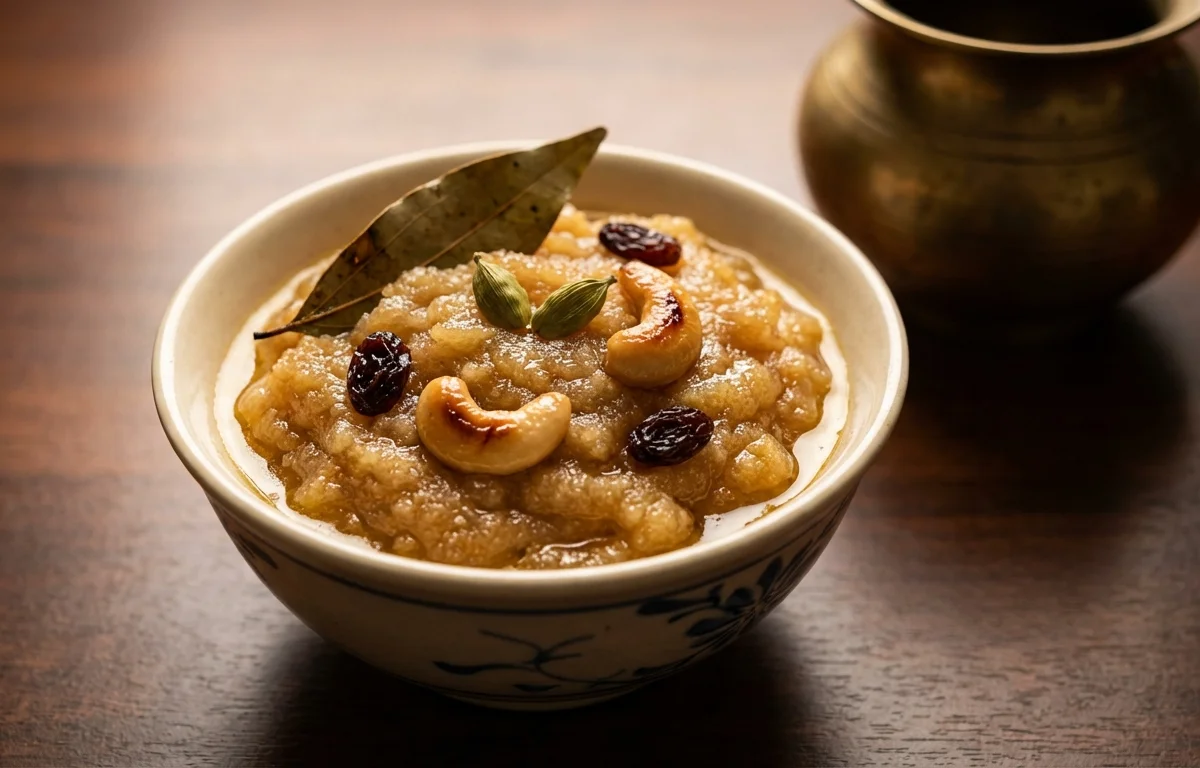
Bengali Suji Halwa
This comforting Bengali-style suji halwa is warm, soft, and lightly fragrant with cardamom. Roasted semolina cooked with milk, water, sugar, and ghee turns into a simple festive sweet that comes together quickly.
For 4 servings
- prep
Measure the ingredients and crush the cardamom.
Keep the semolina, milk, water, sugar, ghee, cashews, raisins, and crushed cardamom ready near the stove so the halwa comes together smoothly once roasting starts.
- boil · ~5 min
Heat the milk, water, sugar, and cardamom.
Add the milk, water, sugar, and crushed cardamom to a saucepan and bring just to a gentle boil, stirring to dissolve the sugar.
- saute · ~2 min
Roast the cashews and raisins in ghee.
Heat the ghee in a heavy pan over medium heat. Add the cashews and cook until lightly golden, then add the raisins and cook until they plump up. Remove them to a small plate.
- saute · ~7 min
Roast the semolina.
Add the semolina to the same pan and roast on low to medium heat, stirring often, until it smells nutty and turns lightly golden.
TIPKeep the heat moderate and stir constantly near the end so the semolina colors evenly without burning. - mix · ~2 min
Pour in the hot liquid carefully.
Lower the heat and slowly pour the hot milk mixture into the roasted semolina, stirring continuously to prevent lumps. The mixture will bubble quickly at first.
- simmer · ~5 min
Cook the halwa until thick.
Keep stirring over low heat until the semolina absorbs the liquid and the halwa turns soft, thick, and starts leaving the sides of the pan.
- garnish
Fold in the fried cashews and raisins.
Mix most of the fried cashews and raisins into the halwa and keep a few aside for the top.
- serve
Serve warm.
Spoon the halwa into katoris, top with the reserved cashews and raisins, and serve warm.
What to keep in mind.
7 tips from the recipe — small details that make a real difference to the final dish.
- 1Use a heavy pan for roasting suji so it colors evenly and does not catch in hot spots.
- 2Roast the semolina until it smells distinctly nutty; pale suji gives a raw-tasting halwa.
- 3Keep the milk-water mixture hot when adding it to the pan, or the halwa can turn lumpy.
- 4Pour the liquid in slowly while stirring constantly, as the suji swells fast and bubbles sharply.
- 5Stop cooking when the halwa looks soft but leaves the sides of the pan; it will firm up slightly as it sits.
- 6If the halwa thickens too much before serving, loosen it with a small splash of hot milk and stir well.
- 7This halwa reheats best on low heat with a little milk or water to bring back its soft texture.
Adapt it for your goals.
Less-sweet
Reduce the sugar slightly for a milder, more cardamom-forward halwa that feels lighter after a meal.
richer festiveRicher-festive
Use all milk instead of part water for a creamier, more luxurious texture suited to puja or special occasions.
nut freeNut-free
Skip the cashews and increase raisins for a simpler version that still keeps the sweet, ghee-roasted character.
veganVegan
Replace ghee with coconut oil or a neutral vegan fat and use plant milk for a dairy-free take with similar softness.
Why this is on our healthy list.
Milk Adds Protein and Calcium
The milk in this halwa contributes protein and calcium, making it more nourishing than a water-only sweet.
Nuts and Raisins Add More Than Sweetness
Cashews provide healthy fats and some minerals, while raisins add fruit-based sweetness and a little fiber.
Comforting Energy Source
Semolina is a quick-cooking grain that gives this dish satisfying energy and a filling, warm texture.
Frequently asked questions
Lumps usually happen when the liquid is added too fast or without constant stirring. Keep the liquid hot and pour it in gradually while stirring the suji continuously.



-curry.webp)
.webp)