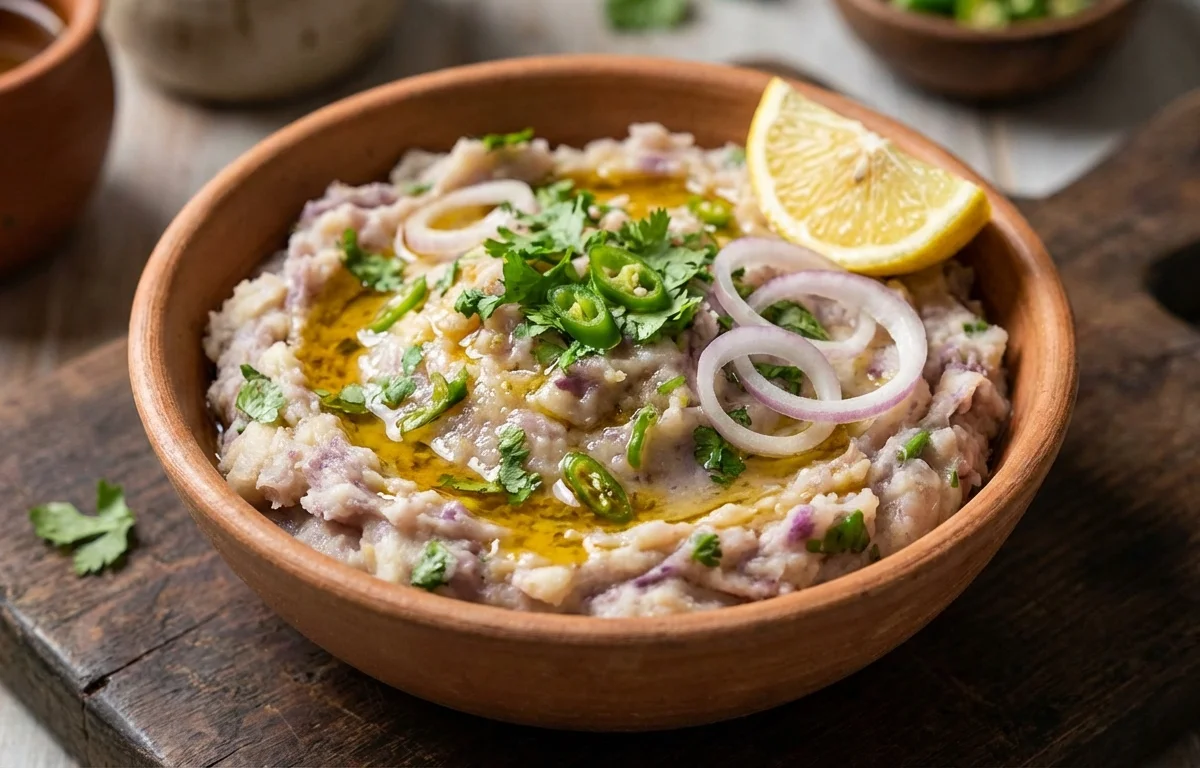
Kosu Pitika
A rustic Assamese mash of creamy boiled colocasia, blitzed with raw mustard oil, fresh green chilies, and lots of chopped onions. The earthy sweetness of the taro roots balances beautifully with the pungent mustard oil, creating a soulful side dish that pairs perfectly with steamed rice and dal.
For 4 servings
- prep · ~15 min
Wash and pressure cook the colocasia roots.
1.Wash colocasia roots thoroughly under running water to remove all mud.2.Place in pressure cooker with just enough water to cover.3.Pressure cook for 2 whistles on medium heat, then reduce to low and cook 5 minutes.4.Turn off heat and let pressure release naturally.TIPChoose small, tender colocasia roots. The larger ones can be slightly fibrous. - prep · ~5 min
Peel and mash the boiled colocasia.
1.Once cool enough to handle, peel off the skin completely.2.Transfer peeled colocasia to a large mixing bowl.3.Mash with a fork or your fingers until it breaks down into a coarse, chunky texture.TIPDon't over-mash — a few small chunks add character to the pitika. - mix · ~2 min
Mix in the aromatics and mustard oil.
1.Add the finely chopped onions to the mashed colocasia.2.Add chopped green chilies and salt.3.Drizzle the raw mustard oil over everything.4.Mix well with your fingers, pressing gently to blend the flavors.TIPUsing fingers instead of a spoon gives a more rustic, authentic texture. The raw mustard oil's pungency is the soul of this dish. - rest · ~5 min
Let the flavors meld for 5 minutes.
Cover the bowl and let it rest for 5 minutes. This allows the sharp mustard oil to mellow slightly and absorb into the mashed colocasia.
- garnish
Garnish with fresh coriander and serve at room temperature.
Sprinkle chopped coriander leaves on top. Serve alongside steamed rice and a simple dal.
What to keep in mind.
7 tips from the recipe — small details that make a real difference to the final dish.
- 1Choose small, tender colocasia roots for a creamier texture and fewer fibers.
- 2Let the pressure release naturally to avoid overcooking and mushy roots.
- 3Do not rinse the mashed colocasia; residual starch helps bind the pitika.
- 4Mix with your fingers to achieve a rustic, chunky texture and even distribution.
- 5Use raw mustard oil for authentic pungency — do not heat or substitute.
- 6Let the pitika rest 5 minutes after mixing so the mustard oil mellows into the mash.
- 7Serve at room temperature; refrigeration dulls the fresh, bold flavors.
Adapt it for your goals.
Vegan
This dish is naturally vegan — no changes needed. It relies only on plant-based ingredients: taro, onions, chilies, mustard oil, and coriander.
low oilLow-oil
Reduce mustard oil to 1 tablespoon for a lighter version. The dish will be less pungent but still enjoyably earthy and spicy.
herbaceous twistHerbaceous twist
Add 1 tablespoon of finely chopped fresh mint or roasted sesame seeds for an extra layer of flavor and texture.
Why this is on our healthy list.
Rich in Dietary Fiber
Colocasia roots are a good source of fiber, supporting digestion and promoting satiety in this rustic mash.
Naturally Gluten-Free
This dish contains no wheat or gluten, making it suitable for those with gluten sensitivities.
Source of Potassium
Taro roots provide potassium, an essential mineral for heart and muscle function.
Low in Fat
With only 2 tablespoons of oil for the whole dish, it is a relatively low-fat preparation.
Frequently asked questions
Potato is not a direct substitute; taro has a unique earthy sweetness and creamy texture. If substituted, the dish will be milder and less authentic.