
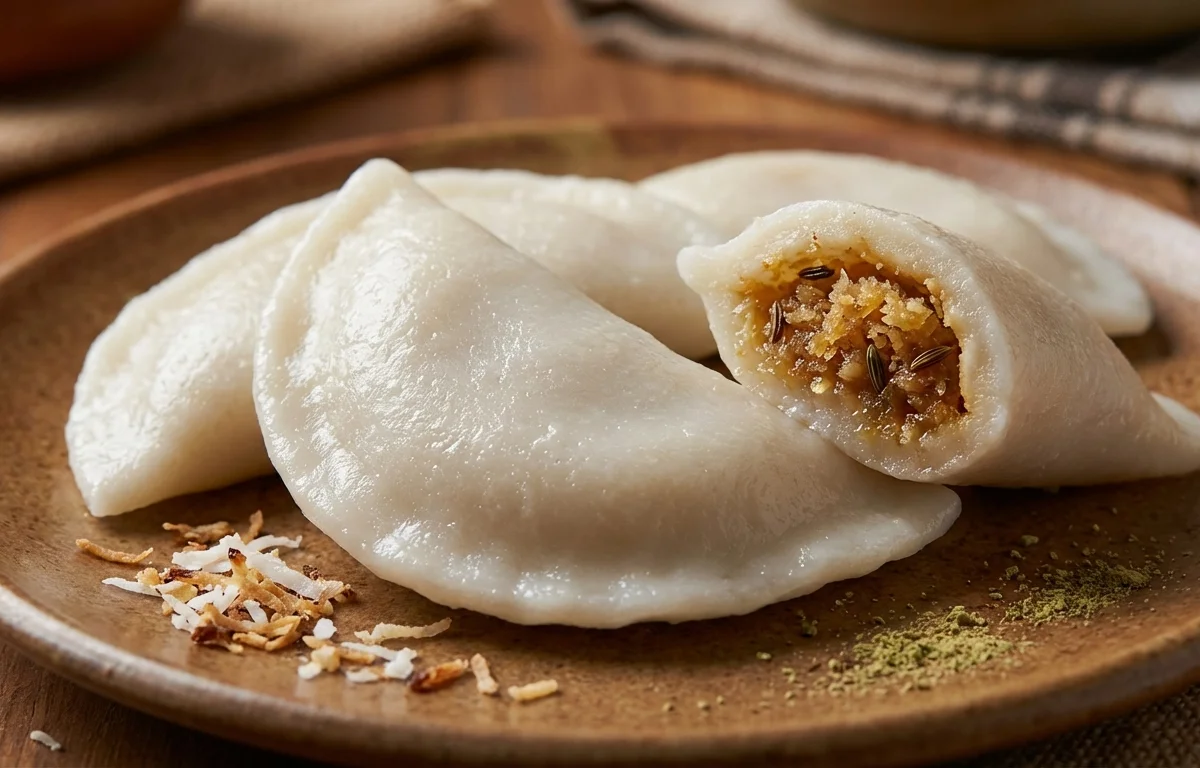
Narikolor Pitha
Delicate, lacy-edged rice flour crepes filled with sweet, nutty coconut-jaggery stuffing. A beloved Assamese festival treat, these soft folded pithas melt in your mouth and pair beautifully with a hot cup of tea on a rainy afternoon.
For 4 servings
- prep · ~6 min
Make the sweet coconut filling.
1.Place a pan over low heat and add the grated coconut and crumbled jaggery.2.Add the crushed cardamom seeds and stir continuously until the jaggery melts completely.3.Cook for 4-5 minutes until the mixture thickens and starts to leave the sides of the pan.4.Remove from heat and let the filling cool slightly. - mix · ~5 min
Prepare the rice flour batter.
In a large mixing bowl, combine the rice flour and a pinch of salt. Gradually add warm water while whisking continuously to form a smooth, lump-free batter. The consistency should be thin and flowing, similar to a crepe batter.
- prep · ~1 min
Set up your cooking station.
Place the cooled coconut filling, the batter, and a small bowl of oil next to the stove. Have a plate ready for the finished pithas.
- fry · ~2 min
Cook the pitha crepes.
1.Heat a non-stick pan over medium heat. Once warm, lightly grease it with a few drops of oil using a paper towel or pastry brush.2.Pour a ladleful (about 1/4 cup) of batter onto the pan and immediately swirl it around to spread into a thin, round circle.3.Let it cook for about 1 minute until the underside sets and the edges start lifting slightly.TIPKeep the heat at medium. Too high and the batter will set before you can spread it thin. - assemble · ~1 min
Fill and fold the pitha.
1.Place a generous spoonful (about 2 tablespoons) of the coconut-jaggery filling in the center of the crepe while it's still on the pan.2.Gently fold the pitha in half to form a semi-circle, pressing the edges down lightly with the spatula.3.Drizzle a few more drops of oil around the edges and cook for another 30-45 seconds until golden and crisp at the edges. - serve · ~15 min
Serve warm.
Transfer the pitha to a plate. Repeat the process with the remaining batter and filling. Serve the narikolor pitha warm, as is or with a cup of Assam tea.
What to keep in mind.
7 tips from the recipe — small details that make a real difference to the final dish.
- 1Use freshly grated coconut for the filling – pre-packaged dried coconut will not yield the same moist, tender texture.
- 2Grind the rice flour fresh if possible; store-bought can be coarser, so sift it once before making the batter.
- 3The batter should be thin and runny, like a dosa or crepe batter – add warm water gradually until it flows easily off the ladle.
- 4Keep the heat at medium throughout; high heat will set the crepe before you can swirl it thin, and low heat will make it chewy.
- 5Cook the filling until the jaggery fully melts and the mixture leaves the sides of the pan – this ensures it won't ooze out while folding.
- 6Assemble the pitha while the crepe is still on the pan and slightly soft – it folds easily and the edges seal better.
- 7These pithas are best served fresh and warm; they can be stored in an airtight container for up to a day, but reheat gently on a tawa.
Adapt it for your goals.
Nutty crunch
Add 2 tablespoons of finely chopped roasted peanuts or cashews to the coconut filling for a contrasting crunchy texture.
spiced versionSpiced version
Add a pinch of freshly grated nutmeg or a few threads of saffron to the filling for a warm, festive aroma.
savoury twistSavoury twist
Replace the jaggery with an equal quantity of grated paneer, a pinch of salt, chopped green chillies, and coriander – a delicious savoury variation for breakfast.
coconut freeCoconut-free
Substitute the coconut with finely grated carrot and cook it with jaggery and cardamom – a colourful and equally sweet alternative.
Why this is on our healthy list.
Gluten-Free Grain Base
Made entirely from rice flour, these pithas are naturally gluten-free, making them suitable for those with gluten sensitivities.
Energy from Natural Sugars
Jaggery provides a source of unrefined carbohydrates, offering a quick energy boost along with trace minerals like iron and magnesium.
Healthy Fats from Coconut
Fresh coconut contributes medium-chain triglycerides (MCTs) that are easily metabolized and may support sustained energy.
Minimal Processed Ingredients
The recipe uses only whole, unprocessed ingredients – rice flour, coconut, jaggery, and cardamom – with no preservatives or additives.
Frequently asked questions
Lumps form when warm water is added too quickly or the rice flour is not sifted. Whisk continuously while adding water slowly, and if lumps appear, strain the batter through a fine sieve.



-curry.webp)
.webp)