
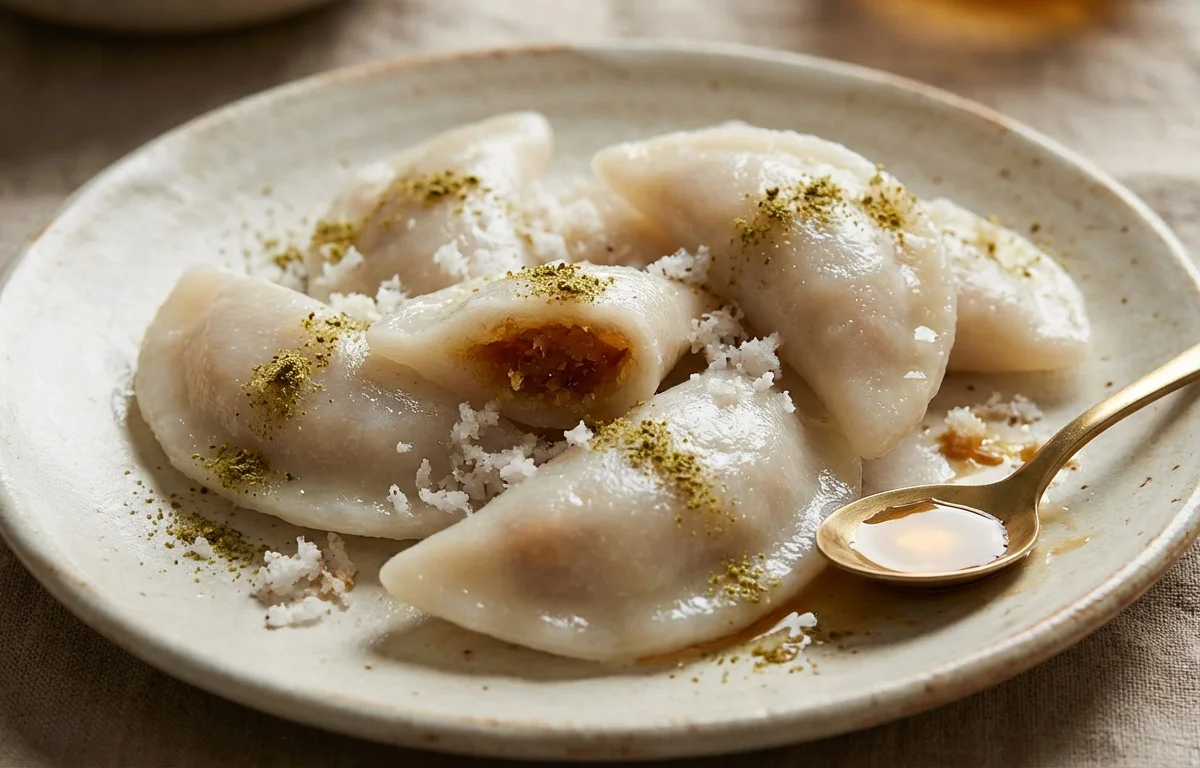
Narkel Puli Pithe
Tender rice flour dumplings filled with sweet coconut and date palm jaggery, then gently simmered in milk until soft and fragrant. This beloved Bengali winter sweet is comforting, delicate, and perfect for festive mornings.
For 8 servings
- saute · ~8 min
Make the coconut filling.
1.Heat a heavy pan over low heat and add the grated coconut.2.Add 0.75 cup date palm jaggery and crushed cardamom seeds.3.Cook, stirring often, until the jaggery melts and the mixture turns sticky but fairly dry, 6 to 8 minutes.4.Take it off the heat and let the filling cool completely.TIPKeep the filling fairly dry so it stays inside the dumplings and does not leak while shaping. - boil · ~5 min
Cook the rice flour dough.
1.Bring 1.5 cups water and 1 pinch salt to a gentle boil in a pan.2.Lower the heat and add the rice flour all at once.3.Mix quickly until it comes together into a soft mass with no dry patches.4.Cover and cook on very low heat for 1 minute, then turn off the heat.TIPAdd the flour in one go and mix right away to prevent lumps. - knead · ~7 min
Knead the dough until smooth.
Transfer the warm dough to a plate, add the ghee, and knead while still warm until smooth and crack-free. Cover with a cloth so it does not dry out.
- assemble · ~15 min
Shape and fill the puli pithe.
1.Divide the dough into 8 equal portions and roll each into a smooth ball.2.Flatten one ball into a small cup with your fingers.3.Place 1 to 2 teaspoons coconut filling in the center.4.Fold into a half-moon and press the edges firmly to seal.5.Repeat with the remaining dough and filling.TIPIf the edges crack, lightly moisten your fingers with water and press them smooth. - simmer · ~10 min
Reduce the milk gently.
Pour the milk into a wide pan, add the bay leaf, and bring it to a gentle simmer. Cook for 8 to 10 minutes, stirring now and then, until it reduces slightly.
- simmer · ~12 min
Cook the puli in the milk.
1.Slide the shaped puli into the simmering milk one by one.2.Cook on low heat until they float and turn tender, 10 to 12 minutes.3.Stir very gently once or twice so they do not stick to the bottom.4.Add the remaining 0.5 cup date palm jaggery and stir until dissolved.TIPKeep the heat low after adding jaggery so the milk stays smooth and does not split. - rest · ~10 min
Let the pithe rest for 10 minutes.
- serve
Serve warm or at room temperature.
What to keep in mind.
7 tips from the recipe — small details that make a real difference to the final dish.
- 1Knead the rice dough while still warm; once cool, it cracks more easily during shaping.
- 2Keep the coconut-jaggery filling fairly dry, or it will seep out and open the puli in the milk.
- 3Cover the dough portions with a damp cloth as you shape so the surface does not dry out.
- 4Seal the half-moon edges firmly with your fingertips; any gap can let milk enter and split the dumpling.
- 5Use a wide pan for simmering so the puli have space and are less likely to stick or tear.
- 6Add the second batch of date palm jaggery only after the puli are cooked and the heat is very low.
- 7Resting the pithe for 10 minutes helps the dumplings absorb the flavored milk and soften evenly.
Adapt it for your goals.
Thicker-kheer-style
Reduce the milk a little longer before adding the puli for a richer, more pudding-like serving style.
less sweetLess-sweet
Cut back slightly on the jaggery in the milk so the coconut filling stays the main sweet element.
veganVegan
Use coconut milk or a mix of coconut milk and water instead of dairy milk, and replace ghee with coconut oil.
stuffed with kheerStuffed-with-kheer
Add a little khoya to the coconut filling for a denser, festive filling with a more luxurious texture.
Why this is on our healthy list.
Naturally gluten-free base
Rice flour makes the outer shell suitable for those who avoid wheat, while still giving the pithe its classic soft texture.
Coconut adds satisfying richness
Fresh grated coconut contributes natural fats and fiber, which make this sweet more filling and flavorful.
Milk provides nourishment
Full-fat milk adds protein and calcium along with a creamy body that turns the dessert into a more substantial treat.
Frequently asked questions
The dough was likely too cool or a little dry. Knead it while warm, keep it covered, and smooth small cracks with lightly wet fingers.


