
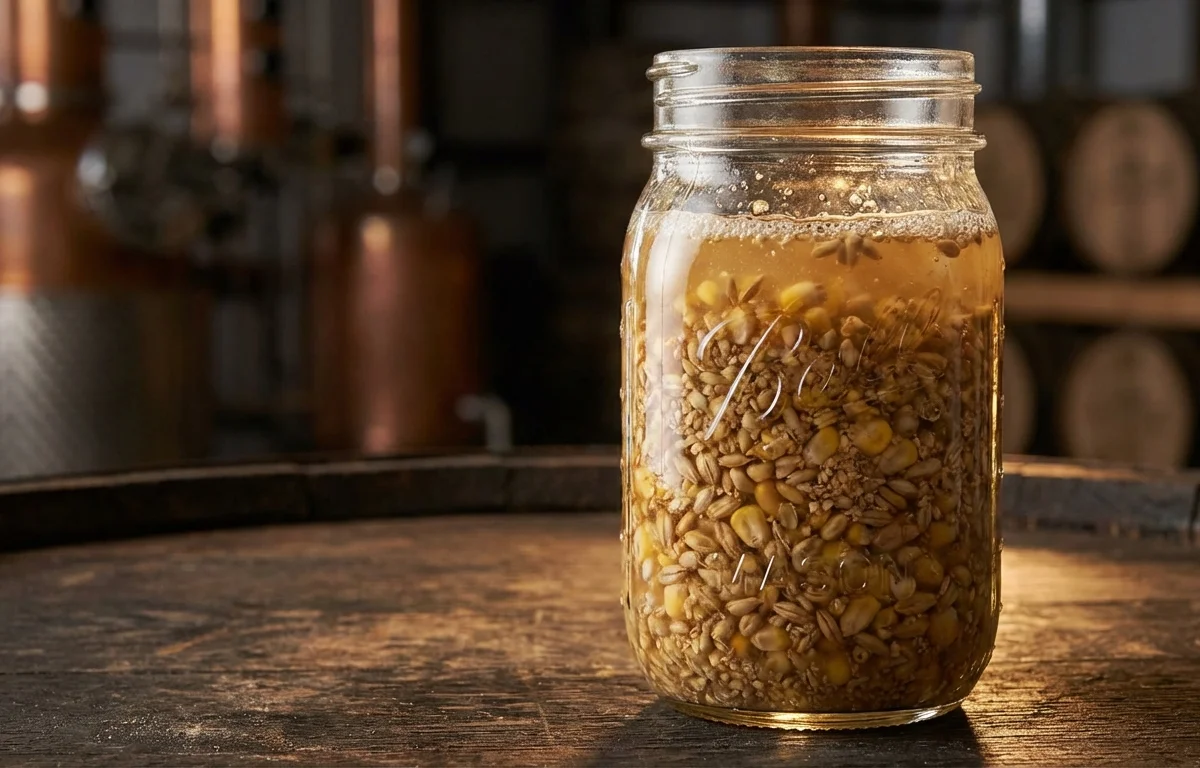
Rye Whiskey Mash
This is the foundational recipe for creating a classic American rye whiskey. It balances the spicy character of rye with the sweetness of corn, creating a fermented wash that's ready for distillation. Perfect for the craft home distiller.
For 5 servings
Sanitize Equipment
1.Thoroughly clean and sanitize your mash pot, fermenter, airlock, stirring spoon, and any other equipment that will touch the mash after boiling. This is the most critical step to prevent contamination from unwanted bacteria.Mash In and Liquefy (Approx. 90 minutes)
1.In a large pot (at least 8-10 gallons), heat 5 gallons of chlorine-free water to 165°F (74°C).2.Turn off the heat. Slowly stir in the flaked rye and flaked corn, mixing vigorously to prevent clumps from forming.3.Check the temperature; it should stabilize around 155°F (68°C).4.Stir in the alpha-amylase enzyme. This enzyme begins breaking down the long starch chains.5.Hold this temperature for 75-90 minutes, stirring every 15 minutes to prevent scorching. The mash will thin out considerably as the starches liquefy.Convert Starches (Saccharification) (Approx. 60 minutes)
1.Allow the mash to cool naturally to 148°F (64°C). You can speed this up by adding the remaining 1 gallon of cool water if needed.2.Once at temperature, vigorously stir in the crushed malted barley and the glucoamylase enzyme.3.Hold the mash between 145-148°F (63-64°C) for 60 minutes, stirring occasionally. The natural enzymes in the barley and the added glucoamylase will convert the liquefied starches into fermentable sugars.Cool the Mash (Approx. 30 minutes)
1.After the 60-minute conversion rest, you must rapidly cool the mash down to 75-80°F (24-27°C).2.The most effective method is using a sanitized immersion chiller. Alternatively, you can place the covered pot in an ice bath in a sink or large tub.3.Cooling quickly minimizes the window of opportunity for airborne bacteria to contaminate your sugary mash.Pitch Yeast and Begin Fermentation
1.Carefully transfer the cooled mash into your sanitized fermenter. Splashing during the transfer is beneficial as it introduces oxygen, which the yeast needs for its initial growth phase.2.If you have a hydrometer, take a specific gravity reading now. It should be between 1.060 and 1.070.3.Sprinkle the distiller's yeast and optional yeast nutrient evenly over the surface of the mash.4.Seal the fermenter and attach an airlock filled with sanitizer or vodka. Place the fermenter in a dark place with a stable ambient temperature around 70-75°F (21-24°C).Monitor Fermentation (5-10 days)
1.You should see active bubbling in the airlock within 12-24 hours. This is CO2, a byproduct of fermentation.2.Allow the mash to ferment undisturbed for 5 to 10 days.3.Fermentation is complete when the airlock bubbling ceases and the specific gravity reading is stable for two consecutive days (typically around 1.005 - 1.010).4.The mash, now called a 'wash', is ready for distillation.
What to keep in mind.
6 tips from the recipe — small details that make a real difference to the final dish.
- 1Always use chlorine-free water (spring, distilled, or filtered), as chlorine can inhibit yeast and create off-flavors.
- 2Temperature control is paramount. Use a reliable digital thermometer and strive to hold your temperatures as steady as possible during the rests.
- 3Stir the mash thoroughly, especially scraping the bottom, to prevent scorching during heating.
- 4Sanitization cannot be overstated. Anything that touches the mash after it's cooled must be sanitized to prevent bacterial infection.
- 5An optional iodine test can confirm starch conversion. Add a drop of iodine to a small sample of mash liquid on a white plate. If it turns black, starches are still present; if it remains reddish-brown, conversion is complete.
- 6Distillation of alcohol without the proper federal and local permits is illegal in many places and can be dangerous if done improperly. This recipe is for the fermented mash only. Always understand and comply with your local laws.
Adapt it for your goals.
High-Rye Mash
For a spicier, more rye-forward character, increase the flaked rye to 8 lbs and decrease the flaked corn to 1 lb. Keep the malted barley the same.
Wheated Rye MashWheated-Rye Mash
Replace the 2.5 lbs of flaked corn with 2.5 lbs of flaked wheat for a softer, smoother profile in the final spirit.
Traditional Mash (No Enzymes)Traditional Mash (No Enzymes)
Omit the alpha-amylase and glucoamylase. Increase the malted barley to 3 lbs. This relies solely on the barley's natural enzymes but requires more precise temperature control.
Why this is on our healthy list.
Whole Grain Base
The mash is created from whole grains like rye and corn, which, before fermentation, provide complex carbohydrates and dietary fiber.
Source of B Vitamins
Grains and the addition of yeast contribute B vitamins, such as niacin and thiamin, which are essential for converting food into energy.
Frequently asked questions
The unfermented mash is essentially a porridge made from whole grains, containing fiber and B vitamins. However, this recipe is a precursor to a high-alcohol spirit. While the final product can be enjoyed in moderation as part of a balanced lifestyle, excessive alcohol consumption has well-documented negative health effects.


