
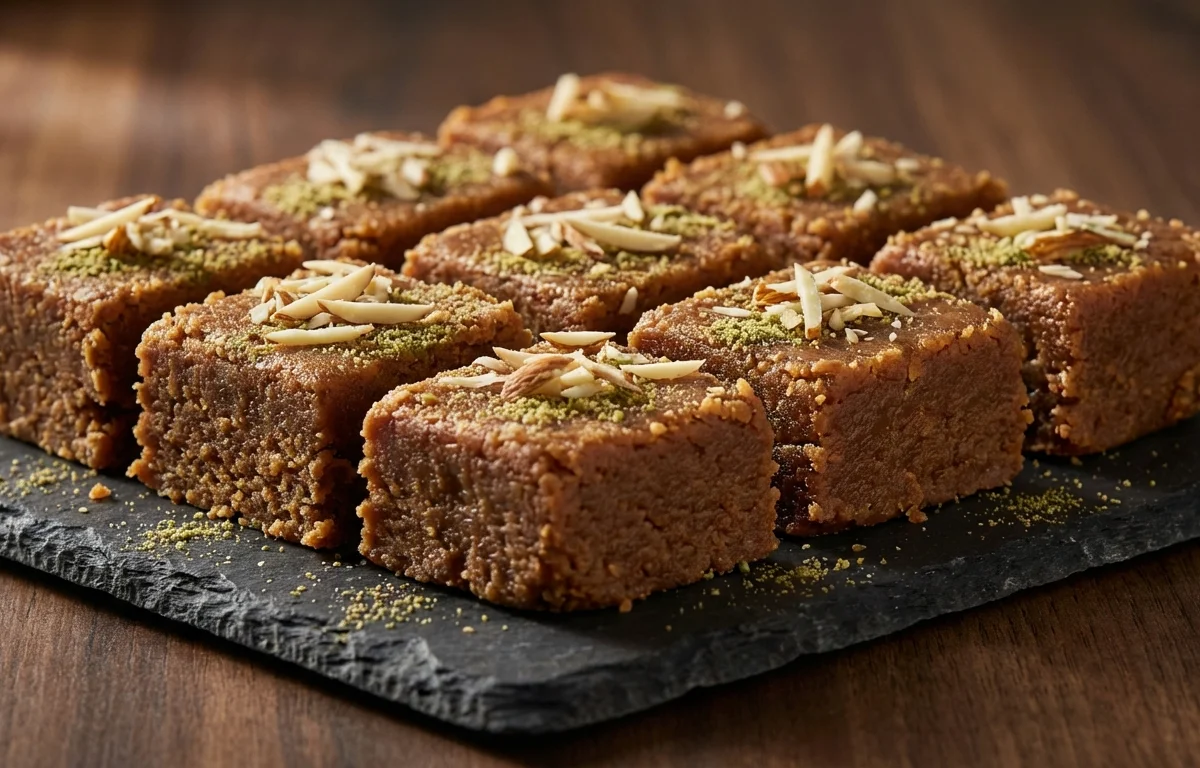
Sukhdi
A quick Gujarati sweet made with whole wheat flour, ghee, and jaggery. It has a rich, nutty taste and a soft, fudge-like bite that melts in the mouth, making it perfect for small festive servings or everyday tea-time treats.
For 8 servings
- prep
Grease a plate and grate the jaggery.
Lightly grease a steel plate or tray with a little ghee from the measured amount. Keep the grated jaggery and cardamom powder ready so you can mix them in quickly later.
- saute · ~10 min
Roast the flour in ghee.
1.Heat ghee in a heavy pan over low heat until melted.2.Add whole wheat flour and mix well to remove lumps.3.Cook on low heat, stirring constantly, until the flour turns deep golden and smells nutty.4.Scrape the pan well as you stir so the flour roasts evenly and does not burn.TIPKeep the heat low throughout; the flour can brown fast at the bottom while staying raw in the middle. - mix · ~2 min
Mix in the jaggery and cardamom.
Take the pan off the heat and let it cool for about 1 minute. Add jaggery and cardamom powder, then stir briskly until the jaggery melts into the hot flour mixture and looks smooth.
TIPDo not add jaggery over direct heat or the mixture can turn chewy instead of soft. - assemble
Spread the mixture and mark pieces.
Pour the hot mixture onto the greased plate and spread it quickly to an even thickness with the back of a spoon or spatula. While still warm, mark 8 squares or diamonds.
- rest · ~15 min
Let the sukhdi set.
Leave it undisturbed until just firm but not fully cold, then separate the marked pieces gently.
- serve
Serve the sukhdi.
Serve at room temperature. Store the remaining pieces in an airtight container once completely cool.
What to keep in mind.
6 tips from the recipe — small details that make a real difference to the final dish.
- 1Use a heavy-bottomed kadai or pan so the wheat flour roasts evenly without scorching at the base.
- 2Roast until the flour shifts from pasty to loose and aromatic; that nutty smell is the best doneness cue.
- 3Let the pan cool briefly before adding jaggery, or the sugar can seize and make the sukhdi chewy.
- 4Spread the mixture immediately after mixing in jaggery, because it starts setting fast as it cools.
- 5Mark the pieces while warm, then separate when just set; if fully cold, the edges may crack unevenly.
- 6If your jaggery has hard bits, grate it finely so it melts smoothly into the hot flour mixture.
Adapt it for your goals.
Nuts-topped
Scatter chopped almonds or pistachios on top before it sets for extra crunch and a festive finish.
ginger spicedGinger-spiced
Add a pinch of dry ginger powder with the cardamom for a warmer, more traditional winter-style flavour.
gol papdi styleGol-papdi style
Make it slightly softer and thicker-cut for a more classic gol papdi texture that feels richer and more melt-in-the-mouth.
millet basedMillet-based
Swap part of the wheat flour with roasted bajra flour for a deeper earthy taste and a more rustic Gujarati variation.
Why this is on our healthy list.
Whole Grain Goodness
Whole wheat flour brings bran and germ, adding more natural fibre and grain nutrients than refined flour sweets.
Mineral-Rich Sweetener
Jaggery is a less refined sweetener that contributes trace minerals along with its deep caramel-like flavour.
Small Portion Satisfaction
Because sukhdi is rich from ghee and wheat flour, a small piece can feel satisfying as a tea-time sweet.
Frequently asked questions
This usually happens when jaggery is added over direct heat or the mixture gets overheated after adding it. Always remove the pan from heat first.


.webp)
.webp)
.webp)