
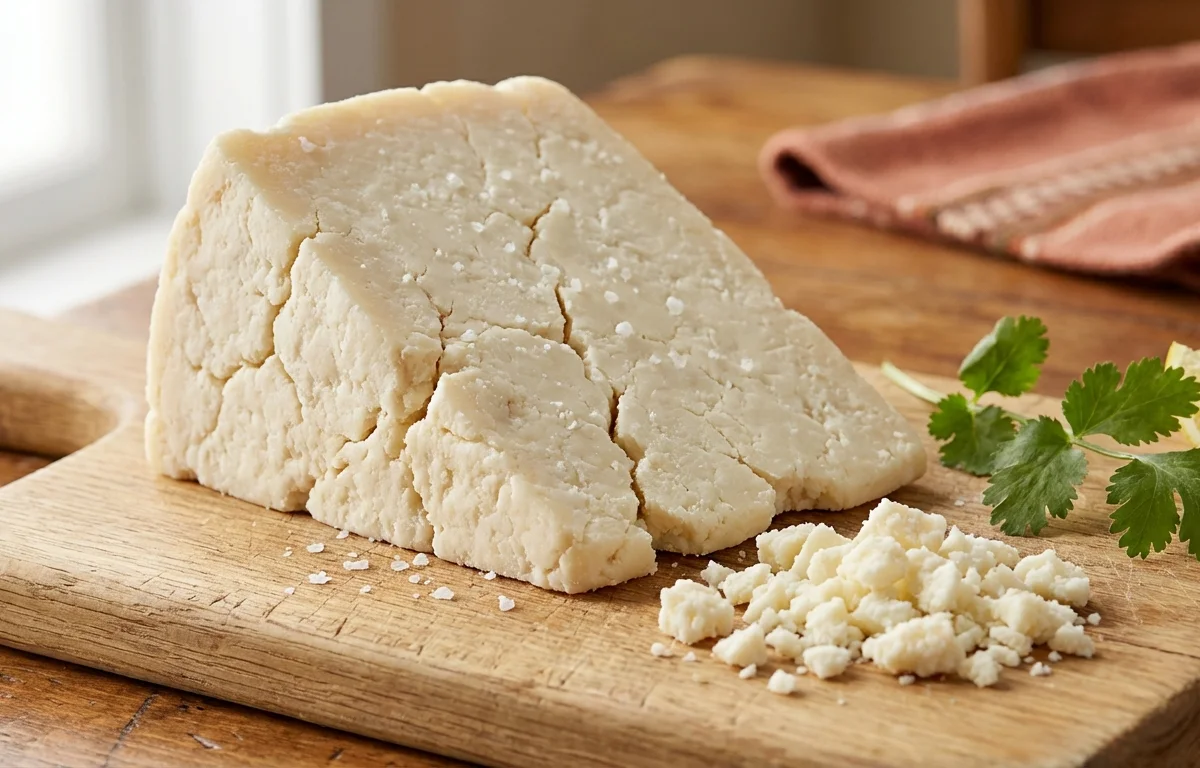
Cotija Cheese
Learn to make authentic, crumbly Cotija cheese at home. This salty, aged Mexican cheese is perfect for crumbling over tacos, salads, and elote. This recipe requires patience and precision, but the rewarding, robust flavor is well worth the effort.
For 16 servings
Sanitize Equipment & Prepare Ingredients
1.Before starting, thoroughly wash and sanitize a large stockpot, long-handled spoon, thermometer, long knife, colander, cheesecloth, and your cheese press. This prevents contamination.2.In a small bowl, dilute the 1/2 tsp of calcium chloride in 1/4 cup of cool, non-chlorinated water. Set aside.3.In a separate small bowl, dilute the 1/2 tsp of liquid rennet in the remaining 1/4 cup of cool, non-chlorinated water. Set aside. Do this just before you need to add it.Heat and Culture the Milk (Approx. 75 minutes)
1.Pour the gallon of milk into the sanitized stockpot. Attach a thermometer to the side.2.Gently heat the milk on medium-low to 90°F (32°C), stirring occasionally to prevent scorching. This should take about 15-20 minutes.3.Once at 90°F, turn off the heat. Sprinkle the mesophilic culture over the milk's surface and let it rehydrate for 2-3 minutes.4.Stir the culture into the milk using an up-and-down motion for 1 minute to ensure it's fully incorporated.5.Stir in the diluted calcium chloride solution.6.Cover the pot and let the milk ripen for 1 hour. Try to maintain the temperature around 90°F (a warm spot in the kitchen or a pre-warmed oven turned off works well).Set the Curd (Approx. 60 minutes)
1.Gently stir the diluted rennet solution into the milk for 1 minute using an up-and-down motion.2.Immediately cover the pot and let it sit completely undisturbed for 45 to 60 minutes.3.Check for a 'clean break' by inserting a clean knife or thermometer into the curd at an angle and lifting straight up. If the curd splits cleanly and the whey that fills the gap is clear, it's ready. If it's soft or milky, wait another 10-15 minutes.Cut and Cook the Curds (Approx. 70 minutes)
1.Using a long knife that reaches the bottom of the pot, cut the curd into 1/2-inch cubes. Make vertical cuts first, then turn the pot 90 degrees and repeat. Finally, hold the knife at a 45-degree angle to make diagonal cuts.2.Let the cut curds rest and heal for 5 minutes.3.Very slowly, heat the curds to 100°F (38°C) over the next 30 minutes. Stir gently with a slotted spoon every 5 minutes to prevent the curds from matting together.4.Once the temperature reaches 100°F, hold it there for another 30 minutes, stirring occasionally. The curds will shrink, firm up, and expel more whey.Drain and Salt the Curds (Approx. 30 minutes)
1.Turn off the heat and let the curds settle to the bottom of the pot for 10 minutes.2.Carefully pour off the whey. You can save the whey for baking or other uses.3.Line a colander with cheesecloth and transfer the curds into it. Let them drain for 15-20 minutes.4.Transfer the drained curds to a large bowl. Break up any large clumps with your fingers and thoroughly mix in the 2 tablespoons of non-iodized salt.Press the Cheese (Approx. 12.5 hours)
1.Line your cheese press mold with a damp piece of cheesecloth, ensuring it's smooth.2.Carefully pack the salted curds into the mold.3.Press at 10 lbs of pressure for 20 minutes.4.Remove the cheese from the press, carefully unwrap it, flip it over, re-wrap it smoothly, and place it back in the press.5.Press at 20 lbs of pressure for 20 minutes.6.Repeat the flipping and re-wrapping process one more time. Press at 40-50 lbs of pressure for 12 hours.Air-Dry and Age the Cheese (30+ days)
1.After pressing, unwrap the cheese. It should be a firm, consolidated wheel. Pat it dry with a clean paper towel.2.Place the cheese on a sanitized cheese mat in a cool (50-60°F / 10-15°C), well-ventilated area. Air-dry for 2-4 days, flipping it twice daily, until the surface is completely dry to the touch.3.Transfer the cheese to an aging environment (like a wine fridge or a dedicated 'cheese cave') at 55°F (13°C) with 80-85% humidity.4.Age for a minimum of 30 days for a mild flavor, or 60-90 days for a sharper, more traditional Cotija. Flip the cheese every 2-3 days to ensure even aging.
What to keep in mind.
6 tips from the recipe — small details that make a real difference to the final dish.
- 1Do not use ultra-pasteurized (UHT) milk; it will not form a proper curd due to the high-heat treatment.
- 2Sanitization is the most critical step in cheesemaking. Ensure all equipment is impeccably clean to prevent unwanted bacteria from spoiling your cheese.
- 3Temperature control is key. Use a reliable digital thermometer and heat the milk slowly and gently to avoid damaging the proteins.
- 4A 'clean break' is the most important indicator that your curd is ready to cut. Don't rush this step, as cutting too early will result in a weak, crumbly cheese.
- 5If you don't have a cheese press, you can create a DIY version using weights (like cans of food) and a mold (like a large, clean can with holes punched in the bottom).
- 6The aged cheese can be stored in the refrigerator, wrapped in cheese paper or parchment paper, for several months.
Adapt it for your goals.
Flavor Infusion
For a sharper, more piquant flavor reminiscent of some artisanal varieties, add 1/8 tsp of lipase powder to the milk at the same time as the culture.
Spicy VersionSpicy Version
Mix 1 teaspoon of finely crushed dried chili flakes (like chile de árbol) into the curds along with the salt before pressing for a spicy kick.
Milk VariationMilk Variation
While traditionally made with cow's milk, you can experiment with using part goat's milk (up to 25%) for a tangier flavor profile.
Why this is on our healthy list.
Rich in Calcium
Cotija cheese is an excellent source of calcium, a mineral essential for building and maintaining strong bones and teeth.
Good Source of Protein
As a dairy product, Cotija provides high-quality protein necessary for muscle repair, immune function, and overall body maintenance.
Contains Probiotics
The fermentation and aging process can introduce beneficial bacteria (probiotics) that support a healthy gut microbiome and aid in digestion.
Frequently asked questions
A 1-ounce (28g) serving of homemade Cotija cheese contains approximately 100-110 calories, primarily from fat and protein.


