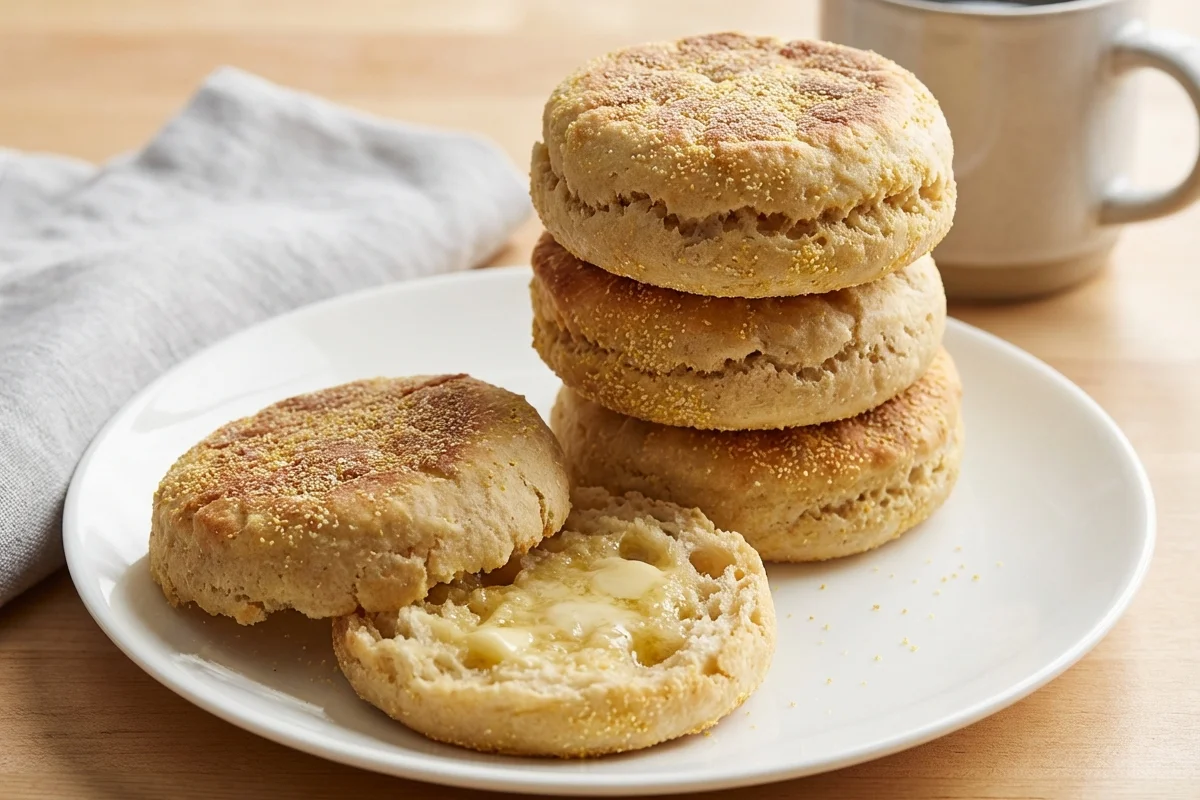
English Muffins
Golden, crusty-on-the-outside, soft-and-chewy-on-the-inside bread rounds, griddled instead of baked for that signature nooks-and-crannies texture. Split with a fork, toast until crisp, and slather with butter for a classic American breakfast.
For 8 servings
- prep · ~7 min
Activate the yeast.
1.Combine lukewarm water and milk in a small bowl.2.Stir in sugar and sprinkle yeast on top.3.Let sit undisturbed for 5-7 minutes until foamy and fragrant. - mix · ~5 min
Mix the dough.
In a large bowl, combine flour and salt. Add the yeast mixture and softened butter. Mix with a wooden spoon or dough hook until a shaggy dough forms.
TIPDon't be alarmed if the dough is sticky — this hydration creates the signature open crumb. - knead · ~10 min
Knead until smooth.
1.Turn dough onto a lightly floured surface.2.Knead vigorously for 8-10 minutes until smooth, elastic, and slightly tacky but not sticky.3.Perform the windowpane test: stretch a small piece — if it forms a thin translucent membrane without tearing, it's ready.TIPResist adding too much extra flour; a slightly tacky dough yields a more tender muffin. - rest · ~90 min
Let the dough rise.
Place dough in a greased bowl, cover with a damp cloth or plastic wrap. Let rise in a warm spot until doubled in volume, about 1 to 1½ hours.
TIPA turned-off oven with the light on creates the perfect warm proofing environment. - prep · ~10 min
Shape the English muffins.
1.Punch down the dough and turn onto a surface dusted with cornmeal.2.Pat or roll the dough to ½-inch thickness.3.Cut rounds with a 3.5-inch cutter; dip cutter in cornmeal between cuts to prevent sticking.4.Gently re-roll scraps and cut remaining rounds.5.Place cut muffins on a parchment-lined baking sheet dusted with cornmeal.6.Dust the tops with additional cornmeal. - rest · ~30 min
Second proof.
Cover shaped muffins loosely with a cloth. Let rise until noticeably puffy, about 30 minutes. They should be light and airy to the touch.
TIPDon't over-proof; they'll continue expanding on the griddle. - grill · ~9 min
Griddle the muffins.
1.Heat a cast iron skillet or griddle over medium-low heat.2.Lightly grease with butter and wipe away excess.3.Cook muffins in batches, leaving space between each.4.Griddle for 7-9 minutes per side until deep golden brown and center reaches 200°F (93°C).5.Adjust heat as needed; the outside should brown slowly while the inside cooks through.TIPLow and slow is key — high heat burns the outside before the center cooks. - rest · ~30 min
Cool completely.
Transfer cooked muffins to a wire rack and cool completely before splitting. This allows the interior crumb to set properly.
- prep · ~1 min
Split with a fork.
Pierce the equator of each muffin all the way around with a fork, then gently pull apart. The fork tines create the classic craggy peaks and valleys.
TIPNever slice with a knife — you'll lose those essential nooks and crannies.
What to keep in mind.
6 tips from the recipe — small details that make a real difference to the final dish.
- 1Use a digital thermometer to check the internal temperature of 200°F (93°C) for perfect doneness.
- 2Dip your biscuit cutter in cornmeal before each cut to prevent the dough from sticking.
- 3For the best open crumb, avoid over-flouring the dough during kneading; it should remain slightly tacky.
- 4Let the muffins cool completely on a wire rack before splitting, or the interior will turn gummy.
- 5Store cooled English muffins in an airtight container at room temperature for up to 3 days, or freeze for up to 3 months.
- 6Reheat split muffins in a toaster or under the broiler for a crisp, golden exterior.
Adapt it for your goals.
Whole Wheat English Muffins
Substitute half the all-purpose flour with whole wheat flour and increase the water by 2 tablespoons for a nuttier, more fiber-rich muffin.
Sourdough English MuffinsSourdough English Muffins
Replace the active dry yeast with 200g of active sourdough starter, reduce the flour to 360g and the water/milk to 300ml total for a tangy, artisanal version.
Cinnamon Raisin English MuffinsCinnamon Raisin English Muffins
Add 1 teaspoon of cinnamon and 100g of plumped raisins to the dough after mixing for a sweet breakfast twist.
Why this is on our healthy list.
Moderate-Fat Breakfast Base
With only 2 tablespoons of butter in the dough, these muffins are lower in fat than many commercial pastries, making them a lighter vehicle for toppings.
No Preservatives or Additives
Homemade English muffins contain none of the dough conditioners or preservatives found in store-bought versions, offering a cleaner ingredient list.
Good Source of B Vitamins
The yeast and all-purpose flour provide B vitamins like folate and thiamine, which support energy metabolism.
Frequently asked questions
The dough likely wasn't kneaded enough to develop gluten, or the second proof was too short. Ensure the dough passes the windowpane test and the muffins look noticeably puffy before griddling.