
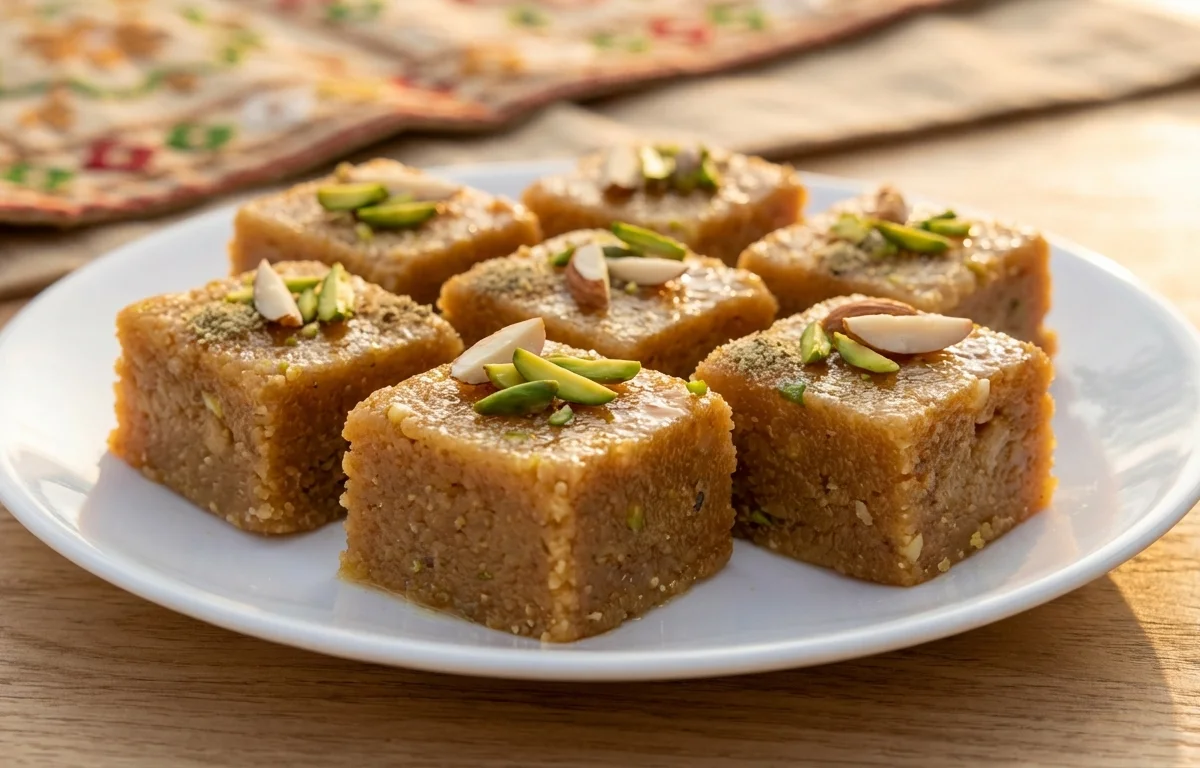
Mohanthal
Rich, grainy gram flour fudge scented with cardamom and saffron, Mohanthal is a festive Gujarati sweet with deep ghee-roasted flavor and a soft, melt-in-the-mouth bite.
For 12 servings
- prep · ~10 min
Prepare the besan mixture.
1.Add besan to a wide bowl.2.Pour in milk and 2 tbsp ghee from the measured ghee.3.Rub with your fingertips until the flour looks damp and clumpy.4.Press through your fingers to make a coarse, grainy texture and rest 10 minutes.TIPThis step gives Mohanthal its signature grainy texture, so do not skip the resting time. - saute · ~18 min
Roast the besan in ghee.
1.Heat the remaining ghee in a heavy pan over low heat.2.Add the prepared besan and stir continuously.3.Cook on low until the mixture turns aromatic, deeper golden, and loose, 15 to 18 minutes.4.Keep the heat gentle so the flour roasts evenly without burning.TIPWell-roasted besan should smell nutty and rich, not raw. - boil · ~7 min
Make the sugar syrup.
1.In another pan, combine sugar and water.2.Bring to a boil over medium heat, stirring until the sugar dissolves.3.Cook until the syrup reaches a one-string consistency, about 4 to 6 minutes.4.Stir in saffron water and cardamom powder.TIPIf the syrup gets too thick, the sweet will set hard instead of soft. - mix · ~3 min
Combine the roasted besan and syrup.
1.Lower the heat under the roasted besan.2.Pour in the hot syrup carefully while stirring continuously.3.Mix until smooth and thick with no dry patches.4.Cook 2 to 3 minutes more until the mixture leaves the sides of the pan. - assemble · ~5 min
Set the Mohanthal.
1.Transfer the hot mixture to a greased tray or plate.2.Spread it evenly to about 1 inch thickness.3.Sprinkle almonds and pistachios on top and press them in lightly.4.Cool until just warm, then mark into 12 squares or diamonds. - rest · ~60 min
Let it set completely.
Leave the tray at room temperature for 1 to 2 hours until firm enough to cut cleanly into pieces.
- serve
Cut and serve the Mohanthal.
What to keep in mind.
8 tips from the recipe — small details that make a real difference to the final dish.
- 1Use coarse besan if you can; it gives Mohanthal its classic sandy, fudgy bite.
- 2After adding milk and ghee for dharabo, rub well and rest fully so small granules form before roasting.
- 3Roast only on low heat and keep stirring, especially at the pan edges, where besan darkens first.
- 4The besan is ready when it smells deeply nutty, turns a richer golden color, and feels lighter and looser in ghee.
- 5Aim for a true one-string syrup; a thinner syrup makes soft, sticky pieces, while a thicker one sets the sweet too hard.
- 6Pour the syrup into the roasted besan while both are hot for the smoothest mixing and best set.
- 7Mark the pieces while the slab is still warm, then let it finish setting so the cuts stay neat.
- 8Store in an airtight container at room temperature for a few days; refrigerate only in very warm weather.
Adapt it for your goals.
Mawa-enriched
Add a little crumbled mawa after roasting for a richer, more festive Mohanthal with a denser, milkier finish.
jaggeryJaggery
Replace sugar syrup with jaggery syrup for a deeper, caramel-like sweetness and a more rustic flavor.
less sweetLess-sweet
Slightly reduce the sugar if you prefer the roasted besan and ghee notes to stand out more clearly.
nut freeNut-free
Skip the almond and pistachio topping if needed; the sweet still sets well and keeps its saffron-cardamom character.
Why this is on our healthy list.
Protein from Besan
Chickpea flour contributes plant protein and makes this sweet more substantial than desserts made only with refined flour.
Nut-Based Goodness
Almonds and pistachios add healthy fats, texture, and some minerals along with a more satisfying finish.
Portion-Friendly Richness
Because Mohanthal is rich with ghee and nuts, small pieces are usually satisfying for festive serving.
Frequently asked questions
The sugar syrup was likely cooked beyond one-string consistency, or the mixture was cooked too long after adding the syrup.



.webp)
.webp)
.webp)