Parwal Mithai
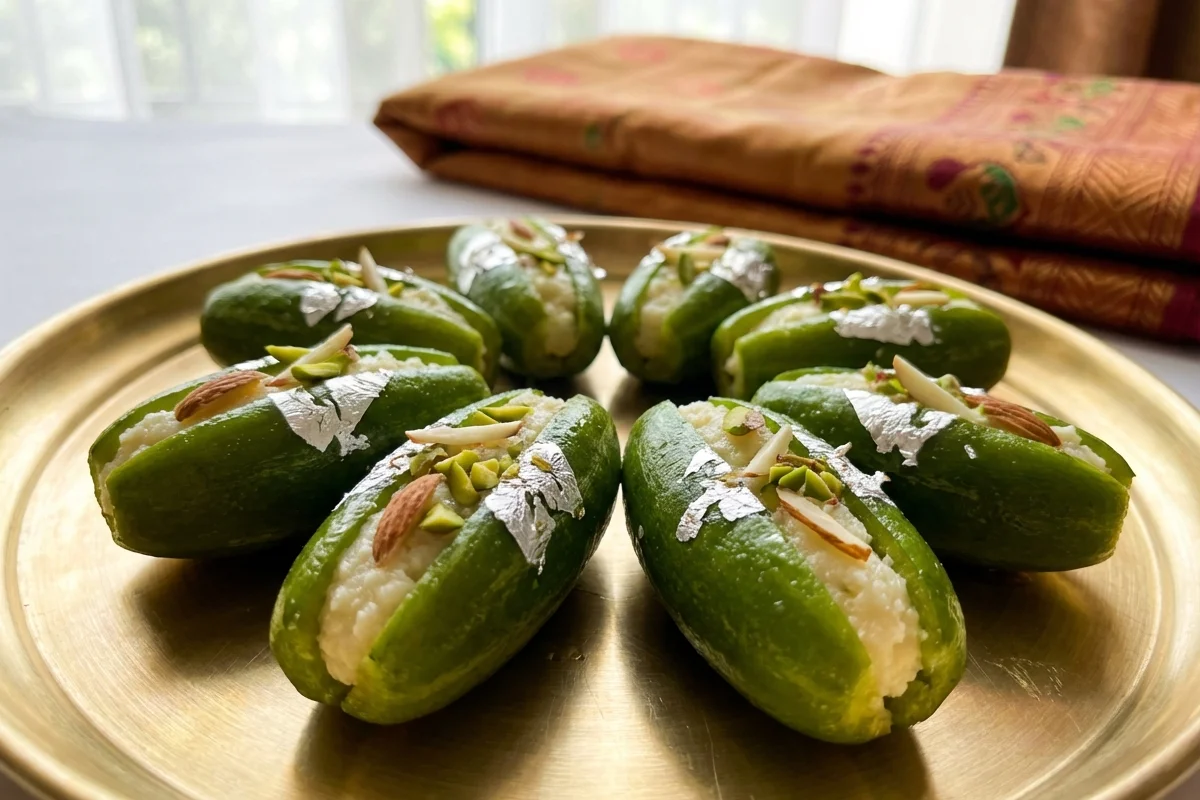
Tender pointed gourds are delicately peeled, deseeded, and boiled until just soft, then stuffed with a rich, sweet khoya filling laced with cardamom and nuts. Each piece is topped with a glossy silver leaf, making it a truly regal dessert from Bihar and Uttar Pradesh.
For 4 servings
- prep
Prepare the parwal gourds.
1.Wash the parwal thoroughly and pat dry.2.Gently scrape the outer skin using a peeler or knife so that only a thin green layer is removed — do not peel too deep.3.Slit each gourd lengthwise along one side, keeping the ends intact, and carefully scoop out the seeds and soft pulp using a small spoon or a paring knife.4.Place the hollowed gourds in a bowl of water.TIPChoose tender parwal with thin outer skin; mature ones have harder skin and prominent seeds. - boil · ~4 min
Blanch the parwal shells.
1.Bring 3 cups of water to a rolling boil in a saucepan.2.Add the cleaned parwal and blanch for 3–4 minutes until they turn bright green and are just fork-tender but still firm — do not overcook.3.Immediately drain and transfer the parwal to a bowl of cold water to stop the cooking.4.Once cooled, drain well and arrange on a plate, open side up.TIPParwal must be only partially cooked at this stage so they hold their shape while stuffing. - prep · ~7 min
Make the sugar syrup.
1.In a heavy-bottomed pan, combine the remaining 1 cup of water with ½ cup sugar.2.Place over medium heat and stir until the sugar dissolves completely.3.Bring to a gentle boil and cook until the syrup reaches a 1-string consistency — about 5–7 minutes.4.Turn off the heat and set aside.TIPTest 1-string consistency by cooling a drop of syrup between your thumb and finger; it should form a single thin thread when pulled apart. - saute · ~5 min
Cook the khoya filling.
1.Heat 2 tablespoons of ghee in a non-stick pan over low heat.2.Add the crumbled khoya and stir continuously to avoid lumps.3.Cook, stirring constantly, until the khoya turns light golden and releases a nutty aroma — about 5 minutes.4.Remove from heat and allow it to cool slightly, then stir in the crushed cardamom powder and rose water.TIPKeep the flame low — khoya can scorch very quickly and become bitter. - assemble
Stuff the parwal.
1.Carefully spoon the warm khoya mixture into each blanched parwal, filling them generously but without packing too tightly.2.Gently press the sides to close the slit, shaping the sweet into its natural form.3.Wipe away any excess filling from the outside surface with a damp cloth to keep the sweets neat. - simmer · ~12 min
Soak the stuffed parwal in sugar syrup.
1.Warm the prepared sugar syrup slightly over low heat — it should be warm, not hot.2.Gently place the stuffed parwal into the syrup in a single layer.3.Simmer on the lowest heat for 10–12 minutes, spooning syrup over the top occasionally, until the parwal turns translucent and absorbs the sweetness.4.Turn off the heat and let them rest in the syrup for at least 1 hour to develop flavor.TIPDo not boil after adding the parwal — gentle heat prevents the khoya from oozing out. - garnish
Garnish and arrange.
1.Using a slotted spoon, carefully lift each parwal out of the syrup and place on a serving platter.2.Top each sweet with a silver leaf, gently pressing it down with a dry brush.3.Scatter slivered almonds and pistachios over each piece for a finishing touch.TIPApply silver leaf with the back of a dry spoon or a soft brush — it sticks best when the surface is slightly tacky. - serve
Serve the Parwal Mithai.
These sweets are best enjoyed at room temperature. They can be refrigerated for up to 3 days; bring them to room temperature before serving for the best texture and flavor.
TIPLeftover syrup can be drizzled over the sweets when serving for extra indulgence.
What to keep in mind.
7 tips from the recipe — small details that make a real difference to the final dish.
- 1Select parwal that are uniformly small to ensure even cooking and a tender bite.
- 2After blanching, plunge parwal into ice water to halt cooking and preserve their vibrant green color.
- 3Use a small spoon or melon baller to scrape out seeds without tearing the delicate shell.
- 4Cook khoya on the lowest heat, stirring non-stop to avoid scorching and bitterness.
- 5Test sugar syrup for one-string consistency: a drop between thumb and index should form a single thread.
- 6Rest stuffed parwal in warm syrup for at least 1 hour so they absorb sweetness fully.
- 7Apply silver leaf using the back of a dry spoon – it adheres best to a slightly tacky surface.
Adapt it for your goals.
Dairy-free
Replace khoya with a mixture of cashew paste and coconut milk solids (reduce ghee to 1 tbsp); the filling becomes nutty and lactose-free while retaining richness.
low sugarLow-sugar
Use jaggery or coconut sugar instead of white sugar and reduce quantity by 25%; the syrup will be less cloying and add a subtle caramel note.
nut freeNut-free
Omit almonds and pistachios from the filling and garnish; replace with toasted melon seeds or dried coconut flakes for crunch without allergens.
saffron infusedSaffron-infused
Add a pinch of saffron threads to the warm sugar syrup; it imparts a golden hue and luxurious floral aroma that pairs beautifully with cardamom.
Why this is on our healthy list.
Vegetable-Based Sweet
Parwal (pointed gourd) is a low-calorie vegetable rich in dietary fiber, making this dessert lighter than typical flour-based mithai.
Good for Digestion
Cardamom and rose water are traditionally used in Indian cuisine to aid digestion and soothe the stomach after a meal.
Source of Healthy Fats
Ghee provides butyrate and fat-soluble vitamins, while nuts offer unsaturated fats and vitamin E in moderate amounts.
No Artificial Preservatives
This homemade mithai uses only natural ingredients — no refined flours, baking powder, or chemical additives.
Frequently asked questions
Fresh parwal is strongly recommended because frozen ones become mushy after thawing and won't hold their shape during stuffing and simmering.



.webp)