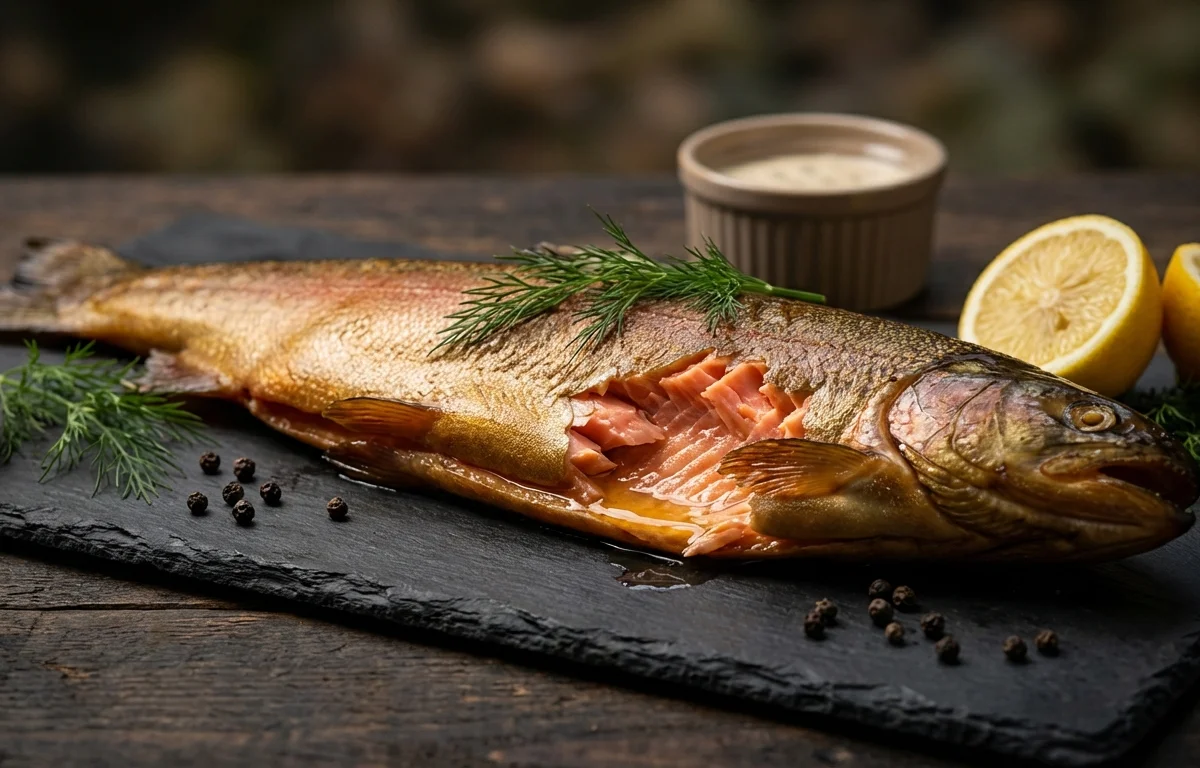
Smoked Trout
Delicate, flaky trout with a subtle smoky sweetness from a gentle wood smoke. The fish is first cured in a simple brown sugar and salt brine, then air-dried to form a glossy pellicle before smoking low and slow over hardwood. Perfect flaked onto salads, spread on crackers, or enjoyed straight from the fillet.
For 4 servings
- prep · ~45 min
Cure the trout.
1.In a small bowl, mix brown sugar and salt together.2.Pat the trout fillets dry with paper towels.3.Sprinkle the sugar-salt mixture evenly over both sides of each fillet.4.Place in a dish, cover with plastic wrap, and refrigerate for 45 minutes.TIPThe cure firms up the flesh and draws out excess moisture — don't rush this step. - prep · ~60 min
Rinse and form the pellicle.
1.Rinse each fillet under cold running water to remove all the cure.2.Pat completely dry with paper towels.3.Place fillets skin-side down on a wire rack set over a baking sheet.4.Let them air-dry at room temperature for 45–60 minutes until the surface feels tacky and glossy.TIPThe tacky surface is the pellicle — it helps the smoke adhere and keeps the fish moist. - prep · ~20 min
Prepare the smoker.
1.Prepare your smoker or grill for indirect cooking at 200°F.2.Drain the soaked wood chips and add them to the hot coals or smoker box.3.Let the smoke become clean — wait until it’s a thin blue stream, not thick white clouds.TIPThick white smoke tastes acrid and bitter. A nearly invisible blue smoke gives the cleanest flavor. - bake · ~120 min
Smoke the trout low and slow.
1.Place the dried trout fillets skin-side down on the smoker grate, away from direct heat.2.Close the lid and smoke for 90–120 minutes, maintaining 200°F.3.Check the trout’s internal temperature with an instant-read thermometer — it should reach 145°F.4.The fillets are done when the flesh flakes easily with a fork and is opaque throughout.TIPPeek through the vent — avoid lifting the lid too often so the temperature stays steady. - rest · ~5 min
Rest and serve.
1.Transfer the smoked trout to a clean plate and let it rest for 5 minutes.2.Season with a small pinch of freshly ground black pepper.3.Serve warm or at room temperature with fresh lemon wedges.
What to keep in mind.
6 tips from the recipe — small details that make a real difference to the final dish.
- 1Use a wire rack for air-drying so air circulates evenly, forming a better pellicle.
- 2Pat the fish completely dry after rinsing — any residual moisture prevents tackiness.
- 3Keep the smoker at a steady 200°F; higher temps will cook the fish too fast and dry it out.
- 4Test doneness by the flake test: the thickest part should separate easily with a fork.
- 5Let the trout rest 5 minutes after smoking to allow juices to redistribute evenly.
- 6Store smoked trout in an airtight container in the fridge for up to 5 days.
Adapt it for your goals.
Herb-crusted
Add a tablespoon of dried dill or fennel seeds to the sugar-salt cure for a subtle herbal note that complements the trout's natural richness.
maple bourbon glazeMaple-bourbon glaze
Brush the fillets with a mix of 2 tablespoons maple syrup and 1 tablespoon bourbon during the last 20 minutes of smoking for a sweet, glossy finish.
peppercorn crackedPeppercorn-cracked
Crush 1 teaspoon of mixed peppercorns (black, pink, green) and press them into the pellicle before smoking for a spicy, aromatic crust.
lemon herb marinadeLemon-herb marinade
Skip the dry cure and marinate the fillets in lemon juice, olive oil, and fresh thyme for 30 minutes; smoke as directed for a brighter, citrusy flavor.
Why this is on our healthy list.
Rich in Omega-3s
Trout is an excellent source of long-chain omega-3 fatty acids (EPA and DHA), which support heart and brain health.
High in Protein
Each serving provides a substantial amount of lean, complete protein to aid muscle repair and satiety.
Low in Saturated Fat
Compared to many meats, trout contains low levels of saturated fat, making it a heart-friendly protein choice.
Source of Selenium
Trout naturally provides selenium, a mineral that acts as an antioxidant and supports thyroid function.
Sugar and Salt in Moderation
The cure uses only a modest amount of brown sugar and salt, most of which is rinsed off, keeping the final dish low in added sugars and sodium.
Frequently asked questions
Yes, but thaw it completely in the refrigerator first, then pat very dry before applying the cure to ensure proper texture.