
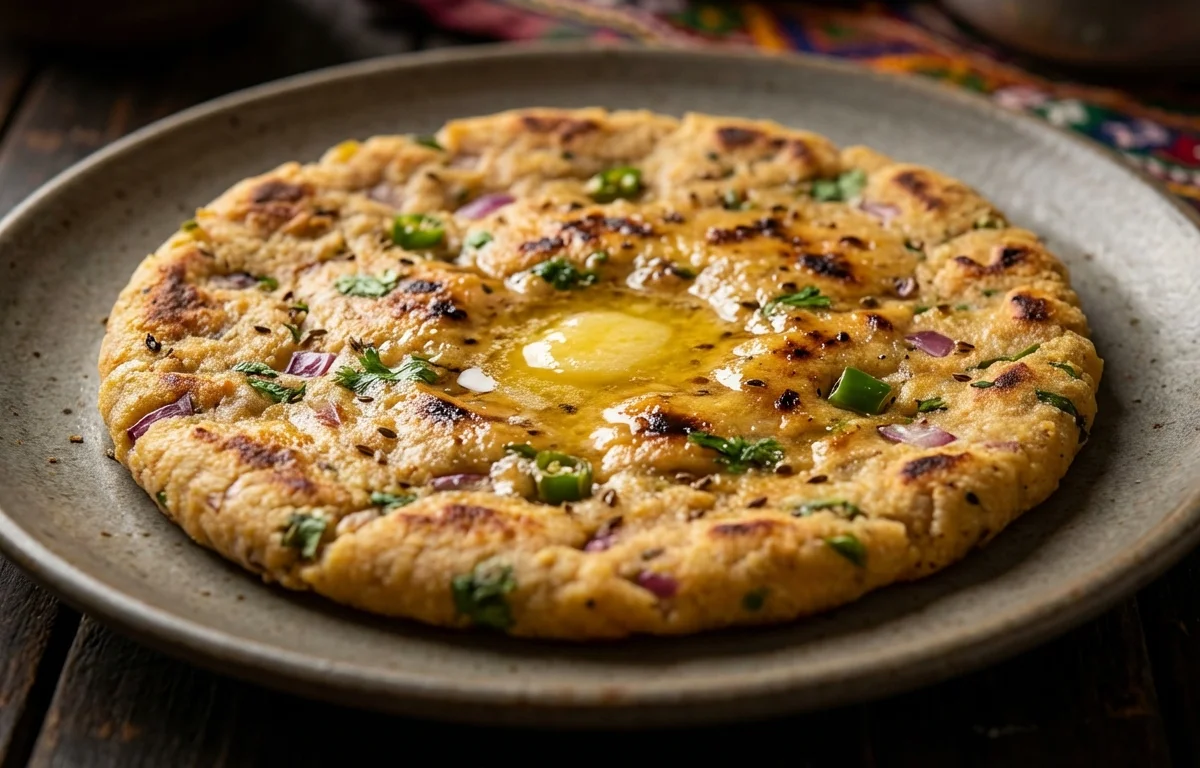
Tikkad
A rustic Rajasthani-style thick wheat flatbread cooked until crisp outside and soft inside. Traditionally made with simple spices and ghee, tikkad is hearty, earthy, and especially good with garlic chutney or a simple sabzi.
For 4 servings
- mix · ~3 min
Mix the dry ingredients.
1.Add whole wheat flour and semolina to a wide bowl.2.Mix in carom seeds, coriander powder, red chili powder, turmeric powder, and salt.3.Stir well so the spices are evenly spread through the flour.TIPRub the carom seeds lightly between your palms before adding them for better flavor. - knead · ~7 min
Knead a firm dough.
Add 1 tbsp ghee to the flour mixture and rub it in. Pour in water little by little and knead into a firm, smooth dough that is slightly stiffer than regular roti dough.
- rest · ~15 min
Cover and rest the dough.
Cover the dough and let it rest for 15 minutes so the flour hydrates and the tikkad rolls more evenly.
- prep · ~5 min
Divide and shape the tikkad.
1.Divide the dough into 4 equal portions.2.Shape each portion into a ball.3.Pat or roll each one into a thick disc about 4 to 5 inches wide.TIPKeep the discs thicker than chapati so they stay soft in the middle after cooking. - fry · ~15 min
Cook the tikkad on a hot griddle.
1.Heat a heavy tawa or griddle over medium heat.2.Place one tikkad on the hot surface and cook until light spots appear on the bottom (2 to 3 min).3.Flip it and cook the second side for 2 minutes.4.Spread a little ghee on both sides and keep turning until golden brown with crisp patches and the center is cooked through.TIPCook on medium heat so the thick bread cooks through without burning outside. - serve
Serve hot.
Serve the tikkad hot with garlic chutney, curd, or a simple vegetable sabzi.
What to keep in mind.
7 tips from the recipe — small details that make a real difference to the final dish.
- 1Keep the dough firmer than roti dough; a soft dough makes tikkad dense and hard to handle.
- 2Resting for 15 minutes is important so the semolina softens and the thick discs roll without cracking.
- 3Pat the discs evenly thick; thin edges will turn too crisp before the center cooks through.
- 4Cook on medium heat only, pressing lightly near the edges so the middle cooks without scorching the surface.
- 5Apply ghee after the first partial cook, not at the start, so the bread develops crisp brown patches instead of frying too fast.
- 6If making ahead, half-cook the tikkad first, cool, then finish with ghee on the tawa just before serving.
- 7Store leftovers wrapped in a cloth or airtight box and reheat on a dry tawa to restore the crust.
Adapt it for your goals.
Low-oil
Use less ghee on the tawa and cook mostly dry for a lighter everyday version that still keeps the classic thick texture.
jainJain
Serve with plain curd or a Jain-style chutney instead of garlic chutney while keeping the spiced tikkad dough unchanged.
spicierSpicier
Increase red chili powder slightly and add crushed black pepper for a sharper, more robust tawa-cooked bread.
herb fleckedHerb-flecked
Mix chopped fresh coriander or dried kasuri methi into the dough for a more aromatic version that pairs well with curd.
Why this is on our healthy list.
Whole Grain Goodness
Made mainly with whole wheat flour, this tikkad offers the bran and germ of the grain, making it more sustaining than refined flatbreads.
Digestive Spice Support
Ajwain and coriander are traditional spices often used in breads to add warmth and support easier digestion.
Steady, Filling Texture
The combination of whole wheat and semolina makes this bread hearty and satisfying, so it works well as a substantial meal accompaniment.
Frequently asked questions
It is usually cooked on heat that is too high or rolled too thick. Keep the flame at medium and cook longer, turning several times.

.webp)
.webp)
.webp)