
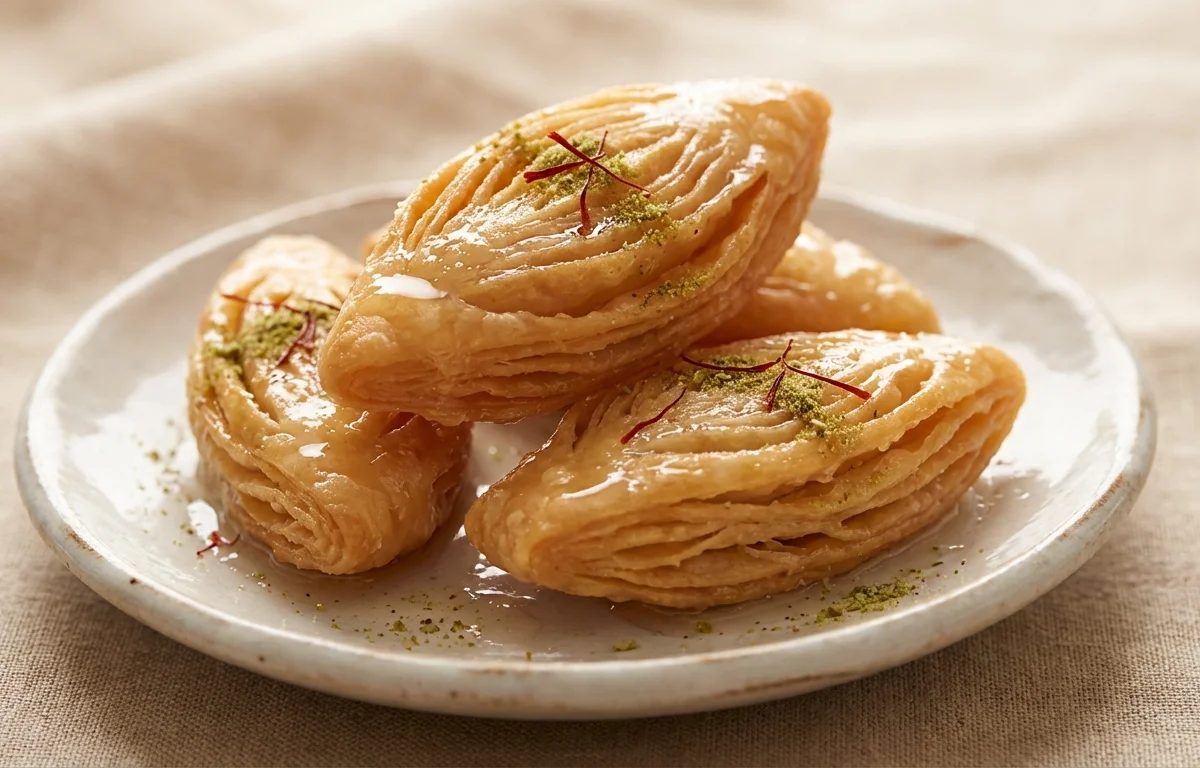
Khaja
Crisp, flaky, deep-fried pastry layers soaked in fragrant sugar syrup. This classic Indian sweet from Bihar and Odisha is a festive favorite, with delicate dough sheets that shatter beautifully with every bite.
For 12 servings
- mix · ~15 min
Make the dough.
1.Combine all-purpose flour and 3 tbsp ghee in a large bowl.2.Rub the ghee into the flour with your fingertips until it resembles breadcrumbs.3.Add cold water gradually and knead into a firm, smooth dough.4.Cover with a damp cloth and rest for 15 minutes.TIPThe dough should be firm, not soft — this ensures crisp layers. - prep · ~10 min
Prepare the sugar syrup.
1.Combine 1.5 cups sugar, 0.75 cup water, and lemon juice in a saucepan.2.Bring to a boil, then simmer until it reaches a one-string consistency (about 8-10 minutes).3.Stir in cardamom powder and keep the syrup warm on very low heat.TIPDrop a little syrup between your thumb and forefinger — it should form a single thread. - prep · ~15 min
Roll and layer the dough.
1.Divide the dough into 4 equal portions and roll each into a ball.2.Roll out one ball into a thin, large disc of about 8 inches diameter.3.Brush the surface with a little melted ghee and dust lightly with corn flour.4.Place a second rolled disc on top, brush with ghee and dust with corn flour again.5.Repeat with the third and fourth layer, creating a stack of 4 sheets.6.Roll the entire stack tightly into a log, like a Swiss roll.7.Cut the log into 12 equal pieces, each about 1 inch wide.8.Gently press each piece and roll it lightly into a small disc about 2 inches across.TIPRoll gently and evenly — pressing too hard will fuse the layers and prevent flakiness. - fry · ~10 min
Deep fry the khajas.
1.Heat oil in a deep frying pan over medium-low heat.2.Slide in 3-4 discs at a time and fry slowly until golden and crisp (about 3-4 minutes per batch).3.Flip occasionally so they cook evenly and puff up.4.Drain on paper towels for 30 seconds.TIPKeep the heat low — high heat will brown the outside while leaving the inside raw and doughy. - mix · ~3 min
Soak the khajas in sugar syrup.
1.While still warm, drop the fried khajas into the warm sugar syrup.2.Let them soak for 2-3 minutes, turning once so both sides absorb the syrup.3.Remove with a slotted spoon and place on a plate to set.TIPDo not overcrowd the syrup bowl — soak in batches for even coating. - garnish · ~10 min
Garnish with slivered pistachio and let them set for 10 minutes before serving.
What to keep in mind.
7 tips from the recipe — small details that make a real difference to the final dish.
- 1Rest the dough for at least 15 minutes to relax gluten and prevent shrinkage while rolling.
- 2Use cold water for kneading — it keeps the dough firm and helps create crisp layers.
- 3Dust corn flour between layers instead of extra ghee; it absorbs moisture and boosts flakiness.
- 4Test sugar syrup consistency by dipping your thumb and index finger — a single thread means it's ready.
- 5Fry on medium-low heat only; too high and the khajas will brown before cooking through.
- 6Soak khajas while they are still warm (not hot) so the syrup penetrates without making them soggy.
- 7Store cooled khajas in an airtight container at room temperature for up to a week — they stay crisp.
Adapt it for your goals.
Saffron-infused
Add a few strands of saffron soaked in 1 teaspoon of warm milk to the sugar syrup for a luxurious aroma and golden hue.
veganVegan
Replace ghee with coconut oil or a neutral vegetable shortening, and use jaggery syrup instead of refined sugar syrup for a vegan and unrefined sweetener version.
whole wheatWhole wheat
Substitute half the all-purpose flour with whole wheat flour for a nuttier flavor and slightly heartier texture — the dough will need a tablespoon more water.
rose khajaRose-khaja
Add 1 teaspoon of rose water to the sugar syrup and garnish with dried rose petals for a floral twist.
Why this is on our healthy list.
Moderate Energy Source
Khajas provide quick carbohydrates from refined flour and sugar, making them a traditional energy-dense festive treat.
Contains Healthy Fats from Ghee
Ghee in the dough supplies butyrate and fat-soluble vitamins, though this is a deep-fried indulgence best enjoyed in small portions.
Cardamom for Digestion
Cardamom powder in the syrup aids digestion and adds a subtle aromatic note that counterbalances the sweetness.
Pistachio Garnish Adds Minerals
Slivered pistachios contribute magnesium, potassium, and vitamin B6, plus a pleasant crunch.
Frequently asked questions
The dough was likely too wet or rested too little. Make sure it is firm and rested for 15 minutes, and fry on low heat so layers have time to separate.


