
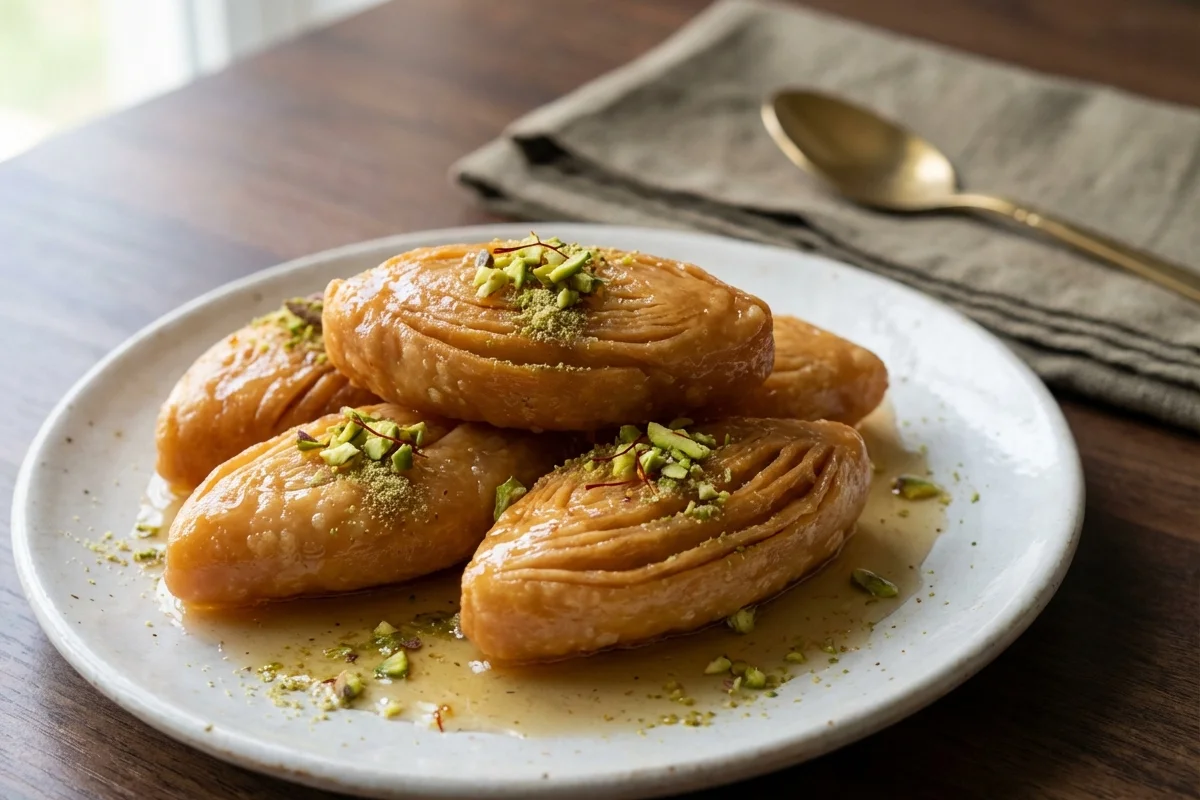
Madatha Kaja
A classic Andhra sweet with crisp, flaky layers folded into tight rolls, fried until golden, then soaked in light cardamom syrup. It has a delicate crunch outside and a juicy sweetness inside.
For 8 servings
- knead · ~20 min
Knead the dough.
1.Add all-purpose flour, melted ghee, and salt to a wide bowl.2.Rub the ghee into the flour until it feels slightly sandy.3.Add water little by little and knead into a firm, smooth dough.4.Cover and let it rest for 20 minutes.TIPKeep the dough firm, not soft, so the layers stay defined after frying. - mix · ~2 min
Make the layering paste.
Mix rice flour and softened ghee in a small bowl until you get a smooth, spreadable paste with no lumps.
- prep · ~10 min
Roll and layer the dough.
1.Divide the rested dough into 4 equal balls.2.Roll each ball into a thin oval or rectangle.3.Spread a thin layer of rice flour paste over one sheet.4.Place the next sheet on top and repeat until all 4 sheets are layered. - assemble · ~8 min
Fold and shape the kajas.
1.Roll the layered dough tightly into a log.2.Trim the ends lightly if uneven.3.Cut the log into 8 equal pieces.4.Place each piece cut side up and gently press, then roll lightly to form small oblong pieces.TIPDo not flatten too much or the flaky folds will disappear. - boil · ~8 min
Make the sugar syrup.
1.Add sugar and water to a pan and bring to a boil.2.Cook until the sugar fully dissolves and the syrup turns slightly sticky.3.Add cardamom powder and lemon juice.4.Turn off the heat and keep the syrup warm.TIPAim for a light one-string syrup. If it gets too thick, the kajas will not soak evenly. - fry · ~15 min
Fry the kajas.
1.Heat oil in a deep pan over low to medium heat.2.Slide in a few shaped kajas without crowding the pan.3.Fry slowly, turning often, until golden and crisp on all sides.4.Remove and drain briefly.TIPFry on lower heat so the inside layers cook through before the outside browns. - rest · ~3 min
Soak the fried kajas in syrup.
Add the hot fried kajas to the warm syrup and let them soak for 2 to 3 minutes, turning once so both sides absorb the syrup well.
- serve
Lift out and serve the madatha kaja.
Remove the kajas from the syrup and place them on a plate or rack for a few minutes. Serve once the outer layer is set and lightly sticky.
What to keep in mind.
7 tips from the recipe — small details that make a real difference to the final dish.
- 1Keep the dough firm while kneading; a soft dough will blur the signature flaky folds.
- 2Spread only a thin rice flour-ghee paste between sheets, or the layers can slip while rolling.
- 3Roll the stacked sheets into a very tight log so the spiral opens neatly after cutting.
- 4When shaping each piece, press gently and roll lightly; over-flattening makes the kaja dense.
- 5Fry on low to medium heat and turn often so the inner layers crisp before the outside darkens.
- 6Dip hot kajas into warm, not hot-boiling, syrup so they absorb sweetness without turning soggy.
- 7Cool them on a rack after soaking so excess syrup drips off and the outer layer sets properly.
Adapt it for your goals.
Mini-madatha-kaja
Cut the rolled log into smaller pieces for bite-size sweets that fry faster and are easier to serve for festivals.
saffron cardamomSaffron-cardamom
Add a few strands of saffron to the syrup for a richer aroma and a festive golden hue.
mildly sweetMildly-sweet
Shorten the soaking time slightly to keep the kajas lighter and less syrupy while preserving the flaky texture.
ghee fried finishGhee-fried-finish
Fry in oil as written, then add a teaspoon of warm ghee over the finished kajas for a more traditional rich aroma.
Why this is on our healthy list.
Quick Energy Sweet
The flour and sugar make this a fast energy-giving festive sweet, useful when served in small portions during celebrations.
Digestive Spice Aroma
Cardamom adds warm fragrance and is traditionally valued in Indian sweets for making rich desserts feel more balanced.
Satisfying Festive Treat
The combination of flaky layers, ghee, and syrup makes a small piece feel indulgent and satisfying, which can help with portioned serving.
Frequently asked questions
Usually the dough was too soft, the layering paste was too thick, or the pieces were flattened too much before frying.


