
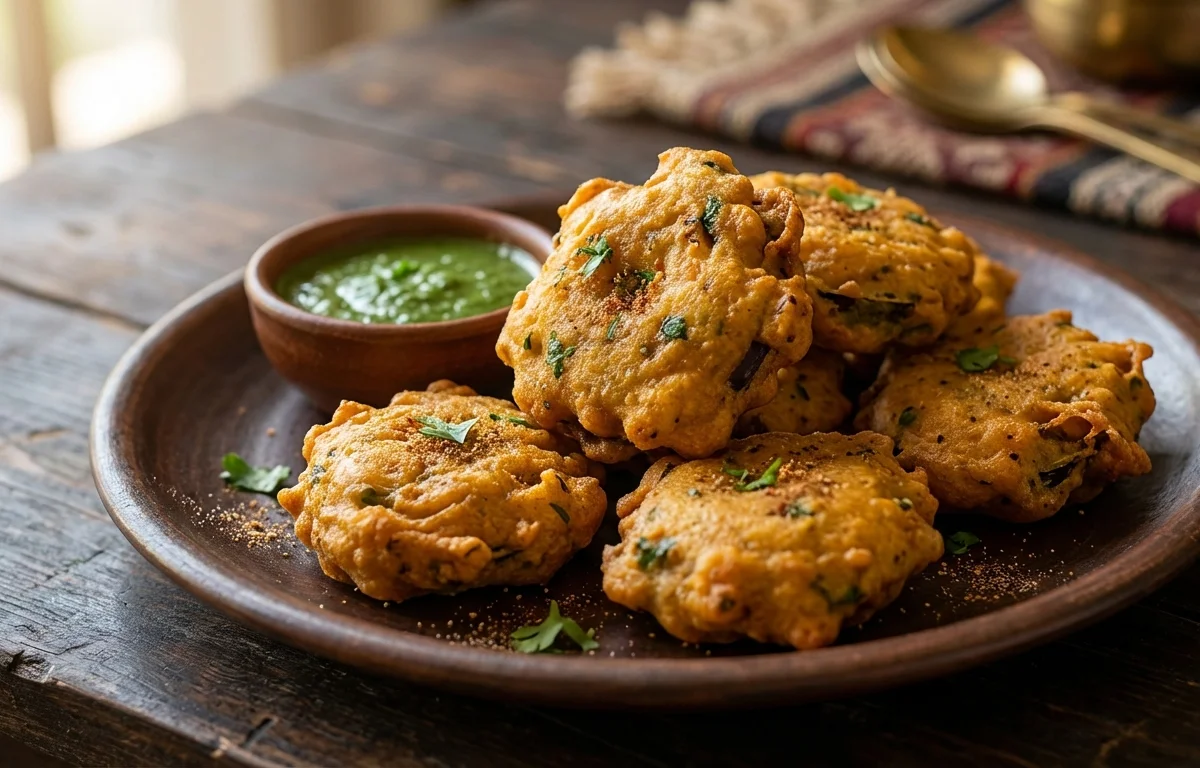
Baigani
Crispy, golden batter-fried eggplant slices that make the perfect Bengali monsoon snack. Thin eggplant rounds are coated in a spiced chickpea flour batter and deep-fried until the outside shatters and the inside turns silky-soft. Best enjoyed with puffed rice (muri) and a steaming cup of tea.
For 4 servings
- prep · ~2 min
Slice the eggplant.
Wash the eggplant and pat dry. Cut into thin rounds about 0.5 cm thick. Lay them flat on a plate.
TIPSlice just before frying — eggplant discolours quickly. If slicing ahead, keep rounds submerged in salted water. - mix · ~3 min
Prepare the spiced batter.
In a mixing bowl, combine chickpea flour, rice flour, red chili powder, turmeric powder, cumin powder, garam masala, black pepper, black salt, salt, and baking soda. Whisk well. Gradually pour in water while whisking until the batter is smooth, lump-free, and coats the back of a spoon thickly.
TIPThe batter should be thick enough to cling to the eggplant slices — not runny. If it drips off too fast, add a little more flour. - rest · ~5 min
Rest the batter briefly.
Let the batter sit for 5 minutes. This helps the flours hydrate fully and makes the coating crispier.
- prep · ~4 min
Heat the oil for deep frying.
Pour oil into a kadai or deep frying pan. Heat over medium flame until a drop of batter sizzles and rises to the top immediately (around 175°C / 350°F).
TIPTest one slice first. If it browns too fast, lower the heat — you want the eggplant to cook through before the coating burns. - fry · ~8 min
Batter and fry the eggplant slices.
1.Dip each eggplant slice into the batter, letting excess drip off.2.Slide carefully into hot oil. Fry 3-4 slices at a time — don't overcrowd.3.Fry 2 minutes on one side until golden, then flip and fry the other side (another 2 minutes).4.Remove with a slotted spoon and drain on paper towels.TIPKeep the oil temperature steady. If it drops too much between batches, let it reheat before adding the next round. - serve
Serve immediately.
Arrange the crispy baigani on a plate. Sprinkle a pinch of black salt or chaat masala on top if desired. Serve hot with muri (puffed rice), kasundi (Bengali mustard), or a cup of ginger tea.
TIPBaigani loses its crunch as it cools — serve within 10 minutes of frying for the best texture.
What to keep in mind.
6 tips from the recipe — small details that make a real difference to the final dish.
- 1Slice eggplant rounds uniformly thin (0.5 cm) so they cook through before the batter darkens.
- 2Rest the batter for a full 5 minutes — this hydrates the flours for a crispier crust.
- 3Keep oil at a steady 175°C; if it smokes, it's too hot, and if the batter sinks, it's too cool.
- 4Fry only 3–4 slices per batch to avoid overcrowding, which lowers oil temperature and makes soggy baigani.
- 5Drain fried baigani on paper towels immediately; serve within 10 minutes to enjoy its signature shatter-crunch.
- 6For extra crispness, add a pinch of baking soda to the batter just before frying — don't skip this optional step.
Adapt it for your goals.
Low-oil
Shallow-fry or pan-fry the battered slices in just 2–3 tablespoons of oil, flipping once — less grease but still good crunch, ideal for everyday snacking.
high proteinHigh-protein
Swap half the chickpea flour with roasted besan (gram flour) and add a tablespoon of flaxseed meal to the batter for extra protein and Omega-3s.
jainJain
Omit the garlic and onion (not used here, so naturally suitable) and replace black salt with rock salt; serve with a jain-friendly green chutney.
Why this is on our healthy list.
Rich in Dietary Fiber
Eggplant provides a good amount of soluble fiber that aids digestion and promotes gut health.
Gluten-Free Snack
Made with chickpea and rice flours — naturally gluten-free and safe for those with celiac sensitivity.
Source of Plant Protein
Chickpea flour (besan) adds protein to this snack, making it more satisfying than plain fried fare.
Low in Saturated Fat
Deep-fried in vegetable oil with no butter or ghee, baigani contains minimal saturated fat when drained well.
Frequently asked questions
Add chickpea flour a tablespoon at a time until the batter coats the back of a spoon thickly — runny batter slides off the eggplant and won't crisp.


